
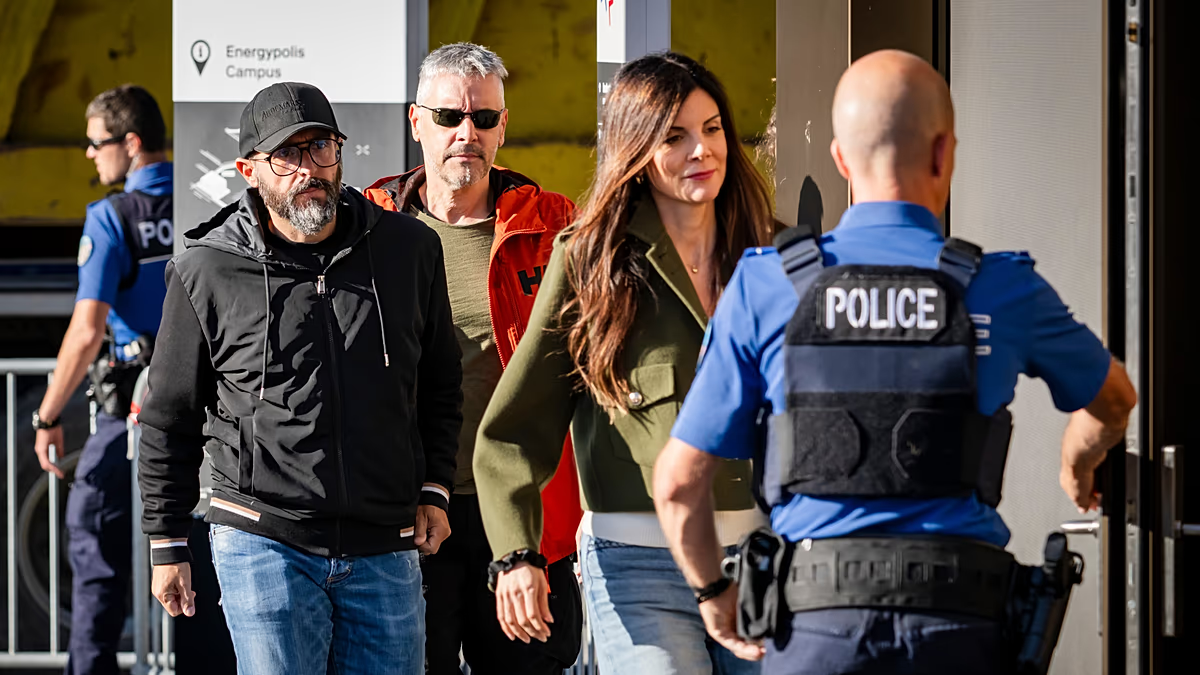



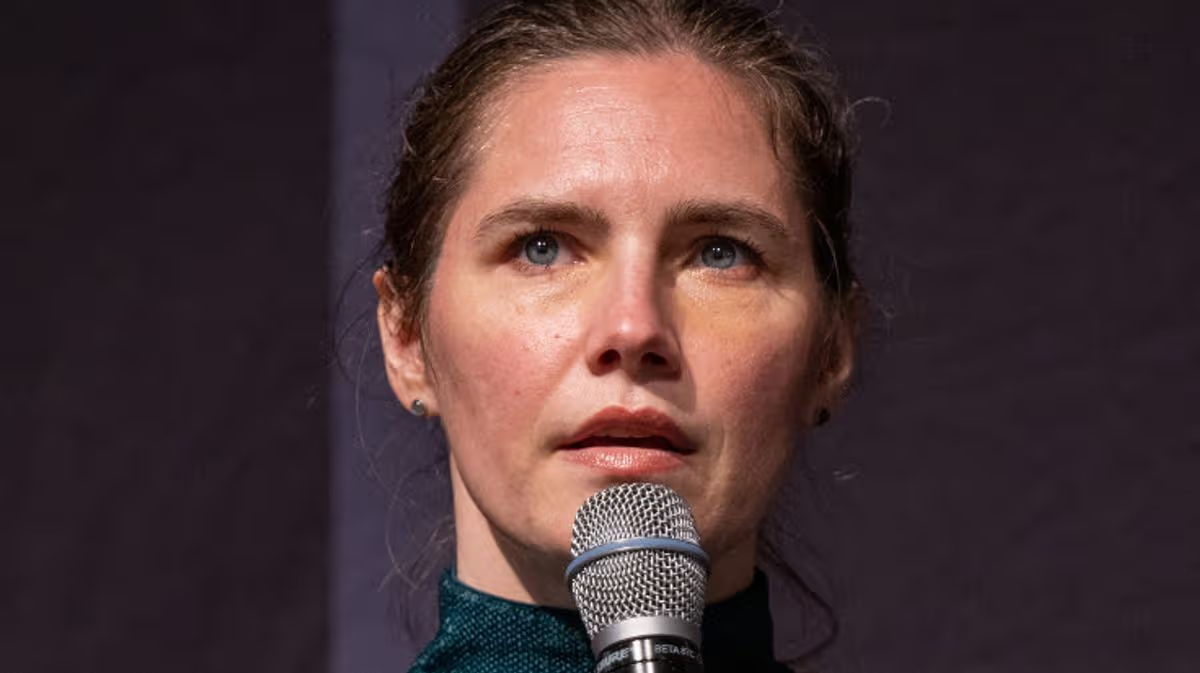
For nearly two decades, Amanda Knox has navigated a world where her name is inextricably linked to tragedy. Recently, in an emotionally charged question and answer session held in Meredith Kercher’s home city of London, Knox opened her heart to a public audience, offering a raw glimpse into a life forever altered by wrongful accusation. Speaking at the Greenwich Picturehouse, an event organized by the London Innocence Project, she described being perpetually “haunted” not by the crime itself, but by the devastating aftermath of being falsely implicated in the death of her friend, the British exchange student. She revealed a profound, lingering grief, stating, “I’m constantly compared to my dead friend,” underscoring the impossible weight of existing in the shadow of Meredith’s memory. At one point, visibly overcome, Knox recounted the despair of her initial imprisonment, facing a 26-year sentence: “I thought I’d never have children and I’d always wanted to be a mother.”
The core of Knox’s anguish stems from a deeply flawed judicial process that she characterizes as a predatory hunt. She recalled feeling like “a prey animal – being hunted down by the justice system and the media,” where every action and statement was cast in the worst possible light. She spoke of confronting the Italian prosecutor who pursued her, a “nightmarish figure” she believed had destroyed her life, though she clarified she did not see him as evil, merely profoundly wrong. Knox emphasized the absurdity of the prosecution’s case against her, which lacked any coherent motive; the court ultimately suggested she had “committed evil for the sake of evil – spontaneously.” This legal and media maelstrom, she explained, created a “deep abyss” within her that will never fully heal, leaving a part of her that “died in Italy.” Her relationship with the country remains a complex “love/hate” dynamic, marked by the trauma of her ordeal.
Despite her eventual exoneration—Italy’s Supreme Court of Cassation acquitted her and her former boyfriend Raffaele Sollecito in 2015—Knox contends that the presumption of innocence is a battle that continues indefinitely. “You always feel like you’ve got something to prove – you’ve got to prove your innocence for the rest of your life,” she told the audience. There is a persistent “anger and grief” over a life that was “totally upended.” Yet, after 18 years, she claims a sense of weary resolution: “I’m kind of over it. I don’t feel the need to explain myself anymore… ‘it’s not me – it’s not my problem now.’” However, this personal closure does not shield her from ongoing public scrutiny. “There’s negative attention and scrutiny – everywhere I go I get scrutinised,” she noted, acknowledging that to some, she remains a figure who has profited from Meredith’s death, rather than a victim of a catastrophic miscarriage of justice.
The event was intended to feature a screening of the documentary “Mouth of the Wolf,” directed by her husband, Christopher Robinson, which captures her return to Perugia and features original songs sung by Knox. The screening was canceled last minute due to licensing issues, but the documentary itself symbolizes her ongoing engagement with her story. This engagement is a point of significant controversy. The Kercher family’s lawyer, Francesco Maresca, has criticized Knox for regularly launching new media initiatives—podcasts, interviews, documentaries—arguing that “enough is enough” and that the family cannot comprehend why she “keeps on doing things like this and just can’t leave this alone.” To her supporters, Knox is a wronged woman reclaiming her narrative; to critics, she is seen as monetizing a tragedy.
The horrific crime that anchors this enduring saga occurred on November 1, 2007, in Perugia, Italy. Meredith Kercher, a popular University of Leeds student on exchange, was found murdered in her bedroom, sexually assaulted and stabbed. Knox, then a 20-year-old student from Seattle, was one of Meredith’s flatmates. The investigation quickly spiraled. A now-infamous photograph of Knox kissing Sollecito outside the flat was portrayed as evidence of callousness. During a grueling interrogation she describes as bullying and physically intimidating, conducted without a lawyer or qualified interpreter, Knox implicated Patrick Lumumba, her bar employer, in the murder. Lumumba was arrested and held for two weeks before being released. In 2009, Knox and Sollecito were convicted and given lengthy sentences. The only individual ultimately convicted for the murder is Rudy Guede, tried separately, whose DNA and bloody footprints were found throughout the crime scene.
Now a mother of two, Knox’s life today includes work as a host of a podcast, which she revealed included recent work in Chester on an episode about Lucy Letby. Her appearance in London was a poignant step in a long journey from a terrified young woman in an Italian prison to a person striving for a voice beyond the headlines. It was a narrative of survival, but one inextricably woven with loss—the loss of her friend Meredith, the loss of years of her own life, and the loss of a fundamental trust in systems of justice and media. Her story remains a stark, human testament to the long and brutal aftermath of a wrongful accusation, where legal exoneration does not equate to public or personal absolution, and where a name, once globally sensationalized, can never truly be owned solely by the person who bears it.