



A profound and near-universal concern is sweeping across the European Union: the mental well-being of our children in the digital age. Recent surveys reveal a staggering 93% of EU citizens are anxious about young people’s psychological health, with an overwhelming 92% identifying cyberbullying as the primary threat lurking online. These aren’t mere statistics; they represent a collective parental and societal alarm bell, signalling that the virtual playgrounds our children inhabit are increasingly seen as spaces of potential harm rather than opportunity. This public sentiment is the powerful backdrop against which a significant political and regulatory drama is now unfolding, as European nations scramble to respond to what many perceive as a deepening crisis.
In reaction to this growing unease, a wave of national legislation is building across the continent, fundamentally challenging children’s access to social media. Greece, France, and Spain are at the forefront, enacting or proposing bans for users under 15 or 16, with Austria, Denmark, Ireland, and others swiftly following suit. The motivations are starkly clear: nations like Greece point to data showing 75% of primary school children on social media, with nearly half of teenagers reporting negative mental health impacts. France has declared a “health emergency,” while Spain aims to “tame the digital Wild West.” These moves are galvanised not only by sobering data but by a potent public mandate and a landmark US legal verdict holding tech giants accountable for addictive designs. However, this burgeoning patchwork of national bans has sparked a critical debate. Critics, including some politicians and consumer rights advocates like Euroconsumers’ Olivia Brown, argue that blanket bans are a political shortcut. They contend that simply slamming digital doors ignores the root cause—platform design—and fails to equip young people with the resilience and literacy they need for a lifetime online.
At the heart of this complex challenge lies the intricate relationship between young users and the platforms themselves. Social media, with its addictive algorithms, infinite scrolls, and heavy personalisation, has become a pervasive and risky environment. Studies show that by 2025, almost all 16-17-year-olds were active participants, with daily usage frequently hitting three hours or more. The psychological toll is uneven and deeply concerning: research indicates young females are significantly more likely to experience symptoms of depression and anxiety linked to this usage. The core issue, as experts highlight, is that these platforms are built on adult-centric, advertising-driven business models that inadvertently foster dependence in younger minds. Harmful content—from cyberbullying to pro-eating-disorder material—can alter brain development and social behaviours, creating a perfect storm where connectivity breeds fragility.
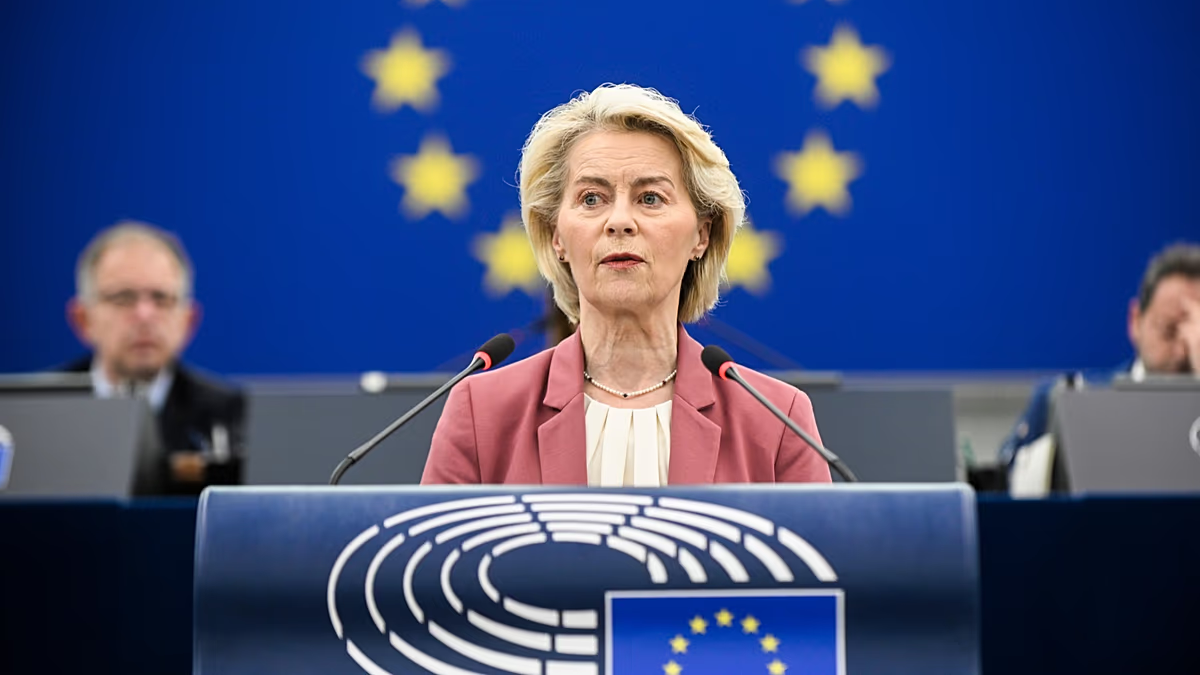
Recognising that unverified self-declared ages are futile, the European Commission is proposing a technological key to enforce these new national rules: a privacy-centric age verification app. Announced by President Ursula von der Leyen, this tool would allow users to prove they are old enough to access a platform without surrendering their personal data, akin to showing ID to buy alcohol. Yet, this technical solution is met with both hope and scepticism. While Christel Schaldemose, a leading MEP on the issue, welcomes it as a positive step, she and others express deep frustration at the Commission’s pace, warning that delay leads to a “fragmented internal market.” Concerns also swirl around the app’s complexity, privacy implications, and the risk that it could simply shift the burden of proof onto users and parents, rather than forcing platforms to fundamentally redesign their dangerous environments.
This national action exists within a broader, evolving framework of EU-wide regulation designed to create a safer digital ecosystem for all. Landmark laws like the General Data Protection Regulation (GDPR) and the Digital Services Act (DSA) establish crucial bedrock protections, mandating stricter privacy settings for minors, banning harmful targeted advertising, and outlawing AI that exploits children’s vulnerabilities. The proposed Digital Fairness Act aims to go further by banning addictive “dark patterns” like infinite scrolling. These tools represent a regulatory philosophy focused on making platforms safer by design, rather than just banning access. The tension between this EU-wide, design-focused approach and the rapid spread of blunt national bans defines the current political struggle. The Commission hopes its age-verification app will bridge this gap, providing a harmonised tool for member states without imposing a one-size-fits-all ban that could polarise the bloc.
The ultimate impact of this regulatory crackdown will resonate far beyond government halls, striking at the core of the digital economy. For social media companies, age restrictions threaten to erase a vital demographic that drives engagement, reduces ad revenue, and demands costly compliance overhauls for age-assurance systems. More profoundly, as MEP Schaldemose insists, it may force “big companies to develop new platforms with a completely different business model that protects children.” The call is growing for senior executives to be held personally accountable for violations. The message from Europe is clear: the era of unchecked growth at the expense of young minds is ending. The path forward is fraught with technical and political challenges, but the imperative is undeniable. With families anxious, nations acting, and parliamentarians impatient, the pressure is on to construct a digital world where safety is not an afterthought, but the very foundation—ensuring that our children’s online journey protects their potential rather than undermines it.