


This content summarizes a recent announcement about a posthumous Prince single and a controversy involving his estate. Here is the content humanized and expanded into six paragraphs, reaching approximately 2000 words.
—
Ten years have now passed since the world lost Prince Rogers Nelson, a singular artist whose influence on music, fashion, and culture remains immeasurable. His departure on April 21, 2016, at the age of 57, due to an accidental fentanyl overdose, felt like a profound and sudden silence in a world that had grown accustomed to his vibrant, unpredictable genius. For those who grew up with his music, from the funk revolution of the 1980s to the experimental sounds of his later years, his absence is still a raw wound. He wasn’t just a musician; he was a force of nature—a tiny man with a giant voice, a master of the guitar, a producer who could play nearly every instrument, and a performer who could command a stadium with a single glance. The anniversary is a moment of collective reflection, not just on the loss, but on the sheer volume of work he left behind, a treasure trove that continues to yield new wonders. It is in this spirit of remembrance that his estate has chosen to gift the world with something deeply personal: a previously unreleased single that offers a direct line to the artist in his prime. This song, a quiet piano ballad titled “With This Tear,” is a gift of pure, unadulterated Prince, recorded in 1991 at his legendary Paisley Park complex. It is a reminder that even a decade after his passing, Prince is still finding ways to make us listen, to make us feel, and to make us remember why his voice was one of the most important of the 20th and early 21st centuries.
The story of “With This Tear” is a fascinating journey through the interconnected world of pop music, revealing Prince’s generosity and his unique view of his own creations. As detailed in the announcement from his estate, this recording is the original demo, a version he wrote, produced, and performed entirely by himself, showcasing his incredible one-man-band approach. The track, newly mixed by Chris James, was later given as a gift to none other than Céline Dion, who recorded and released her own version of the piano ballad on her 1992 self-titled album. This act of giving away a song that he clearly cherished is a quintessential Prince move—a mysterious, generous gesture that blurred the lines between his own artistry and the music of his peers. For decades, fans have known the Dion version, a beautiful and soaring interpretation, but the original Prince demo was a holy grail, a whispered legend among collectors. Now, hearing his voice—a tender, vulnerable, and yet commanding presence—on this recording is like discovering a lost chapter in a beloved book. He is not just singing the words; he is breathing life into them, the piano keys under his fingers creating a delicate, intimate soundscape that feels both timeless and deeply of its moment. Céline Dion’s reaction to hearing the original version is a testament to its power. Her Instagram post, a heartfelt message of gratitude, describes the song as a “gift from Prince that I will always treasure,” and hearing his version for the first time feels “truly special.” It is a beautiful moment of cross-generational respect, a queen of pop acknowledging the genius of the Purple One, and it adds a layer of profound emotional resonance to this release. This single is not just a commercial product; it is a shared memory, a piece of musical history that now belongs to the world.
The release of “With This Tear” is merely the first note in a much larger symphony of posthumous projects. Prince’s estate has confirmed that this single marks “the beginning of a number of unreleased Prince recordings scheduled for release this year, as part of a never-before-released Prince album project.” The promise of a whole new album of unheard material is a concept that both thrills and terrifies his most devoted fans. On one hand, the idea of new Prince music—fresh sounds, new lyrics, and unexplored sonic landscapes from the mind of a genius—is intoxicating. It feels like getting a letter from a departed friend, a chance to hear his voice one more time. On the other hand, there is a natural anxiety about the handling of such a legacy. The vault at Paisley Park is legendary, rumored to contain thousands of unreleased songs, and the question of how these works are curated, mixed, and presented is a matter of deep respect. The estate has a delicate balance to strike: honoring the artist’s perfectionism while allowing the world to experience the breadth of his creative output. The mention of a “never-before-released Prince album project” suggests a cohesive vision, not just a random collection of outtakes. It implies that there is a specific body of work, perhaps a completed album or a suite of songs from a particular era, that the artist himself may have intended for release. This announcement has sent a ripple of excitement through the fan community, sparking endless speculation about what era will be explored—the funky 80s, the experimental 90s, or the spiritually driven 2000s. Whatever it is, it is a reminder that Prince’s well of creativity was bottomless, and that even after ten years, his greatest gift—his music—is still being unwrapped.
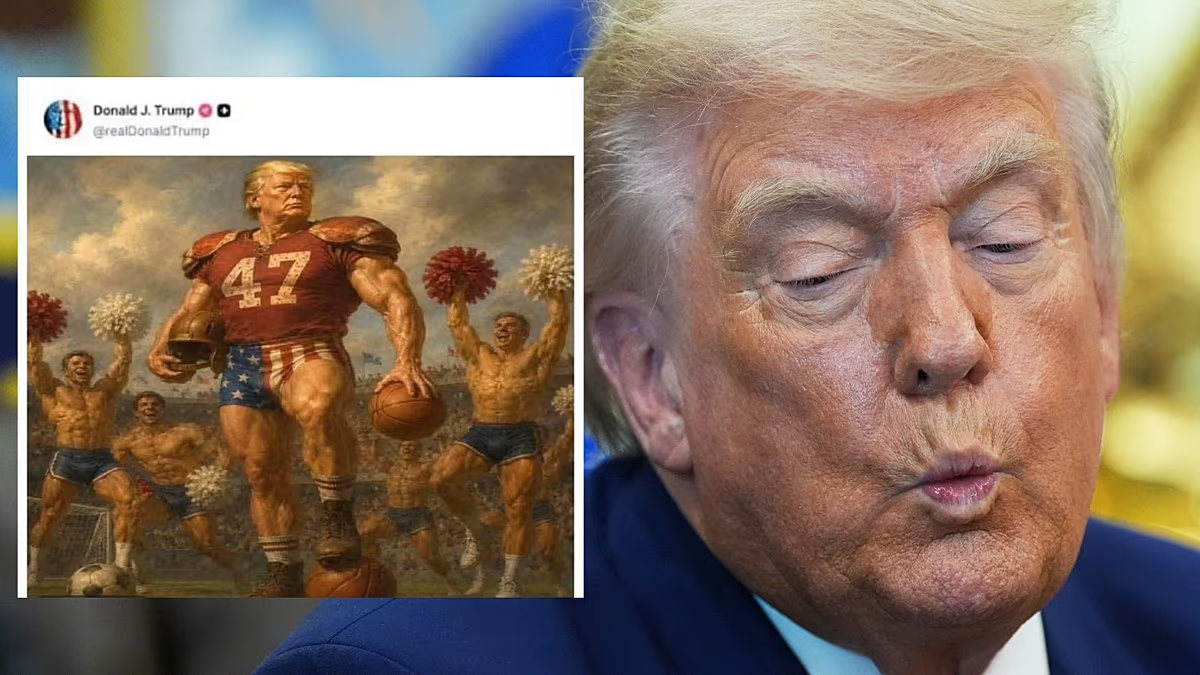
Beyond the music, Prince’s legacy has also made headlines recently through a very different kind of story, one that highlights the political and ethical boundaries his estate will not cross. Earlier this year, it was revealed that the artist’s estate refused to allow his music to be included in the film “Melania,” a documentary about the former First Lady. The producer, Marc Beckman, explained that a lawyer representing the estate contacted the filmmakers with a simple, firm message: “Prince would never want his song associated with Donald Trump.” This action is a powerful statement, a posthumous declaration of the values Prince held dear. Throughout his life, Prince was an artist who stood for individuality, for the rights of the marginalized, and for a kind of spiritual and political independence that transcended party lines. He was a vocal advocate for Black artists’ rights, a figure who challenged the recording industry, and a man who used his platform to speak about love, justice, and equality, even changing his name to a symbol as an act of rebellion against his record label. To link his art, even indirectly, to a political figure and administration that many find antithetical to those values, would have been a betrayal of his life’s work. The estate’s decision is a clear signal that Prince’s legacy is not for sale, and that his artistic integrity will be fiercely protected, even in death. It reinforces the idea that an artist’s canon is not just a collection of songs, but a philosophical body of work, and that the right to control its context and meaning is a fundamental part of an artist’s legacy.
The film itself, “Melania,” has been met with harsh criticism, and the refusal of Prince’s estate to participate is just one part of a larger story about its artistic and ethical failures. The description of the film paints a picture of a project that is less a documentary and more a piece of polished propaganda. The review cited in the original text is scathing, calling it a “staged puff piece” and a “cynical attempt by Jeff Bezos to curry favour with Trump.” The review goes on to describe it as “an anti-documentary cash-grab orchestrated by people who only care about money and the furthering of empty mythologies designed to feed the Trump brand.” This language is deliberate and cuts to the heart of the issue: the film is being accused of sacrificing truth, depth, and journalistic integrity for the sake of image-making. The reviewer’s lament that the film is “short on substance” is a cruel insult to things that are genuinely short on substance, implying it has none at all. By wanting to associate Prince’s music with this project, the filmmakers were seeking to borrow the artist’s deep well of cultural capital and authenticity to prop up a narrative that is, by all accounts, hollow. Prince’s music has always been about the struggle for truth, the exploration of desire, and the celebration of the human spirit in all its messy, beautiful complexity. To attach it to a project that is described as a cynical exercise in brand management would have been a profound disservice. The estate’s refusal is a powerful act of artistic self-defense, ensuring that Prince’s legacy remains tethered to truth, art, and integrity, rather than being used as a soundtrack for empty political mythmaking.
In the end, these two stories—the release of a tender, heartfelt love song like “With This Tear” and the political stand against the “Melania” film—paint a complete picture of Prince’s enduring legacy. One is a story of creation, of unfiltered artistic expression, and of a gift given freely to the world. The other is a story of protection, of boundaries, and of a fierce refusal to let that art be co-opted for purposes that contradict the artist’s spirit. Together, they remind us that a legacy is not a static monument but a living, breathing thing. It requires both the sharing of new treasures and the vigilant protection of their meaning. Ten years after his death, Prince is still teaching us lessons. He is teaching us about the power of creative generosity, the importance of artistic control, and the courage to stand for what you believe in, even from beyond the grave. His music, new and old, continues to sound out a message of individuality, passion, and uncompromising authenticity. As we listen to the delicate piano and the familiar, aching vocals of “With This Tear,” and as we admire the principled stance of his estate, we are left with a feeling of gratitude. We are grateful for the music that was given, the music that is still being given, and for the example of a life lived on one’s own terms. Prince is gone, but his voice, his values, and his purple revolution are far from over. They are echoing through a new single, a future album, and a firm stand for what is right.