


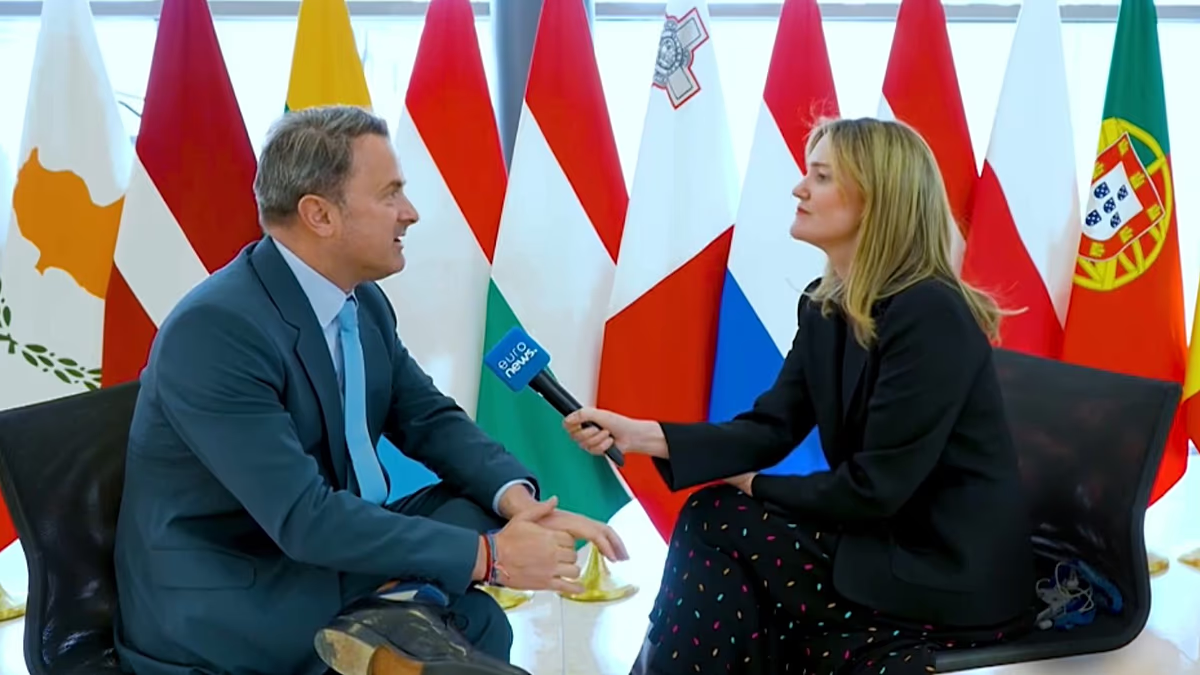
In a striking and deeply personal condemnation, Luxembourg’s Foreign Minister, Xavier Bettel, has drawn a direct historical parallel between the treatment of minorities in contemporary Hungary and the policies of past fascist regimes. Speaking to Euronews, Bettel—who served as Luxembourg’s Prime Minister for a decade and is one of the EU’s few openly gay leaders—recalled a tense confrontation with Hungarian Prime Minister Viktor Orbán during a meeting of EU leaders in Brussels. He challenged Orbán’s government over laws that target the LGBTQ+ community, framing the issue not merely as a matter of personal identity, but as a fundamental fight for the rights of all minorities. Bettel emphasized that his advocacy stems from a commitment to protecting vulnerable groups, stating, “It’s not the fact that I’m gay that I just fight for gay rights, but it’s the fact that I fight for minorities.” His remarks carried the weight of lived experience, highlighting the personal struggle for self-acceptance that precedes public scrutiny.
The conversation gained renewed urgency as it coincided with a landmark ruling from the European Court of Justice (ECJ) against Hungary’s controversial 2021 legislation. Often labeled a “child protection” law by Orbán’s government, it effectively banned the portrayal or discussion of homosexuality and transgender issues in media accessible to minors. Critics across Europe and human rights organizations denounced it as a blatant tool for discrimination and social exclusion. In an exceptional show of unity, the European Commission and fifteen EU member states launched legal action, arguing the law violated core European values. They even noted its alarming resemblance to Russia’s 2013 “gay propaganda” law, underscoring a worrying ideological alignment with regimes hostile to fundamental human rights. The ECJ’s ruling affirmed these concerns, finding that the Hungarian law unlawfully stigmatizes LGBTQ+ people and breaches the EU’s founding principle of respect for human dignity, freedom, and equality.
Bettel’s critique, however, transcended legal technicalities and ventured into a powerful moral and historical argument. He recounted telling Orbán directly, “Being gay is not a choice, but being homophobic is a choice.” This simple yet profound statement cuts to the heart of the matter: legislation based on prejudice intentionally targets an innate aspect of human identity. More starkly, Bettel likened the political strategy behind such laws to the early stages of historical persecution. “To do politics by blaming someone reminds me seriously of how it starts with Jewish people and then with gypsies and etc.,” he said. This comparison to the scapegoating of Jewish and Roma communities in Europe’s darkest hours is not made lightly; it serves as a sobering warning about where the rhetoric of exclusion and “othering” can lead when it is codified into law and normalized by the state.
The personal nature of the exchange was palpable in Bettel’s description of the room’s reaction. He noted that the issue was not even on the formal agenda, yet he felt compelled to speak. When he directly addressed Orbán in front of the assembled EU leaders, including the Presidents of the Commission and Council, a telling silence fell. “It was a very clear answer from Viktor,” Bettel observed, “because usually he always answers and he did not answer.” This silence spoke volumes, suggesting either an inability to engage with the human argument presented or a strategic refusal to do so. Bettel also challenged the law’s flawed logic with wry personal testimony, stating, “I told Viktor at that moment that I didn’t become gay because I watch TV.” This remark highlighted the absurdity of claiming that mere exposure to information can dictate one’s sexual orientation, and pointed to the law’s true function: to erase LGBTQ+ lives from public view and enforce a narrow, state-approved version of normality.
The confrontation underscores a deeper, ongoing conflict within the European Union—a clash between its foundational values of pluralism and human rights and the rising tide of illiberal nationalism in some member states. For leaders like Bettel, the issue is existential: the EU cannot be a union of values if it tolerates legislation that systematically marginalizes a segment of its own citizenry. The ECJ’s ruling provides a crucial legal backbone to this principle, but Bettel’s intervention highlights the essential human and moral dimension that must accompany the legal battle. It is a reminder that behind the treaties and court cases are real people whose dignity and place in society are under direct attack from their own government.
Ultimately, Xavier Bettel’s comments represent more than a diplomatic rebuke; they are a poignant appeal to conscience and historical memory. By speaking from his own experience and invoking Europe’s tragic past, he frames Hungary’s laws not as an internal political matter, but as a test for the entire European project. His message is that safeguarding minorities is the bedrock of a free and democratic society, and that when a government begins to legislate against one group, it threatens the rights and security of all. The silence that met his challenge in that Brussels meeting room may have been defeaning, but it has now been replaced by the clear voice of Europe’s highest court and the unwavering advocacy of those who believe the Union’s future must be one of inclusion, not exclusion.