

The political landscape of Europe continues to be sharply defined by the war in Gaza, and at its forefront is Spanish Prime Minister Pedro Sánchez, a leader on a determined and increasingly isolated mission. Undeterred by previous failures, Sánchez has once again committed to formally proposing the suspension of the European Union’s foundational Association Agreement with Israel. This pact, established in the hopeful climate of the year 2000, forms the bedrock of all economic and political relations between Brussels and Tel Aviv. For Sánchez, this is not merely a diplomatic maneuver but a matter of urgent moral and legal principle. He has leveled stark accusations against Israeli Prime Minister Benjamin Netanyahu, charging him with setting the Middle East ablaze through the conduct of the war in Gaza and the escalating conflict with Hezbollah in Lebanon. Sánchez, alongside the leaders of Ireland and Slovenia, represents a vocal bloc within the EU that argues mere condemnation is insufficient—the bloc’s relationship with Israel must bear tangible consequences for actions they see as clear breaches of international law.
The pressure for a substantive EU response is mounting from multiple directions, creating a perfect storm around this diplomatic tool. An internal review conducted by the European Union itself has concluded that Israel is in violation of the human rights clause embedded within the Association Agreement, specifically citing the devastating toll in Gaza and the ongoing violence of settler evictions in the West Bank. Simultaneously, the democratic machinery of the EU is being activated from the ground up. A European Citizens’ Initiative titled “Justice for Palestine” has successfully gathered over one million signatures from citizens across member states, legally forcing the European Commission to officially consider and respond to the call for a suspension. This confluence of top-down diplomatic pressure and bottom-up public demand transforms Sánchez’s proposal from a symbolic stance into a concrete, unavoidable agenda item, testing the EU’s commitment to linking trade privileges with human rights observance.
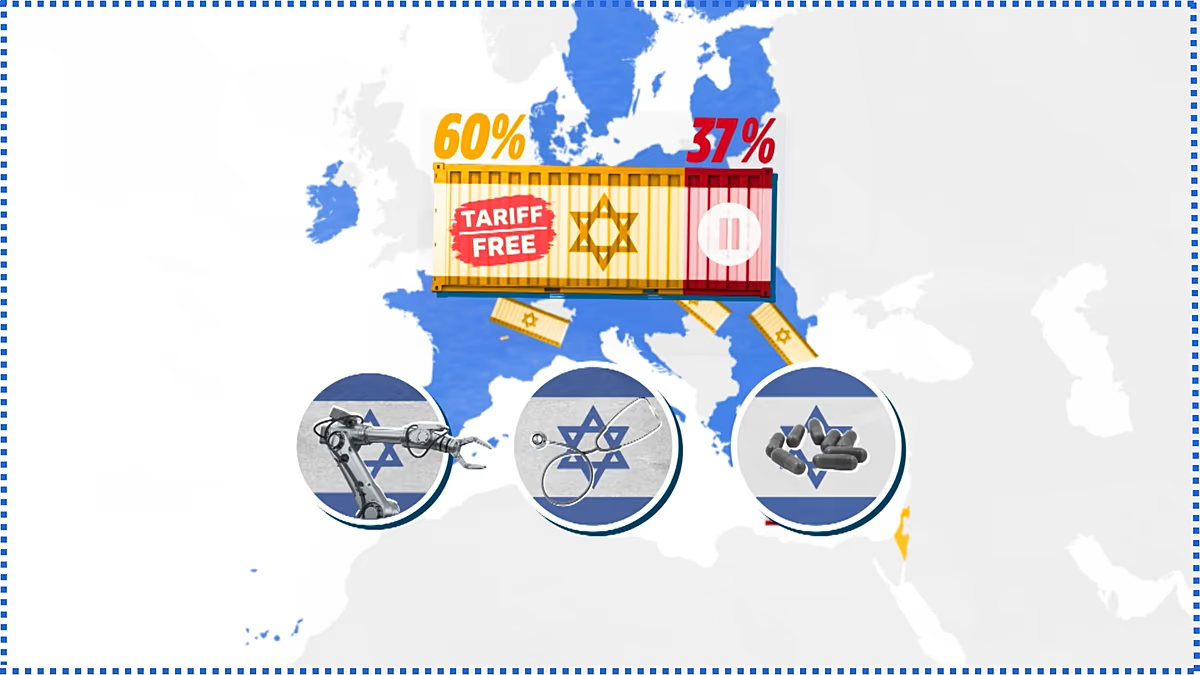
Understanding the high stakes requires a look at the agreement’s real-world impact. A suspension is not a full-scale trade embargo. Approximately 60% of Israeli exports to the EU, its largest trading partner with a relationship worth over €45 billion annually, already enter under standard World Trade Organization rules with zero tariffs. The crucial leverage lies in the remaining 37% of goods—sophisticated products like machinery, medical devices, and pharmaceuticals—which benefit from special, duty-free treatment granted exclusively by this preferential pact. Suspending the trade aspects of the agreement would suddenly reinstate tariffs on these key exports. European Commission estimates suggest this would impose an additional €227 million in annual duties on Israeli companies and simultaneously freeze millions in bilateral EU funding for joint research, development, and cooperation projects. It is a targeted economic pressure point designed to inflict significant discomfort rather than collapse.
However, the path from proposal to action is fraught with diplomatic hurdles, illustrating the deep divisions within the 27-member bloc. While Sánchez may have the backing of Ireland and Slovenia, and while Israel has lost the unwavering support of Viktor Orbán’s Hungary on this issue, securing the necessary consensus remains a formidable challenge. Germany and the Czech Republic, among others, have historically been more cautious, emphasizing Israel’s security needs and the importance of dialogue. Notably, even traditionally supportive Italy has begun to adopt a harder line following attacks on Christian sites in the region, signaling a possible shift in the complex calculus. The legal procedure offers a narrow path: to fully tear up the agreement would require unanimity, an almost impossible bar to clear. But a suspension of the trade privileges alone can be enacted with a qualified majority vote, making it a more plausible, though still difficult, objective for Sánchez’s coalition.
The battle, therefore, is as much about European unity and identity as it is about Israel. Sánchez’s relentless campaign forces a fundamental question upon his fellow leaders: at what point do documented violations trigger the clauses the EU itself wrote into its trade agreements? Is the human rights dimension a serious condition or merely rhetorical cover? For proponents, suspension is a necessary, proportionate step to uphold international law and the EU’s own values. For opponents, it is a dangerous precedent that isolates a democratic ally in a volatile region and undermines European influence. The outcome will reveal much about the current balance of power in Brussels and the practical weight of ethical foreign policy in an era of brutal conflict.
As the proposal is tabled once more, the world watches to see if the third time will be the charm for Pedro Sánchez. Whether he succeeds or fails, his persistent effort has already irrevocably altered the conversation. He has moved the debate beyond statements of concern into the realm of tangible costs and consequences, ensuring that the EU’s relationship with Israel cannot quietly return to business as usual. The coming votes and deliberations will test the solidarity of the European project, measuring the distance between its professed values and its actionable politics in a time of profound crisis.