


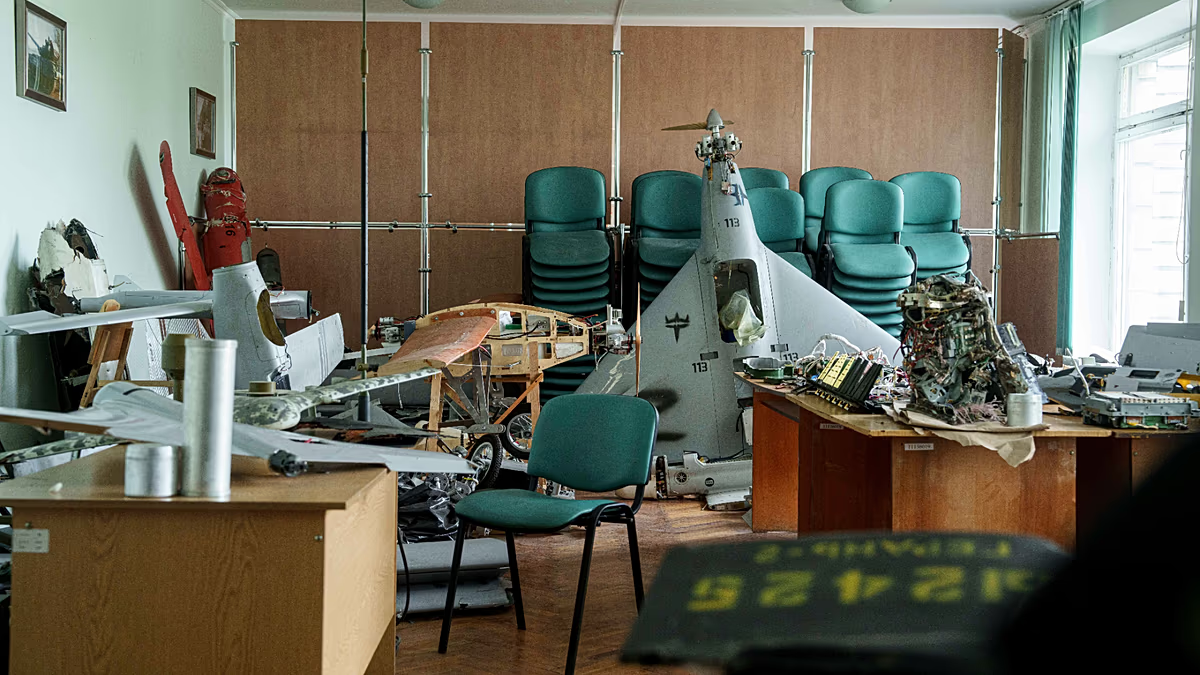
The ongoing conflict in Ukraine has revealed a persistent and lethal pipeline: despite comprehensive international sanctions, advanced Western components continue to fuel Russia’s war machine. Ukrainian military intelligence has meticulously documented that hundreds of thousands of foreign-made parts are found in the drones, missiles, and vehicles attacking its cities. A significant portion of these crucial components originates from Germany, a nation at the heart of the European Union’s sanctions regime. Detailed analyses, such as those from the War and Sanctions portal, list 137 German components in Russian weapons systems, with 59 specifically identified in various drones. This reliance underscores a grim reality; modern Russian armaments are heavily dependent on a globalized tech ecosystem, one that sanctions have struggled to completely sever.
Among the most prevalent German-made parts are transistors, the fundamental building blocks of modern electronics. Companies like Infineon Technologies find their products, often manufactured in the billions for consumer electronics, at the heart of Russian ordnance, such as the jet-powered Geran-5 drone. This weapon, capable of speeds up to 600 km/h with a range of nearly 1,000 kilometers, represents a direct threat enabled by accessible microtechnology. Similarly, components from industrial giants like Bosch, including fuel pumps, have been identified in the ubiquitous Shahed-136 kamikaze drones, which Russia launches in devastating swarms—setting a grim record of over 6,400 in a single month. The problem extends beyond drones; German inductors, capacitors, and other parts are integral to advanced Russian military vehicles like the armored Kamaz transport and the Linza medical evacuation vehicle, illustrating the breadth of the supply chain infiltration.
The journey these components take from German factories to Russian battlefields is complex and deliberately obscured. Manufacturers uniformly state they have halted all direct business with Russia. The pathway, instead, runs through a shadowy network of intermediaries and third countries. As one stark example revealed, an Austrian-made sensor from ams-OSRAM, shipped to a company in Hong Kong in 2024 with contractual prohibitions against military use, was later found in a Russian Geran-2 drone manufactured in 2026. This pattern of transshipment—through hubs like Hong Kong, China, Turkey, and others—allows parts to be laundered through seemingly civilian supply chains. As Infineon Technologies acknowledged, while they implement “no-Russia” clauses and block known suspicious entities, monitoring a product’s resale over its entire lifecycle is “extremely difficult,” especially when only about 60 states enforce coordinated sanctions.
Confronted with evidence of their products in Russian weapons, German companies express frustration and point to the limitations of their control. Bosch suggested that some components cited may be counterfeits, while others are standard, high-volume items like those found in smartphones, making end-use tracking a monumental challenge. Rheinmetall reported learning from German customs authorities that civilian fuel pumps from its subsidiary, produced in 2020, had surfaced in Russia without its knowledge or consent. These responses highlight a systemic issue: the current legal and commercial frameworks are built for peacetime efficiency, not for policing global embargoes against a determined adversary. Companies perform due diligence, but as Bosch noted, “The end use of our supplies is often unknown because of complex, multi-stage supply chains.”
This persistent leakage points to structural weaknesses within the EU’s sanctions and export control architecture, as criticized by advocacy groups like B4Ukraine. The current system often targets specific entities but fails to dismantle the wider networks of illicit firms and distributors that facilitate circumvention. High legal thresholds mean prosecutors must prove a company had concrete knowledge of military end-use, a difficult bar to meet. Furthermore, due diligence obligations for exporters are limited and not uniformly mandatory. These gaps allow for scenarios where export-controlled machinery can be falsely declared as non-controlled in a third country before being shipped onwards to Russia, sometimes even to firms linked to the original European exporter.
Consequently, there are growing calls for profound reform to close these dangerous loopholes. Recommendations include lowering the legal threshold from “certain knowledge” of military use to a “reasonable cause for suspicion,” which would trigger mandatory export license checks. Secondly, instituting mandatory, standardized due diligence procedures for sensitive goods would require companies to actively vet customers and heed red flags. Finally, extending these stricter obligations to strategically vital sectors like precision engineering and dual-use components would cast a wider net. The goal is to align EU rules with stricter international standards, transforming the system from a reactive to a proactive one. As the analysis makes clear, until the pathways for components are systematically disrupted, European technology will continue to inadvertently empower the very aggression its policies seek to halt, with devastating consequences on the ground in Ukraine.