


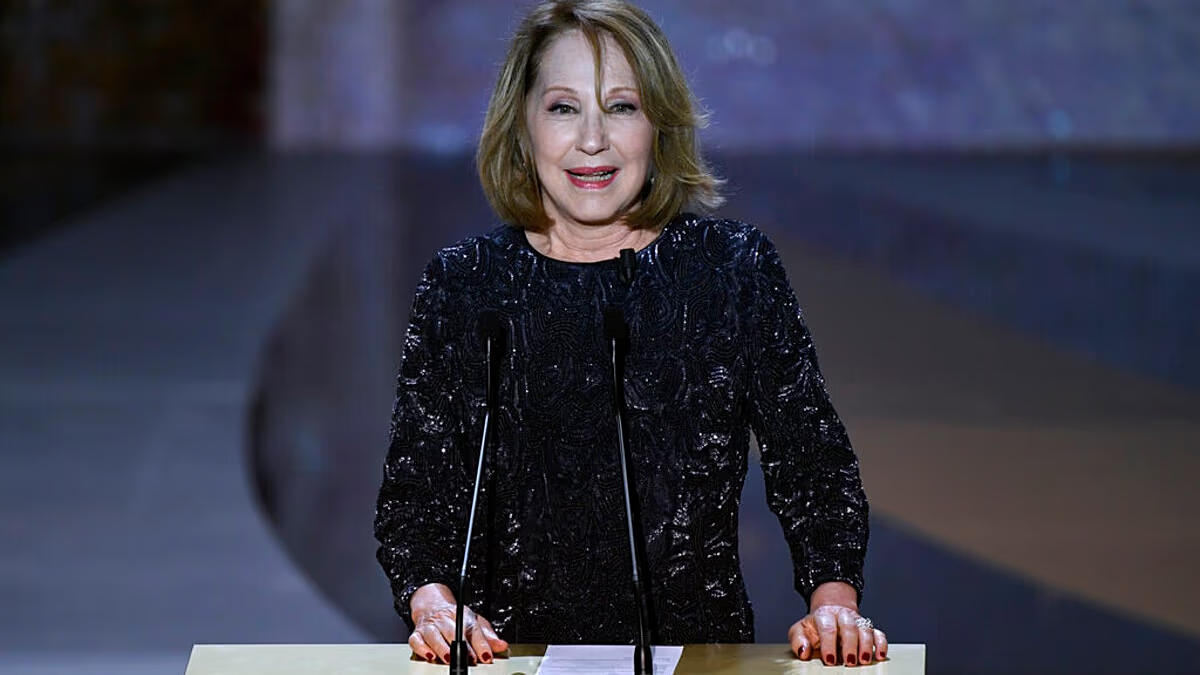
The world of cinema has lost one of its most luminous and enduring stars. French actress Nathalie Baye, a four-time César winner and an icon whose career gracefully bridged the intimate world of French auteur cinema and the global Hollywood stage, has died at the age of 77. Her family confirmed she passed away peacefully at her Paris home on Friday evening after a battle with Lewy body dementia, a neurodegenerative disease. The news sent waves of sorrow through France and the international film community, prompting immediate and heartfelt tributes. President Emmanuel Macron, capturing the sentiment of a nation, described her on social media as “an actress with whom we have loved, dreamed and grown up,” a luminous presence who had “accompanied the last decades of French cinema with her voice, her smiles and her modesty.”
Baye’s journey to becoming a defining face of French film was as unique as her talent. Born in 1948 in Normandy to bohemian painter parents, a young Nathalie, grappling with dyslexia, left formal school at 14 to pursue dance in Monaco. Yet, it was the stage that ultimately called her. A graduate of the prestigious Conservatoire National Supérieur d’Art Dramatique, she began her film career in the 1970s, quickly aligning herself with the great cinematic voices of the era. Her early work with masters like François Truffaut in Day for Night and Claude Sautet established her not just as a capable performer, but as a subtle, intelligent presence who could convey profound emotion with remarkable economy. The 1980s cemented her status, as she embarked on an unprecedented streak of César wins, taking home the Best Actress award three years consecutively from 1981 to 1983.
Those awards highlighted a period of extraordinary depth in her filmography. She won her first César for Jean-Luc Godard’s Slow Motion, and her second for her poignant role in The Informer, where she played a prostitute entangled in a gripping moral crisis. Another classic, The Return of Martin Guerre, saw her deliver a masterfully restrained performance as Bertrande de Rols, a woman caught in an astonishing historical mystery. These roles showcased her unique ability to embody resilience, complexity, and a certain elegant toughness. She was never a distant star; she was a woman you could recognize, whose characters felt authentically woven into the fabric of life, with all its quiet struggles and hidden strengths.
While she remained a pillar of French cinema, the new millennium introduced Nathalie Baye to a vast international audience. Her role as the warm, conflicted mother of Leonardo DiCaprio’s charismatic con man in Steven Spielberg’s Catch Me If You Can was a revelation to many outside France, proving her star power could translate seamlessly onto the Hollywood screen. This global recognition was further bolstered by her work with the brilliant Canadian director Xavier Dolan, who cast her as one of his signature formidable, emotionally charged mothers in Laurence Anyways and It’s Only the End of the World. Even in her later years, she remained fiercely contemporary, delighting audiences with a witty meta-performance in the hit series Call My Agent!, where she played a fictionalized, comically quarrelsome version of herself alongside her real-life daughter, actress Laura Smet.
Her life off-screen was marked by a similar authenticity and passion. For five years, she shared her life with French rock legend Johnny Hallyday, a relationship that placed her at the heart of the country’s cultural landscape. They co-starred in Godard’s Détective in 1985, and their daughter, Laura Smet, continues the family’s artistic legacy. Baye’s personal grace and modesty were often noted by colleagues and the press, making her a beloved figure beyond her film sets. French Culture Minister Catherine Pégard, expressing her emotion, stated that Baye had “illuminated a long page in the history of French cinema with her talent and luminous personality,” a sentiment that perfectly captures the light she brought to both her art and her public persona.
Nathalie Baye’s legacy is etched in nearly 80 films, a body of work that traverses genres and generations. From the New Wave echoes of Truffaut and Godard to the sleek thrillers of Claude Chabrol, from the poignant family dramas of Xavier Dolan to the blockbuster charm of Spielberg, she navigated each with unwavering integrity and skill. She was an actress who could command a César-winning role in a provocative art-house film like An Intimate Affair—for which she also won Best Actress at the Venice Film Festival—and then seamlessly transition to the beloved world of Downton Abbey. Her career was a testament to the power of nuanced, intelligent performance, proving that true star quality lies not in grandeur, but in relatable truth. As the curtain falls on her remarkable life, Nathalie Baye leaves behind a filmography that is a gift to cinema, and the memory of an artist who, with quiet power and luminous humanity, made audiences feel, dream, and understand a little more about the human heart.