


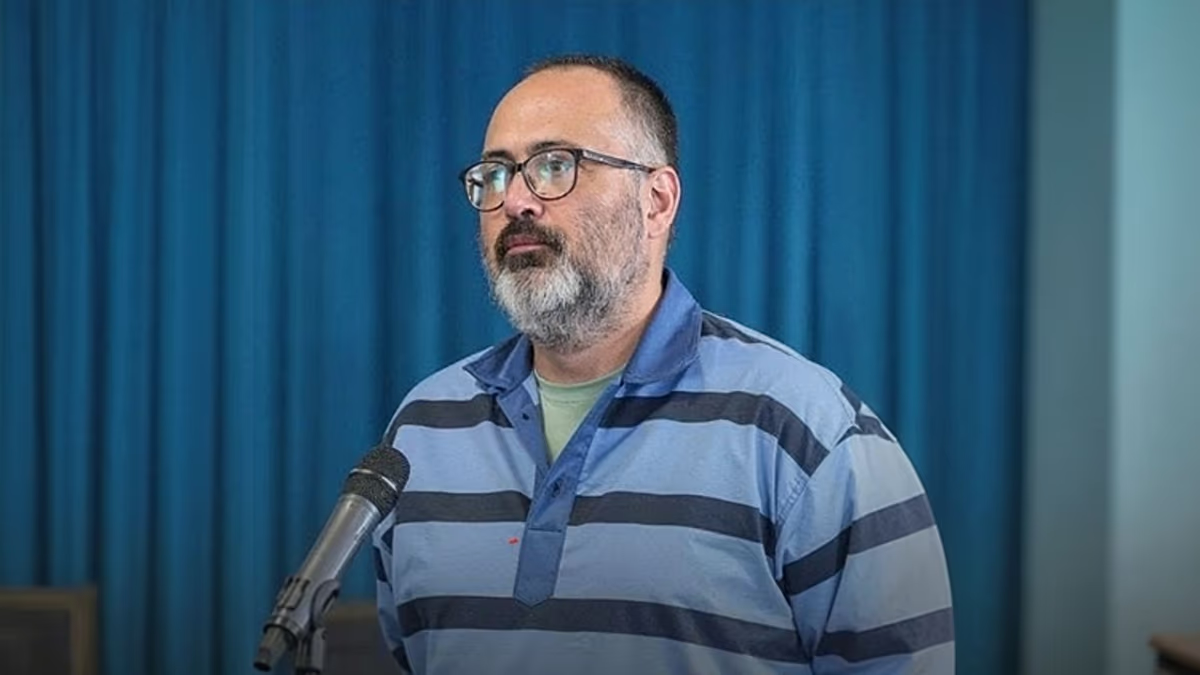
The recent execution of Mehdi Farid on charges of espionage for Israel represents a chilling and now tragically common episode in Iran, where a staggering surge in state-sanctioned killings has become a central tool of governance. According to the official narrative from the Tehran judiciary, Farid, a former employee of the Atomic Energy Organisation, was executed for infiltrating a sensitive defence network on orders from Israel’s Mossad, providing details on facilities and personnel. This account, delivered through state media, claims he made a “frank confession.” However, this case, like so many others, is shrouded in profound doubt and highlights a brutal system where the death penalty is increasingly deployed amid internal and external crises. Since a major conflict with Israel began in February of last year, Iranian authorities have framed domestic dissent and alleged foreign collaboration as an “all-out war,” using this rhetoric to justify a dramatic escalation in executions, which reached a record high in 2025.
A starkly different story emerges from human rights groups and Iranian civil society organizations, painting a picture of grave injustice in Farid’s case. The group Hengaw presents an alternative account: that Farid was an IT student who, after being approached by individuals linked to Israel, refused to cooperate and instead voluntarily reported the contact to Iranian security services, handing over any information and money received. According to this version, his cooperation was ignored, and he was prosecuted and ultimately executed for the very “crime” he attempted to thwart. This discrepancy underscores a critical and repeated warning from human rights monitors: that Iran’s judicial processes in security cases are fundamentally flawed, relying on forced confessions extracted under duress, denying access to independent legal counsel, and conducting trials in revolutionary courts that lack any semblance of fairness or transparency.
The execution of Mehdi Farid is not an isolated incident but part of a deliberate and terrifying pattern. Just one day prior, Iranian media reported the execution of Amir Ali Mirjaafari, convicted of arson and collaborating with Israel and the U.S. during protests. Judiciary officials labelled him part of a “Mossad network,” a now-familiar accusation used to tarnish protestors. Furthermore, the transfer of another death row inmate, Ahsan Afwal, signals that more executions are imminent. This wave follows explicit calls from figures like Judiciary Chief Gholam Hossein Mohseni Ejei to speed up the implementation of “heavy sentences,” including executions, in response to recent protests. The state is systematically using the death penalty not merely as punishment for crime, but as an instrument of political terror to quell potential dissent and create a climate of fear amidst wartime tensions and social unrest.
The scale of this repression is quantified in horrifying statistics. According to a joint report by Iran Human Rights and Together Against the Death Penalty, Iran executed at least 1,639 people in 2025—the highest number recorded since 1989 and a 68% increase from the previous year. This number is not an abstract figure; it represents a historic peak in state killing, with a significant portion of executions linked directly to the national security climate following the June 2025 conflict with Israel. Human rights groups note that at least ten people have been executed specifically on charges related to “collaborating with Mossad and Israel” since that conflict. This sudden spike illustrates how geopolitical confrontation is leveraged to intensify domestic crackdowns, with individuals accused of ties to Israel serving as scapegoats in a broader campaign of intimidation.
Behind each statistic and official charge lies a human story and a broken judicial process. The cases of Farid, Mirjaafari, and countless others follow a grim template: arrests by security forces, detention in notorious prisons like Evin, closed-door trials before revolutionary courts, and convictions based on confessions whose voluntariness is universally questioned by international observers. The reversal of Farid’s initial 10-year sentence to a death penalty after a prosecutor’s objection reveals the arbitrary and punitive nature of the system. When the head of the judiciary declares an “all-out war” and demands harsher treatment, it signals to judges that mercy and due process are off the table, reducing the courtroom to a rubber stamp for state vengeance rather than a hall of justice.
In conclusion, the execution of Mehdi Farid encapsulates a regime in crisis, resorting to unprecedented levels of lethal violence to maintain control. The conflicting narratives of his case—patriot or spy—highlight the opacity and brutality of a system where fair trial guarantees are absent. The record-breaking execution rate in 2025 is a direct result of this deliberate policy, merging external geopolitical strife with internal suppression. As Iran continues to navigate war and protest, the international community and human rights defenders are left to document the rising toll, warning that each execution is both a profound human tragedy and a step toward consolidating a rule by fear. The story of Mehdi Farid, therefore, is more than a news item; it is a stark testament to a state normalizing the ultimate punishment as a routine political tool.