

In the Gulf, a fragile ceasefire holds, the thin and temporary barrier between contained tension and a return to open conflict. For British Ambassador to the UAE, Edward Hobart, this precarious pause is the essential precondition for any lasting diplomacy. As he stated in an interview with Euronews, “We’re not going to resolve the war while we’re still fighting.” His blunt message underscores a hard truth of international relations: meaningful dialogue cannot run parallel to active warfare; it must follow a cessation of hostilities. The entire region now exists in that narrow, anxious gap between fighting and talking, with hope contingent on the silence of weapons. Ambassador Hobart expressed a cautious optimism that this pause could be “the beginning step into something which brings us to a sustainable resolution,” but the stability of that hope depends overwhelmingly on a tiny, turbulent stretch of water.
That critical pressure point is the Strait of Hormuz, a mere 33 kilometers wide but vital to global energy security. It is far more than a regional flashpoint; it is a global artery, and its closure sends immediate shockwaves through the world economy. Hobart’s pragmatic observation that “You can’t talk very easily while you’re firing missiles across the Straits of Hormuz” frames the urgent priority for diplomats. This urgency has directly shaped high-level talks between the UK and the UAE, with recent discussions between foreign ministers focusing intensely on reopening the Strait. Behind this immediate crisis management lies a broader, strategic recalibration of the UK-UAE partnership. Security cooperation is being reinforced, but so too are the systems that build long-term resilience, extending collaboration into areas like artificial intelligence, the energy transition, and combating illicit finance, creating a multifaceted alliance designed for a volatile world.
The necessity of this fortified partnership has been brutally tested. Recent attacks on the UAE represented not a minor escalation but a dangerous step-change, described by Hobart as “unprecedented, unwarranted and hugely dangerous.” Yet, in the face of this threat, the UAE’s defensive capabilities proved remarkably effective, intercepting an estimated 95% of incoming projectiles. This figure is more than a statistic; it is a powerful signal of military preparedness, international coordination, and a sophisticated defence architecture functioning under extreme pressure. The UK’s response to these events was deliberately measured, embodying a principle of support without escalation. As Hobart clarified, while this was not the UK’s war, Britain played a key role in enabling U.S. support for Gulf defence, demonstrating a commitment to regional security that is firm but carefully calculated to avoid inflaming the situation further.
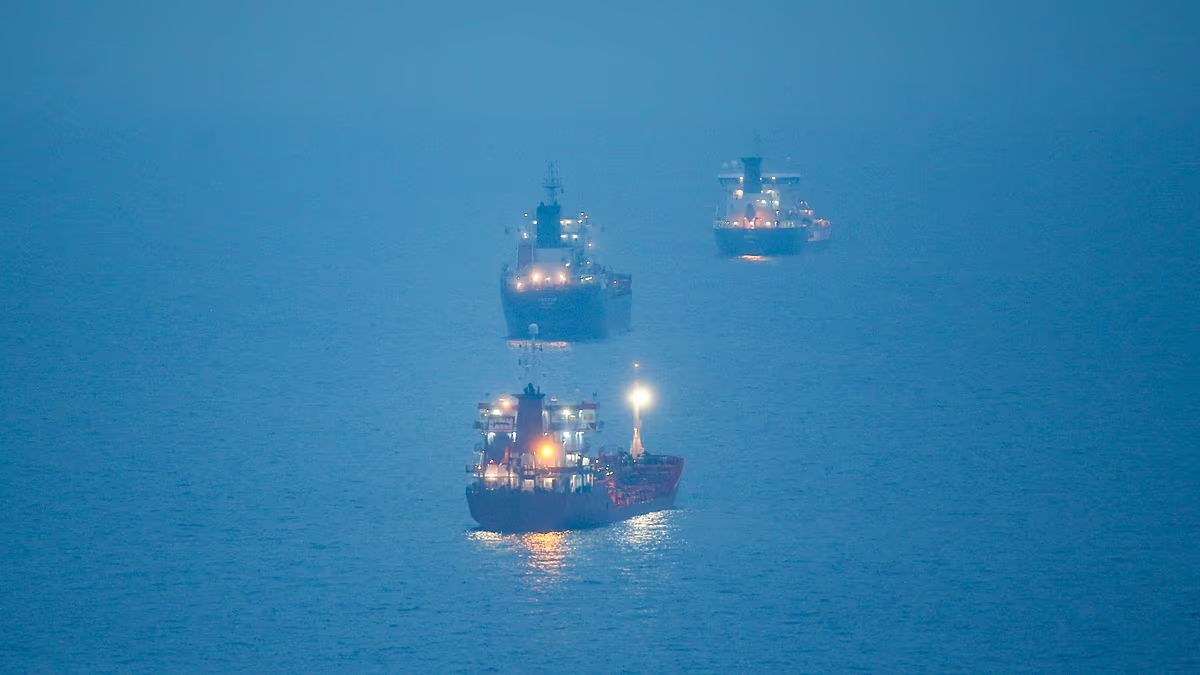
The crisis has also catalyzed a significant international alignment on maritime security, transforming it from a technical concern into a top geopolitical priority. The core principle, as outlined by Hobart, is straightforward: “What we want is the law of the sea to be followed… these international thoroughfares [kept] open and flowing.” This position is now backed by substantial collective action, with over 50 nations participating in efforts to uphold freedom of navigation in the region. However, this broad coalition manages rather than removes the underlying risk. Hobart acknowledges that the threat persists, merely reduced “while there isn’t fighting and while there is a prospect of talking.” For the millions of residents in the UAE, this translates into a life of cautious normality. Daily routines continue, but with a heightened awareness that conditions can shift rapidly, requiring citizens and expatriates alike to remain attentive to official guidance.
Navigating this environment requires a careful balance between reassurance and stark realism—a balance the Ambassador sees as critical. It involves projecting a calming message to maintain social and economic stability, while also acknowledging and responding decisively to an objectively volatile security situation. Zooming out from the immediate tensions, a more structural reality for the UAE comes into focus. The nation operates within a turbulent regional landscape it cannot single-handedly control. Therefore, its strength and strategy lie not in dictating events, but in its agility and resilience in responding to them. Despite the acute pressures, the fundamental pillars of the UAE’s success remain unshaken: its strategic geography, its open and conducive business environment, and its proven capacity to adapt.
For now, this complex balance—between ceasefire and conflict, defence and diplomacy, normality and vigilance—is holding. The path forward remains uncertain, contingent on the durability of the silence over the Strait of Hormuz and the difficult diplomatic conversations that silence is meant to enable. The international community’s reinforced maritime presence and the deepened UK-UAE strategic partnership are stabilising factors, but they operate within a landscape where the risk of escalation is merely dormant. The ultimate test will be whether this managed pause can be leveraged not just for tactical de-escalation, but for the sustainable political resolution that Ambassador Hobart cautiously hopes for, a resolution that would finally allow the region to move from a fragile gap between wars into a more secure and lasting peace.