

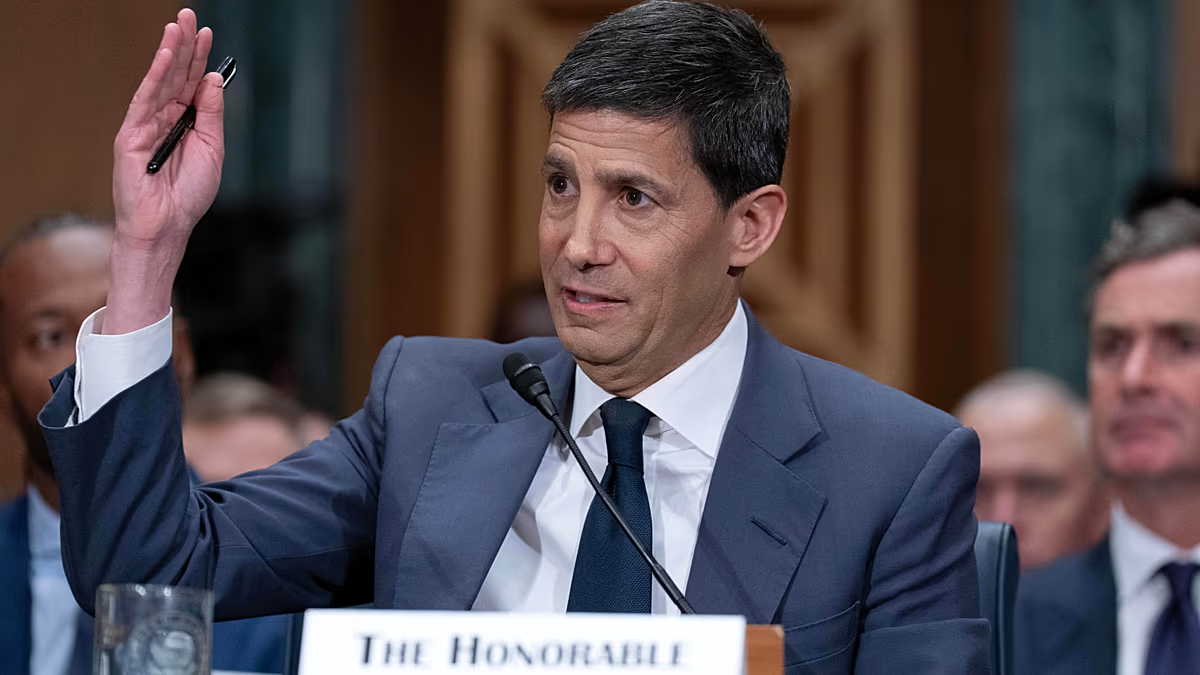
The nomination of Kevin Warsh to Chair the Federal Reserve has thrust the central bank’s cherished independence into the heart of a fierce political storm. In a tense hearing before the Senate Banking Committee, Warsh vehemently defended his professional integrity against pointed accusations that he had struck a covert deal with the White House on interest rate policy. He assured lawmakers that President Trump had never asked him to commit to a specific path for borrowing costs, and he swore he would act independently if confirmed. This pledge was put to the test in a stark moment when Republican Senator John Kennedy asked if he would become the President’s “human sock puppet,” to which Warsh firmly replied, “Absolutely not.” His testimony was a direct effort to calm profound anxieties on Capitol Hill about the politicization of monetary policy, but the shadow of presidential pressure loomed large throughout the proceedings.
Indeed, the hearing underscored the immense external pressure facing the Federal Reserve. Just hours before Warsh appeared, President Trump stated in a televised interview that he would be “disappointed” if Warsh did not move quickly to cut interest rates. This public admonition, juxtaposed with Warsh’s assurances of autonomy, highlighted the precarious tightrope the nominee must walk. The central bank is currently navigating the delicate task of combating persistent inflation, which remains elevated at 3.3%, while the political executive openly campaigns for looser policy. This friction has created a significant confirmation hurdle, suggesting the administration may struggle to gather the necessary votes before Chair Jerome Powell’s term expires in mid-May, potentially leaving the world’s most important financial institution in a state of prolonged uncertainty.
The opposition to Warsh’s nomination is both broad and deeply rooted, forming a coalition of Democratic critics and dissenting Republicans. Democratic senators led the charge, accusing Warsh of being a political opportunist who tailored his economic views to suit the party in power. Senator Elizabeth Warren echoed the “sock puppet” characterization, warning that his confirmation would enable an “illegal takeover” of the Fed. Critics pointed to his past advocacy for higher rates during the Obama administration, contrasting it with his more dovish recent commentary under President Trump. When confronted with a Wall Street Journal report alleging the President had privately urged him to cut rates, Warsh dismissed the story as relying on inaccurate sources, again staunchly affirming the Fed’s independence as “essential” for economic stability.
However, the most critical roadblock may come from within the President’s own party. Republican Senator Thom Tillis has declared he will not support Warsh’s nomination as long as an ongoing Department of Justice investigation into incumbent Chair Jerome Powell remains active. This probe, examining whether Powell committed perjury in testimony about a Fed building renovation, is viewed by Tillis and several colleagues as a meritless political attack. Their stance is one of loyalty to Powell, whom they believe is being unfairly targeted. Tillis’s position effectively freezes the nomination in the closely divided committee, as he has vowed to withhold his vote until the investigation is dropped—a condition outside the Senate’s control, creating a formidable political and procedural logjam.
Beyond the political confrontation, the hearing also delved into complex ethical and logistical challenges. Senators raised pointed questions about Warsh’s personal finances, specifically his investments in private companies like SpaceX and Polymarket, the full extent of which have not been publicly detailed. Warsh defended himself by noting the Office of Government Ethics had already approved his plan to divest all such holdings within 90 days of confirmation. Compounding this is an unprecedented scenario: Jerome Powell has indicated he plans to remain on the Fed’s Board of Governors until his term ends in 2028, regardless of the chairmanship outcome. This sets the stage for a deeply awkward power dynamic, with a former Chair sitting beside his successor—a situation not seen in Washington for decades. While President Trump has threatened to remove Powell from the board entirely, legal experts widely believe such an action would face steep constitutional hurdles, further complicating the transition.
In summary, the battle over Kevin Warsh’s nomination transcends a simple personnel change. It represents a fundamental stress test for the institutional guardrails of American economic governance. The proceedings laid bare a multifaceted conflict involving intense presidential pressure, deep partisan and intra-party divisions, ethical scrutiny, and uncharted procedural territory. Warsh’s repeated vows of independence were his shield, but they did not dissipate the profound scepticism surrounding his nomination. With a Democratic opposition unified in its distrust, key Republican support conditional on an external legal process, and the specter of a former Chair looking over the new one’s shoulder, the path to confirmation appears extraordinarily narrow. The outcome will not only determine who leads the Fed but will send a lasting signal about the resilience of its autonomy in an era of intense political polarization.