


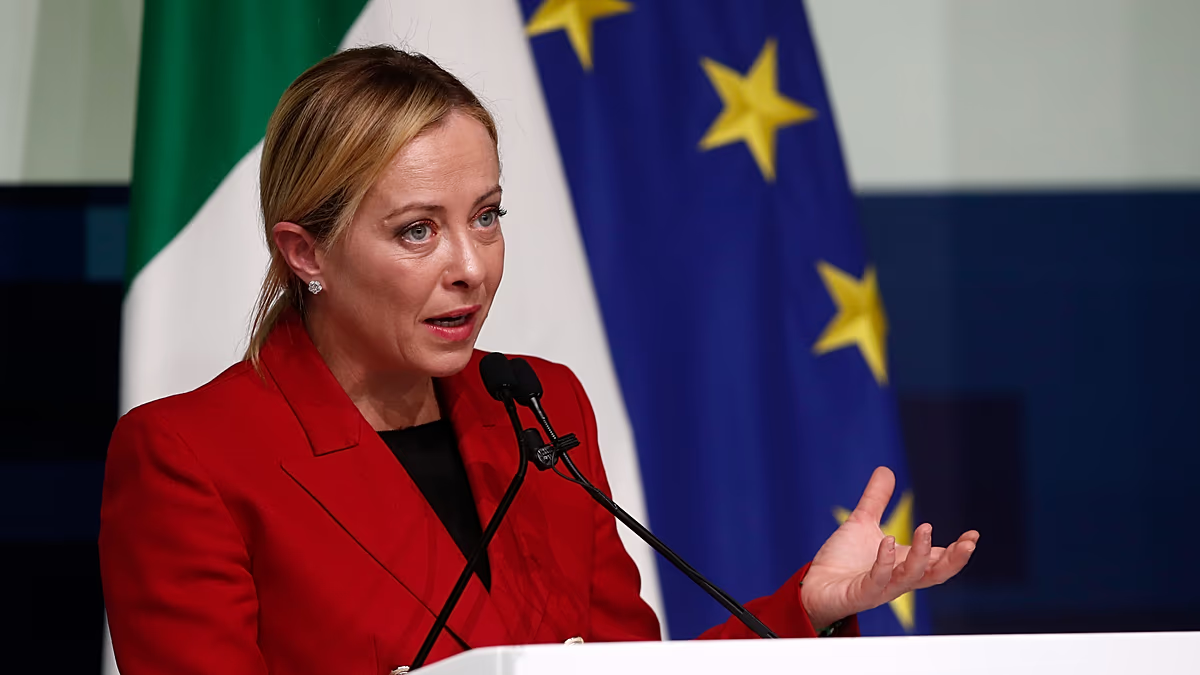
Italian Prime Minister Giorgia Meloni is preparing for a significant visit to Azerbaijan in the coming months, anticipated between May and June. This upcoming diplomatic engagement underscores the deepening and multifaceted relationship between Rome and Baku, which has evolved well beyond simple diplomatic courtesy into a substantive strategic partnership. While the full agenda remains to be finalized, the visit is framed within a context of ongoing high-level exchanges, including at forums like COP29, and serves to reinforce a bilateral connection that has become increasingly vital for both nations. At its heart, this relationship is powered by a convergence of economic interests and geopolitical strategy, with Italy viewing Azerbaijan as a key partner in a volatile region and Azerbaijan valuing Italy as a major gateway to the European Union.
The cornerstone of this partnership, and undoubtedly a central topic for Prime Minister Meloni’s discussions in Baku, is energy security. Since the inauguration of the Trans Adriatic Pipeline (TAP), the final leg of the massive Southern Gas Corridor, Azerbaijan has transformed into a critical supplier of natural gas to Italy and beyond. Luca Schieppati, TAP’s Managing Director, provided concrete figures that illustrate this lifeline: the pipeline has delivered over 47.5 billion cubic metres (bcm) to Italy alone, and in 2025, this flow covered approximately 16% of the nation’s total gas demand. For a Europe reshaped by the urgent need to diversify away from Russian supplies, TAP’s role cannot be overstated. It has delivered over 57 bcm to the continent overall, providing not just volume but reliability—a quality Schieppati emphasized by noting the system has maintained 100% availability since operations began.
This reliability is not passive; it is actively bolstered by continuous investment and upgrades, such as recent enhancements at a compressor station in Greece that increased the pipeline’s long-term capacity. The steady annual delivery figures—hovering around 9.5 bcm in recent years—demonstrate a consistent and dependable flow that forms a bedrock for Italy’s energy planning. As Schieppati pointed out, Italy is the primary destination for Azerbaijani gas via TAP, acting as a crucial entry point that feeds supplies into the wider European market. This dynamic positions Italy not merely as a consumer but as a strategic energy hub, amplifying its influence within EU energy policy. Meloni’s visit will therefore serve to reaffirm this energy alliance, ensuring its stability and exploring avenues for its future development.
However, to view the Italy-Azerbaijan relationship solely through the lens of gas would be a significant oversimplification. As highlighted by analyst Simona Scotti of the Topchubashov Think Tank, Italy now stands as Azerbaijan’s leading trade partner, and cooperation is rapidly diversifying. While energy remains the dominant sector, ties are expanding into areas such as defence, aviation, infrastructure, and agriculture. This diversification is strategic for both parties. For Azerbaijan, it is a path to a more balanced and modern economy, reducing its historical over-reliance on hydrocarbon exports. For Italy, it represents commercial opportunities for its industrial and engineering firms and a chance to deepen its political footprint in the strategically important South Caucasus region.
Prime Minister Meloni’s visit, therefore, will navigate a complex tapestry of interests. On one hand, there is the immediate, practical necessity of securing energy supplies and discussing the operational future of projects like TAP. On the other, there is the broader, long-term project of building a comprehensive partnership. Discussions will likely touch upon regional stability, connectivity projects linking Europe and Asia, and cooperation within international frameworks. The relationship is not without its complexities, given the geopolitical tensions in the South Caucasus and differing perspectives on issues like human rights, but the prevailing momentum is firmly geared towards pragmatic engagement and mutual benefit.
In conclusion, Giorgia Meloni’s forthcoming journey to Baku is more than a routine diplomatic trip; it is a testament to a partnership that has matured into a pillar of Italy’s foreign and energy policy. It symbolizes a European shift towards diversified, reliable energy sources, with Azerbaijan playing a starring role in that narrative. Yet, the dialogue in Baku will look beyond the pipeline, aiming to solidify a wide-ranging alliance that encompasses trade, security, and regional strategy. As both nations seek to navigate an uncertain global landscape, this strengthened bilateral bond offers a measure of stability and a shared vision for a collaborative future, making Meloni’s visit a significant moment for European geopolitics and energy resilience alike.