

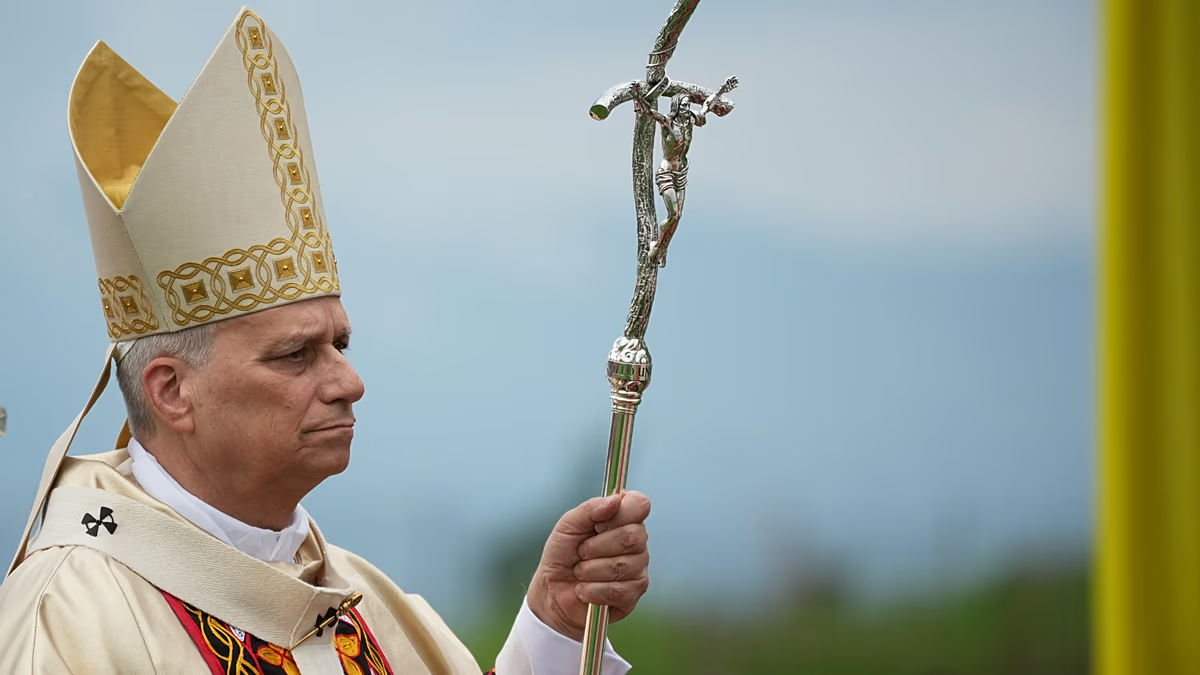
In a striking convergence of history, theology, and modern geopolitics, U.S. Vice President J.D. Vance recently invoked the patron saint of his own conversion, Saint Augustine, to challenge Pope Leo XIV’s criticism of American military action in Iran. Speaking at a Turning Point USA event, Vance referenced the “more than a 1,000-year tradition of just war theory”—a tradition deeply rooted in Augustine’s writings—to warn the pontiff to “be careful when he talks about matters of theology.” The irony was profound: as Vance spoke, Pope Leo XIV was in Annaba, Algeria, paying homage at the basilica built over the tomb of Saint Augustine himself. It was in that ancient city, then known as Hippo Regius, that Augustine penned much of the intellectual foundation for the very principles Vance claimed to defend. This stark juxtaposition highlighted a fundamental clash over who has the authority to interpret a shared moral tradition in a time of conflict.
This theological dispute escalated into a public diplomatic row, beginning when Pope Leo XIV labeled President Donald Trump’s threat to destroy Iran’s “whole civilisation” as “truly unacceptable.” Trump responded on social media, accusing the pope of being “weak on crime” and “terrible for foreign policy,” falsely suggesting the pontiff supported Iran’s right to nuclear weapons. Unfazed, the pope declared from the papal plane that he feared no administration and would continue to preach the Gospel message of peace and dialogue. This exchange reveals the core issue: a struggle over the application of Catholic “just war” doctrine. As articulated by Augustine and later Thomas Aquinas, this framework sets a high bar for moral warfare, requiring a grave, certain threat, the genuine exhaustion of all peaceful alternatives, and a proportionality where the good achieved outweighs the inevitable harm. It is designed precisely to prevent nations from being the sole judges of their own righteous cause.
The Trump administration’s attempt to frame Pope Leo XIV as a naive pacifist who misunderstands the necessity of force is, according to theologians, a misrepresentation of both the man and the modern Church’s track record. The pope, a registered Republican before his election, has supported Ukraine’s right to self-defense. Historically, the Vatican has carefully applied just war principles on a case-by-case basis, quietly accepting the post-9/11 campaign in Afghanistan while opposing the Gulf and Iraq Wars on the grounds that they failed the “last resort” criterion. As Massimo Faggioli, a professor of ecclesiology, notes, the modern papacy now uses the doctrine predominantly as a restraint, not a permission slip. Furthermore, Vance’s suggestion that the pope should stick to “morality” and avoid foreign policy betrays, in Faggioli’s view, a narrowed vision that reduces morality to sexual ethics alone, dangerously excluding war and peace from the moral universe.
The American Catholic hierarchy itself pushed back against the administration’s narrative. Bishop James Massa, chair of the U.S. Conference of Catholic Bishops’ Committee on Doctrine, reiterated that a “constant tenet” of the just war tradition is that military action is only legitimate in self-defense after all peace efforts fail. He emphasized that when the pope speaks on such matters, he is not offering a personal opinion but preaching the Gospel and exercising his sacred ministry. This internal Catholic debate underscores a significant challenge for the administration: its usual playbook for discrediting critics falls flat. As Faggioli points out, they cannot dismiss this pope as a communist or a radical leftist European—he is an American theologian with a clear record. This has created an “intra-American debate” within the Church, making it harder to delegitimize the moral critique coming from the Vatican itself.
Beyond the war of words lies a deeper, more unsettling conflict about the nature of faith and power. Pope Leo XIV, speaking from Cameroon, warned against those “who manipulate religion and the very name of God for their own military, economic, and political gain.” Meanwhile, in a jarring contrast, U.S. Defense Secretary Pete Hegseth led a Pentagon worship service, quoting a pseudo-scriptural passage popularized by a violent film scene. Theologian Joseph Capizzi cautions that any believer who claims God for their side should do so with “great fear and trembling.” This episode, for Capizzi, is ultimately a “teaching moment” that reaffirms the Church’s enduring moral authority and the profound gravity of its ancient doctrines. Polls suggest this authority resonates, showing Catholic voter disapproval of Trump rising and significant opposition among the faithful to military action in Iran.
Ultimately, this confrontation is symptomatic of a years-long struggle over the soul of American Christianity and the fusion of faith with political identity. Faggioli sees in Trumpism a “form of political messianism,” where a secularized vacuum is filled by a leader viewed by some as a divinely-appointed deliverer. This stands in stark contrast to the Church’s call for prudence, proportionality, and peace. While Capizzi holds hope that bridges can be mended, the events—including a bomb threat against the pope’s brother in Illinois—reveal how dangerously charged this discourse has become. As the pope’s brother himself predicted, this is a pontiff who will not stay quiet. The enduring lesson, echoing from Augustine’s City of God to today’s headlines, is that when justice is removed, kingdoms risk becoming little more than great bands of robbers. The current debate is a poignant reminder that this thousand-year-old conversation about war, morality, and power remains painfully, urgently relevant.