

A Diplomatic Offensive for Freedom of Navigation
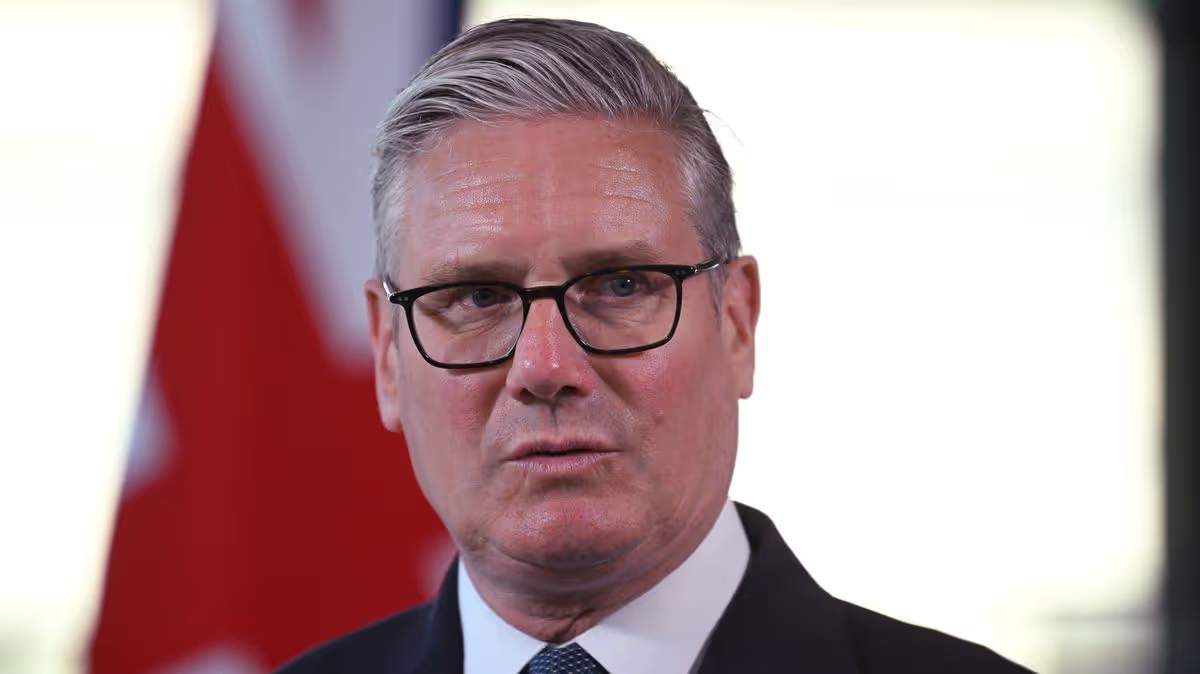
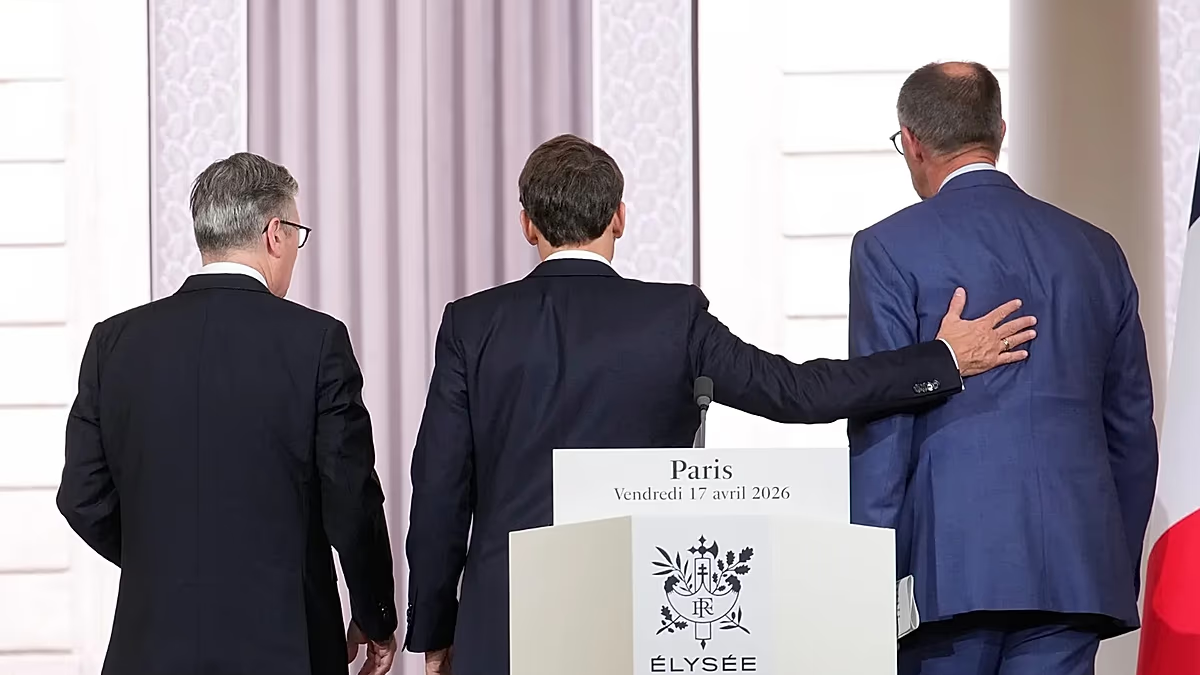
In a pivotal meeting in Paris, European leaders signaled a decisive shift in the international response to the crisis in the Strait of Hormuz. Co-chaired by French President Emmanuel Macron and British Prime Minister Keir Starmer, the gathering of 49 nations aimed to chart a course toward lasting maritime security, even as Iran announced a temporary reopening of the critical waterway for the duration of a fragile ceasefire. This announcement, while welcome, was met with profound skepticism by the assembled leaders, who viewed it as a tactical pause rather than a permanent solution. The core outcome of the summit was a firm commitment to accelerate planning for a neutral, multinational defensive mission. This European-led initiative is deliberately framed as separate from the ongoing US blockade of Iranian ports, representing a distinct diplomatic and strategic path focused on restoring and guaranteeing the principle of freedom of navigation for all.
The European approach consciously distances itself from Washington’s more confrontational stance. President Donald Trump, in a characteristically forceful social media post, reaffirmed that the US naval blockade would persist indefinitely, directly linking its duration to the completion of a transactional deal with Iran. In contrast, Macron and Starmer articulated a vision for a mission that would include neither the United States nor Iran, aiming to position itself as a neutral stabilizing force above the fray of the immediate conflict. Macron welcomed recent ceasefire developments but insisted on the strait’s full and unconditional reopening, firmly rejecting any notion that passage could become a toll-based or privatized system. Starmer echoed this, cautioning that Iran’s move must be transformed into a “lasting and workable proposal,” underscoring that trust had been too deeply broken for declarations alone to suffice.
The urgency driving this diplomatic push stems from the strait’s irreplaceable role in the global economy. As a chokepoint for roughly one-fifth of the world’s traded oil and liquefied natural gas, weeks of disruption have sent shockwaves through energy markets, stranded commercial vessels, and left over 20,000 seafarers in limbo. European governments have uniformly refused to participate in the US blockade, viewing it as an act of war that would dangerously escalate the conflict. Italian Prime Minister Giorgia Meloni, present in Paris, broadened the perspective, noting that the crisis threatens not only energy flows but also vital fertilizer shipments, directly implicating global food security. She stated Italy’s readiness to contribute to a future defensive operation, focusing on reassuring commercial traffic and mine clearance, while explicitly ruling out any offensive role.
A clear tension emerged, however, regarding the ultimate scope and membership of the proposed mission. German Chancellor Friedrich Merz offered a stark warning, stating that failure to contain the crisis risked sparking a “multidimensional global war.” While indicating Germany’s potential contribution to areas like mine clearance, he openly contradicted the French position by expressing a desire for eventual US participation in the effort, believing American involvement would be desirable for the mission’s credibility and effectiveness. This divergence highlights the delicate balancing act European powers face: constructing a credible, neutral force while navigating the practical realities of global security, where US military capabilities are often seen as indispensable. The planned follow-up military conference in London will be the first real test in reconciling these differing strategic viewpoints into a coherent operational plan.
Beneath the operational discussions lies a fundamental clash over principles and sovereignty. The European initiative is, at its heart, a reassertion of the foundational international norm of freedom of navigation in strategic waterways—a principle Iran’s actions have challenged. By proposing a defensive coalition, Europe seeks to uphold this norm without being drawn into the wider US-Iran confrontation. The mission’s success hinges on its perceived legitimacy and strict adherence to a defensive mandate, as emphasized by all European leaders. Any perception that it is a veiled escalation or an extension of the blockade would undermine its neutrality and risk provoking the very conflict it aims to prevent. The coming weeks will involve intense diplomacy to solidify contributions, define precise rules of engagement, and establish a clear chain of command under a European banner.
As the temporary ceasefire clock ticks toward its expiration, the accelerated plans in Paris and London represent a race against time to establish a durable security architecture. The European path is fraught with complexity, requiring unity among diverse member states, careful navigation of US relations, and the maintenance of an unequivocally defensive posture. The goal is not merely to patrol the strait but to create a sustainable framework that deters future closures and de-escalates tensions, thereby insulating global commerce from regional conflicts. Whether this ambitious diplomatic offensive can transition from accelerated planning to a successful, on-the-water reality will be a defining test for European strategic autonomy and its ability to serve as a stabilizing force in an increasingly volatile world.