

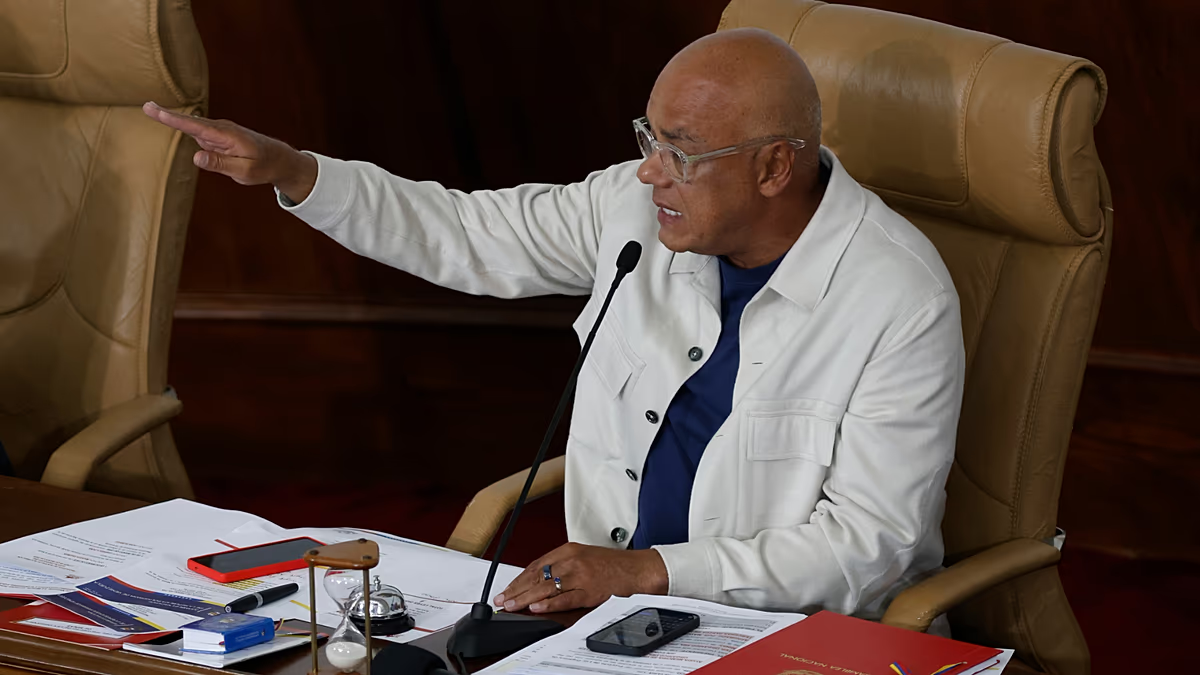
A significant and hopeful step has been taken in the often-fraught relationship between Venezuela and the European Union. In a high-level meeting held at the Federal Legislative Palace in Caracas, representatives from both sides forged a new working agenda aimed at mutual cooperation. This dialogue, chaired by Jorge Rodríguez, President of the Venezuelan National Assembly, alongside senior EU diplomats, signals a deliberate move to rebuild political bridges long strained by years of political crisis and sanctions. While details remain sparse, Rodríguez framed the discussions around establishing a “roadmap for productive development,” suggesting a focus on tangible economic and social projects. The very act of convening in the heart of Venezuelan government power speaks to a mutual desire to move beyond mere diplomatic posturing and toward a structured, practical partnership.
The European delegation, led by Pelayo Castro Zuzuárregui and the EU’s Chargé d’Affaires in Venezuela, María Antonia Calvo Puerta, represents a calibrated re-engagement with the administration in Caracas. Importantly, this parliamentary dialogue was not an isolated event. It was complemented by meetings between EU officials and members of Venezuela’s executive branch, including a sit-down with interim president Delcy Rodríguez, which both parties described as a move toward more “cordial and productive” relations. This multi-tiered approach indicates the EU is engaging with various centers of power within Venezuela’s complex political landscape. However, this institutional shift unfolds against a backdrop of continued division, as the Venezuelan opposition, led by María Corina Machado, conducts its own vigorous diplomatic campaign across European capitals, highlighting the delicate balancing act the EU must perform.
The timing of this diplomatic thaw is not coincidental; it aligns with a pivotal economic development that has reshaped the international landscape for Venezuela. After a suspension dating back to 2019, the International Monetary Fund (IMF) and the World Bank have officially resumed their relations with the country. This decision represents a critical vote of confidence—or at least a pragmatic assessment—from the world’s premier financial institutions. Interim President Delcy Rodríguez publicly celebrated the move, framing it as a victory for national progress over what she termed “Venezuelan extremism,” a clear reference to opposition efforts to maintain Venezuela’s international isolation. She portrayed the reinstatement as foundational for economic recovery, a sentiment that underscores how domestic and foreign policy are inextricably linked for the current government.
For the administration in Caracas, the re-opening of doors at the IMF and World Bank is a cornerstone of a broader campaign for international reintegration. It provides a veneer of financial normalization and potential access to future resources and technical assistance. Rodríguez explicitly linked this financial progress to the political dialogue with the EU, suggesting a strategic vision where economic and political reacceptance go hand-in-hand. The government’s narrative is clear: after years of navigating severe economic challenges under a cloud of non-recognition and sanctions, Venezuela is methodically working its way back into the fold of multilateral institutions. The EU’s willingness to now define a cooperative agenda is seen as the logical next step in this painstaking process of diplomatic rehabilitation.
Nevertheless, the path forward is strewn with complexity. The EU’s engagement with the government does not negate its deep concerns regarding democratic principles, human rights, and the upcoming presidential elections. The parallel diplomatic tracks—one with the government and another with the opposition—illustrate the Union’s attempt to foster dialogue and encourage conditions for a peaceful, electoral resolution to Venezuela’s long-standing political crisis. The awarding of a major honor to opposition figure María Corina Machado in Madrid, even as EU officials met with government leaders in Caracas, perfectly encapsulates this dual-track strategy. The EU is, in effect, trying to keep channels open to all parties, promoting cooperation on development while consistently advocating for democratic guarantees.
In conclusion, the meeting in Caracas marks more than just another diplomatic exchange; it is a symbol of cautious, calculated optimism. Both Venezuela and the European Union appear to be testing the waters for a more stable and functional relationship, underpinned by a nascent agenda for development and the significant milestone of re-engagement with international financial bodies. Yet, this rapprochement exists within a fragile equilibrium. Its sustainability will depend not only on the implementation of concrete cooperative projects but also on the evolution of Venezuela’s internal democratic processes. The world will be watching to see if this new chapter can foster tangible benefits for the Venezuelan people while contributing to a much-needed political stability that has eluded the nation for years.