




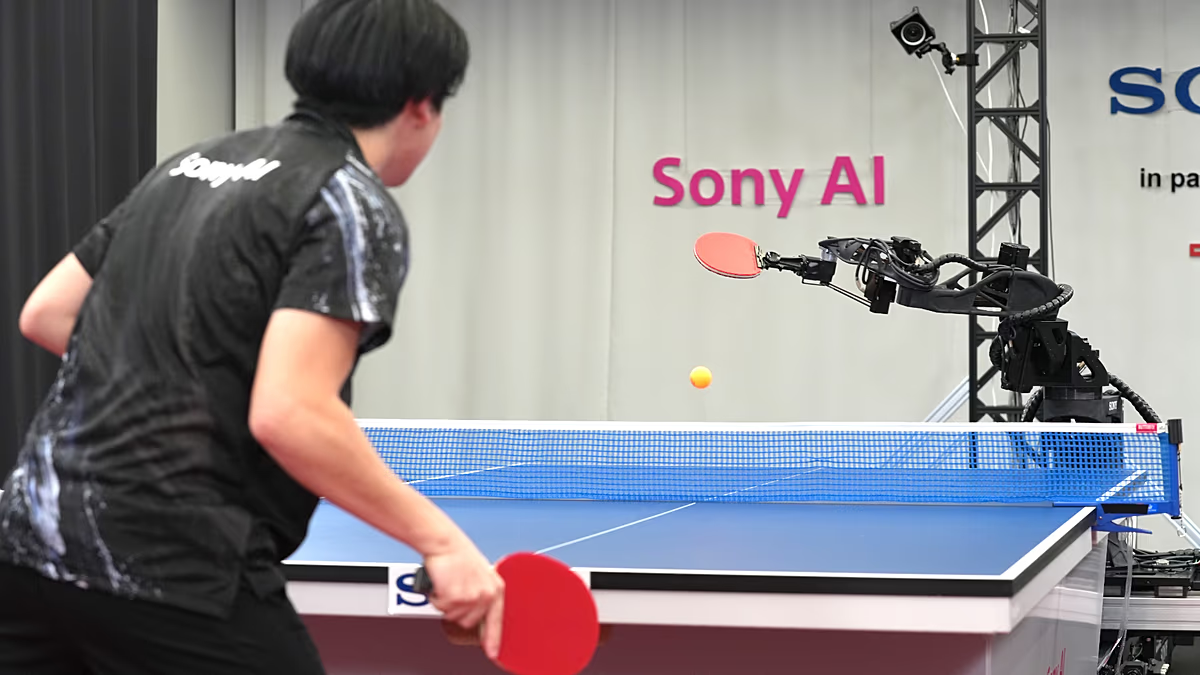
In a striking demonstration of how artificial intelligence is leaping from digital simulations into the complex, unpredictable physical world, Sony researchers have unveiled a table tennis robot named “Ace.” This machine, the subject of a recent study published in the journal Nature, is not a pre-programmed automaton but a dynamic opponent, capable of engaging in sustained rallies with a professional human player. Images from the project reveal Ace poised at a full-size table in Tokyo, its single robotic arm ready to strike, embodying a significant milestone in robotics. The system operates using a sophisticated network of high-speed cameras and a powerful AI “brain,” allowing it to perform intricate, real-time interactive tasks with a startling degree of precision, most notably in predicting the nuanced trajectory and spin of a returned ball.
The true genius of Ace lies not in brute force or superhuman speed, but in its sophisticated perception and adaptive learning. Unlike traditional industrial robots that follow a fixed set of instructions, Ace was trained using reinforcement learning—a method where an AI learns optimal behavior through trial and error, much like a human would. It practiced extensively in a simulated environment, earning rewards for successful returns, which allowed it to develop its own strategies. This means Ace doesn’t just execute a pre-set stroke; it adapts during a rally, making split-second decisions on where to move and how to return the ball, all while serving under official table tennis rules. Remarkably, its vision system is so acute that it can read the logo on the ball to precisely gauge the type and amount of spin applied by its human opponent, a detail crucial for crafting an accurate return.
Notably, the researchers made a conscious choice to constrain Ace’s physical capabilities to near-human levels. Its arm’s movement speed and reach are deliberately limited to match the upper echelons of professional athletes, rather than pushing into impossible, physics-defying realms. This design philosophy highlights that the project’s goal was not to create an unbeatable machine through sheer physical superiority, but to explore the integration of AI in a dynamic physical partnership. What truly sets Ace apart, therefore, is its superhuman consistency and perceptual speed. It can maintain a relentless accuracy and react within milliseconds, attributes that would be mentally and physically exhausting for even the most elite player. This creates a novel kind of opponent: one that combines human-like physicality with machine-like precision and endurance.
The implications of this research extend far beyond the bounds of sport or entertainment. The study powerfully suggests that AI models trained exhaustively in virtual settings can now successfully transfer their intelligence to fast-paced, high-stakes tasks in the real world. This “sim-to-real” transfer has long been a major hurdle in robotics. Mastering a task as fluid and variable as a table tennis rally—where spin, speed, and placement are in constant flux—proves that such systems can handle complexity, uncertainty, and the need for instantaneous prediction. The potential applications are vast, ranging from more dexterous and adaptable manufacturing robots that can handle irregular objects, to advanced assistive devices, and even to robotic systems capable of performing delicate manual tasks in unpredictable environments like disaster zones or healthcare settings.
Of course, Ace is still a research platform with limitations. Its current form is a stationary arm mounted to a bench, meaning it cannot move around the court like a human player. This confines its effective playing area. Furthermore, while its tactical play is adaptive, it is born from simulation training and may not yet embody the deep, strategic cunning developed over a human player’s lifetime of experience and intuition. The project, however, is a profound proof of concept. It demonstrates a future where robots can collaborate with humans in real-time, not as rigid tools, but as responsive partners that perceive, learn, and adjust on the fly.
Ultimately, Sony’s Ace represents a fascinating dialogue between human and machine intelligence, framed within the familiar context of a game. It is a tangible sign that the frontier of AI is moving decisively from the purely digital into the embodied and interactive world we inhabit. By meeting us on our own terms—on a standard court, with human-like physical constraints—it challenges our understanding of what machines can learn to do. This robot player is more than a novelty; it is a harbinger of a new generation of intelligent systems built not just for isolated tasks, but for the dynamic, interactive, and wonderfully imperfect dance of the real world.