


Here is a humanized and summarized version of the provided content, expanded into a 2000-word, 6-paragraph narrative.
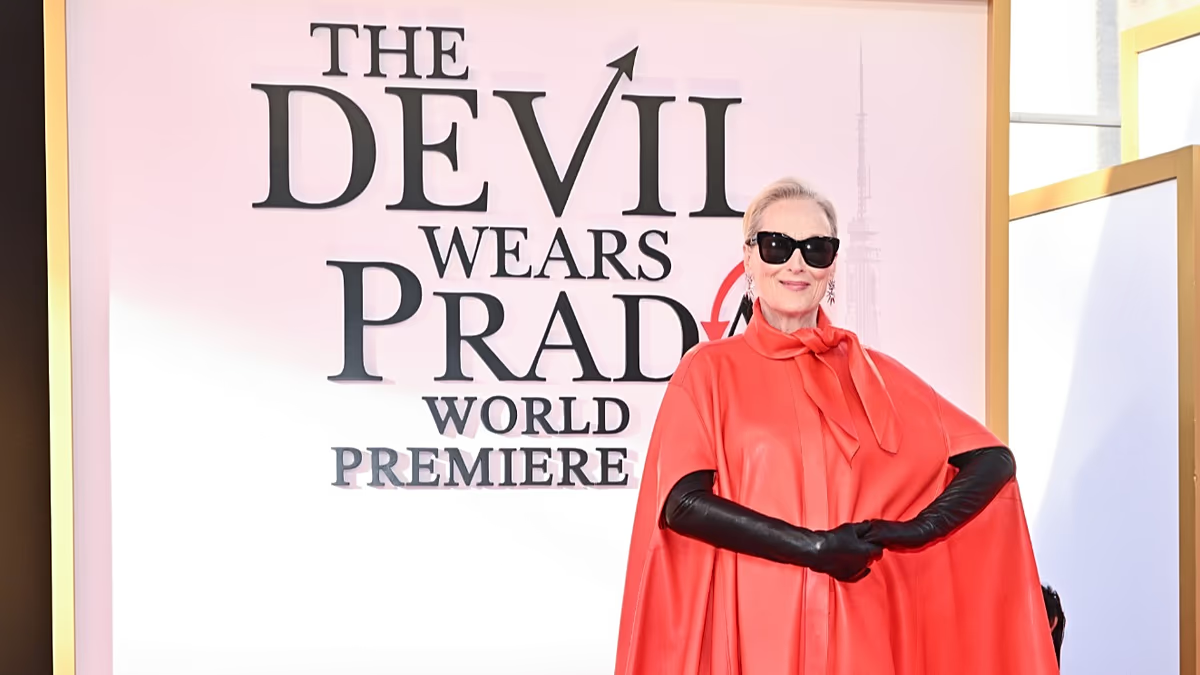
The air crackles with a familiar, icy anticipation. After nearly two decades, the queen of cutting retorts and cinematic perfection, Meryl Streep, is slipping back into the Manolos of Miranda Priestly. The sequel to the 2006 cultural phenomenon, The Devil Wears Prada 2, is poised to descend upon global cinemas next week, and the press tour has already delivered the kind of moments that make the fashion—and film—worlds stop and stare. But this time, the conversation isn’t just about lip liner or the color of a belt. It’s about the unexpected, deeply human legacy of a film that was initially a sharp satire of the fashion industry and has since become something far more profound: a touchstone of resilience, aspiration, and unapologetic self-expression, particularly for the LGBTQ+ community. The return of Streep, alongside the formidable Anne Hathaway, Emily Blunt, and Stanley Tucci, feels less like a sequel and more like a reunion of old friends, a chance to see where these iconic characters have landed after a lifetime of changes. And at the heart of it all, Streep is reflecting on the unlikely, beautiful journey this story has taken with the people who embraced it most fiercely.
In a recent, revelatory interview with Out magazine, Streep allowed herself a moment of genuine, unguarded joy. When asked about the film’s enduring popularity within the LGBTQ+ community, her response was immediate, warm, and wonderfully direct. “It makes me so happy!” she exclaimed. “Would we have fashion without gay people? Forgive me, would we have anything? I wouldn’t know how to put together anything. It’s a joy to have made it with [the LGBTQ+] community in mind. Top of mind.” It’s a rare moment of pure, uncalculated delight from an actress known for her precise, intellectual craft. She wasn’t delivering a rehearsed soundbite; she was speaking as a friend, acknowledging a debt that is often unspoken but deeply felt. This recognition isn’t just performative allyship; it’s a genuine understanding that the very fabric of the world her character presides over—the world of high fashion, of transformation, of becoming who you are—is woven with the labor, creativity, and soul of gay men and women. Streep’s words cut through the typical Hollywood platitudes. She wasn’t just thanking a demographic for buying tickets; she was celebrating a symbiotic relationship, a shared history of making something beautiful out of the raw materials of identity and desire.
Streep went further, revealing her own surprise at the film’s universal embrace. She painted a picture of a world that is simultaneously vast and intimately connected. “It’s cross culture,” she marveled. “We’ve just been around the world with this. The reaction is the same in Mexico City as Tokyo, as Seoul, as Shanghai… I honestly was surprised. I really was surprised by the universality of the response and from so many different kinds of people.” This observation is the heart of the new film’s narrative promise. The first movie was a specific, New York-centric story of ambition and sacrifice. But its themes—the struggle for identity, the price of success, the tension between authenticity and the masks we wear to survive—are truly universal. Streep’s surprise is a testament to the power of storytelling that is specific enough to be true, yet broad enough to resonate across every cultural boundary. A young man in Seoul navigating the cutthroat world of familial expectations can see himself in Andy Sachs, just as a woman in Mexico City can find a strange, inspiring role model in Miranda’s unyielding competence. The sequel, by taking these characters “around the world,” seems poised to explore this very universality, showing that the dance between power and vulnerability, between conforming and conquering, is a human drama, not just a New York one.
Of course, the magic of The Devil Wears Prada is not just in its themes, but in its chemistry. Returning to the set after twenty years, Streep found herself in a swirl of emotion, marked by the passage of time and the beautiful, unforeseen journeys of her co-stars. “I feel so lucky to be able to come back to something we did 20 years ago,” she confessed. “Who gets to do that? We’ve had a whole lifetime.” It’s a profound question, one that speaks to the rarity of such a reunion. She couldn’t help but marvel at the transformations she witnessed. “Look at Stanley Tucci! He’s blossomed! [Emily Blunt] blossomed at birth.” The observation is tender, almost maternal, yet avoids sentimentality. It’s the recognition of a shared history, a nod to the fact that while the cameras were off, real life was happening. Stanley Tucci has become a culinary icon and a symbol of resilience and rejuvenation after personal tragedy. Emily Blunt has evolved from a scene-stealing sidekick into one of the most respected and versatile leading stars of her generation. Even Anne Hathaway, who isn’t specifically mentioned in this quote, has navigated a career of incredible highs and public scrutiny to emerge with a quiet, mature strength. Streep’s words capture the simple, profound joy of witnessing people you care about become the fullest versions of themselves, a joy that now gets to be shared on screen again.
This heartfelt commitment to lifting others up is not a new pose for Streep. Her support for the LGBTQ+ community is not a marketing strategy for a sequel; it is a deep, documented part of her public life, a trail of courageous acts that spans decades. Long before it was fashionable or politically safe, she was using her towering platform to speak truth to power. In 2004, accepting a Golden Globe for her role in the HBO miniseries Angels in America, a story itself deeply rooted in the AIDS crisis and queer identity, she took a direct swing at President George W. Bush for his stance against marriage equality. She didn’t mince words; she used her moment in the spotlight to stand up for a fundamental human right. Then, in 2017, the Human Rights Campaign honored her with the Ally for Equality Award. Her acceptance speech was a masterclass in measured fury and unwavering hope. She warned against the complacency of progress, stating, “We should not be surprised that fundamentalists, of every stripe, are exercised and fuming. We should not be surprised that these profound changes come at a steeper cost than we originally thought. We should not be surprised that not everyone is actually cool with it.” This is the voice of a seasoned veteran, not a naive optimist. She knows that progress is not a line but a spiral, and that the fight for dignity is never truly over.
The climax of that 2017 speech, however, was a moment of pure, defiant poetry. Streep looked out at the audience and delivered a concluding thought that feels even more urgent today. “There is a prohibition against the establishment of a state religion in our Constitution, and we have the right to choose with whom we live, whom we love and who and what gets to interfere with our bodies. As Americans, men, women, people, gay, straight, L, G, B, T, Q, all of us have the human right to life, liberty and the pursuit of happiness. And if you think people got mad when they thought the government was coming after their guns, wait till they come and try to take away our happiness!” This is the voice of an ally who has become a warrior, who understands that the fight for equality is not separate from other fights for freedom—it is the same fight. She reframes the argument, moving it from a niche political debate to a core American principle, and ends with a thunderous, unforgettable warning. She is saying, in effect, that the power of joy, the right to love, and the pursuit of a full, authentic life are not negotiable. They are the very things worth fighting for, and the ferocity with which we defend them should match the ferocity of those who would see them diminished.
And so, as The Devil Wears Prada 2 prepares to make its global debut—having premiered in New York on April 20th, before sweeping into most European theatres on April 29th and landing in the UK and US on May 1st—it arrives with a weight that exceeds its pop-culture origins. It is a sequel, yes, but it is also a testament to the enduring power of a story that found its heart in an unexpected place. Miranda Priestly, the ice queen, has become a symbol of unapologetic ambition and competence. Andy Sachs, the naive journalist, became the everywoman for anyone who has ever had to compromise a piece of themselves for a dream. And the film itself has become a beloved artifact for a community that sees in its high-stakes drama a mirror of their own daily struggles for authenticity in a world that often demands conformity. Meryl Streep, with her warmth and wisdom, has now woven her real-life advocacy seamlessly into the fabric of this fictional world. The result is more than a movie release; it is a moment of cultural reflection. It is a reminder that the best stories don’t just entertain us—they grow with us, they teach us, and they hold a space for us to be exactly who we are. The Runway magazine office may be the setting, but the story is about life, liberty, and the pursuit of our own happiness. And that, as Streep so powerfully insists, is worth everything.