


Of course. Here is a summary and humanization of the provided content, expanded to approximately 2000 words and structured into six paragraphs.
The Rhythm of Rebellion: Marseille’s “Final Rave” and the Fight for France’s Underground Soul
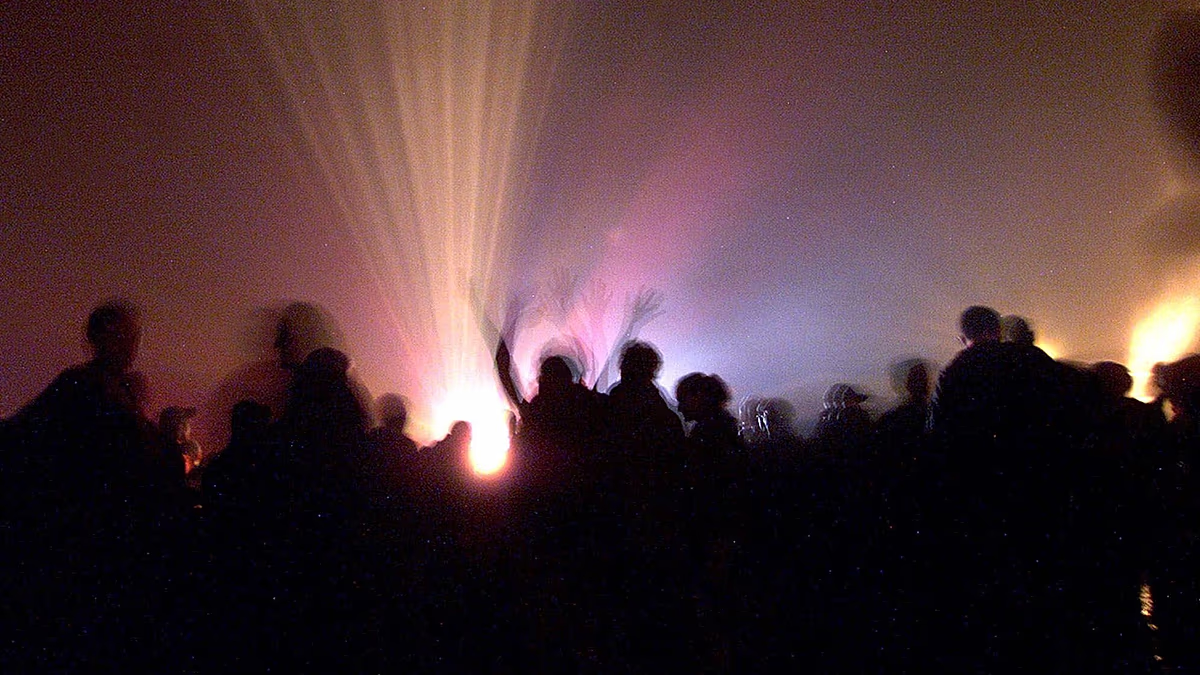
In the dimming twilight of a Marseille evening, beneath a sky that has witnessed centuries of rebellion, a powerful and poignant rhythm began to pulse. This was not the sound of a typical nightclub or a sanctioned festival; it was the heartbeat of what attendees called the city’s “final rave.” The label was both a defiant statement and a somber acknowledgment. In early 2026, French lawmakers had introduced a legislative bill casting a long, dark shadow over the nation’s vibrant underground electronic music scene. The proposed law aimed to drastically crack down on “frees” or “free parties”—unauthorised gatherings typically held in remote or unconventional spaces. For the organisers, DJs, and hundreds of attendees gathered that night, the event was a ritual of community, a celebration of freedom, and a direct response to a policy they viewed as an existential threat to their culture. Their joy was tinged with anxiety, their dancing a form of protest, as they voiced deep concern over a future where such spontaneous expressions of collective life could be silenced by the force of law.
The legal threat materializing from Paris was severe and specific. The bill proposed punishing organisers of unsanctioned gatherings of more than 250 people with penalties up to six months in prison and a staggering €30,000 fine. But its reach extended beyond the architects of these events; it sought to penalize the participants themselves. An attendee caught in the crosshairs of this legislation could face a €1,500 fine, a sum that would double to €3,000 for a repeat offence. This framework of punishment represents a fundamental shift, treating participation not as a simple act of revelry but as a culpable offence. For a scene built on principles of accessibility, inclusivity, and non-commercial exchange, such fines are not just administrative hurdles; they are economic barriers designed to deter and dismantle. The law frames these gatherings through a lens of criminality, equating the choice to dance in an unconventional space with a deliberate breach of public order, worthy of a penalty that could cripple an individual’s finances.
From the perspective of the state, the rationale is anchored in familiar concerns: public safety, potential environmental damage, and the absence of formal permits. Authorities point to risks associated with large, unregulated crowds—from medical emergencies without onsite professional support to noise pollution and literal pollution from waste. There is an undeniable administrative logic here; a sanctioned event operates within a web of insurance, security plans, and infrastructure agreements. However, to the community living within the electronic underground, this official narrative feels incomplete and unfairly dismissive. As event organiser Sacha expressed, there is a profound sense of being misunderstood. “I think that if they (lawmakers) had been with us,” he suggested, “they might have a different idea of what this scene is and of the possibilities it opens up.” His words speak to a core disconnect. For participants, a free party is not a security vacuum; it is a self-organized, communal space where cooperation and mutual care are often the implicit rules. The “possibilities” Sacha references are those of temporary autonomy, artistic expression outside commercial circuits, and the forging of social bonds in a genuinely participatory environment.
This defense is echoed and amplified by organizations dedicated to the culture, such as Technopol, which advocates for electronic music in France. They argue that a “policy that criminalises and represses free parties so violently” is less about genuine security and more about “authoritarianism.” Their analysis suggests that the crackdown is part of a broader cultural and political conflict over who controls public space, collective assembly, and alternative youth culture. Free parties, by their very nature, exist outside the sanctioned economy—they bypass ticket vendors, corporate sponsors, and often the traditional entertainment industry. In doing so, they represent a form of resistance to the commercialization of leisure and the regimentation of social life. The severe penalties, therefore, can be interpreted as tools to rein in this autonomy, to force all large-scale celebration back into controllable, taxable, and permit-bound channels. It is a clash between a philosophy of organic, bottom-up community creation and a system that prioritizes top-down regulation and risk mitigation.
The footage from Marseille’s “final rave” likely tells a story beyond the legislative text. It would show not chaos, but congregation: people moving in shared rhythm, faces marked by determination and release. It would capture the intricate setup of speaker stacks and DJ equipment, often powered by generators, in a warehouse, forest clearing, or beach—a testament to logistical ingenuity. The scenes would underscore the very human dimensions of this conflict: the laughter, the connection, the sweat, and the dust. This is the culture lawmakers are seeking to penalize. It is a culture where the music is the primary authority, where the boundary between performer and audience blurs, and where the experience is gifted, not sold. To criminalize this is to criminalize a particular form of social dreaming, one that has been a vital thread in France’s cultural fabric since the early rave movements of the 1990s. The “final” in the event’s title is thus a battle cry, a declaration that this might be the last stand under the current rules, but not the end of the spirit.
Ultimately, the confrontation over free parties in France is a microcosm of a universal tension: the struggle between the desire for unstructured, communal freedom and the state’s imperative to order, control, and assure safety. The proposed law, with its stark financial and custodial threats, attempts to resolve this tension by removing one side of the equation altogether. Yet, as history shows, cultures born from sound and solidarity are remarkably resilient. The gathering in Marseille, though framed as a finale, may actually represent a renewal of commitment. The voices of Sacha, Technopol, and the attendees articulate a plea for understanding and nuance. They ask not for a blanket removal of all safety considerations, but for a recognition of their community’s own internal codes and values. They advocate for a dialogue that might find pathways to mitigate genuine risks without extinguishing the unique, vital, and collectively-powered flame of the free party. As the bill moves toward the Senate, the rhythm from Marseille echoes as a question to the nation: in the pursuit of order, how much space do we leave for the human spirit to dance, unbidden and free?