



In April 2026, an Austrian court delivered a notable verdict in a case that touched upon international espionage, Cold War-era nerve agents, and high-level political intrigue. The Vienna criminal court acquitted Johannes Peterlik, a former senior Austrian foreign ministry official, of charges related to leaking confidential documents. Peterlik, who served as the ministry’s highest-ranking civil servant from 2018 to 2020, had been charged in October 2025 with “abuse of official authority and breach of confidentiality.” Prosecutors argued that he had improperly requested a classified report from the Organisation for the Prohibition of Chemical Weapons (OPCW) in October 2018. This report was not just any document—it contained critical information, including the chemical formula for Novichok, a deadly nerve agent developed in the Soviet Union. The substance was central to the notorious 2018 poisoning of former Russian double agent Sergei Skripal in Salisbury, England, an event that sparked a major international crisis. Despite the gravity of the accusations, the court found insufficient evidence to convict Peterlik, though prosecutors promptly announced their intention to appeal the decision, indicating the case was far from settled in the eyes of the state.
The trial unveiled a complex web of alleged espionage activities stretching across Europe. Prosecutors claimed that Peterlik had shared several OPCW documents with Egisto Ott, a former Austrian intelligence official. Ott himself is embroiled in a separate, sprawling trial where he faces multiple charges, including passing sensitive devices and selling secret information to Russia. He denies all allegations. The connections deepened with the mention of Jan Marsalek, the former chief operating officer of Germany’s collapsed fintech firm Wirecard, who is currently a fugitive wanted for fraud. According to reports, Ott is accused of having passed secret information to Marsalek for years. An international media investigation, highlighted by Austrian outlets like Der Standard, revealed that Marsalek now lives under a false identity in Moscow and is suspected of working for Russian intelligence services. This network of individuals—spanning government, intelligence, and corporate sectors—painted a picture of clandestine operations with potential ties to a major geopolitical adversary.
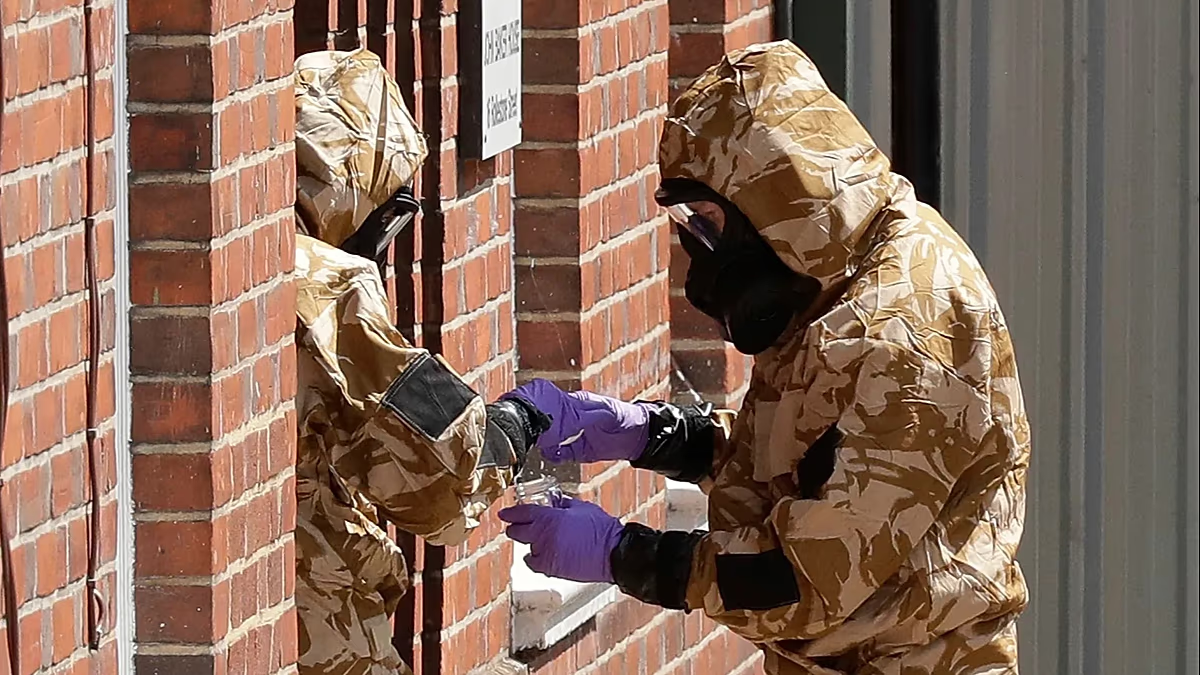
At the heart of the case was the Novichok nerve agent, a symbol of covert chemical warfare and Cold War legacy. Developed in the Soviet Union, Novichok gained global infamy after being used in the Skripal poisoning, which left Sergei Skripal and his daughter critically ill and resulted in the death of a local woman. The OPCW report that Peterlik accessed detailed the investigation into this attack, including the agent’s formula—information of immense sensitivity. Prosecutors alleged that Marsalek, in an attempt to impress business associates, flaunted documents containing the Novichok recipe, suggesting how such classified material could be misused. The presence of internal OPCW documents in these circles raised alarming questions about security breaches within international bodies tasked with policing chemical weapons. For Austria, a neutral EU nation not part of NATO, this episode underscored its vulnerability to espionage activities that exploit diplomatic and institutional channels.
The acquittal of Peterlik highlights the challenges in prosecuting high-stakes espionage cases, where evidence is often shrouded in secrecy and national security concerns. The court’s decision hinged on the prosecution’s inability to prove that Peterlik acted “without official necessity” in requesting the OPCW report. His defense likely argued that, as a top civil servant, he had legitimate reasons to access such information for diplomatic or security assessments. However, the prosecution’s appeal suggests they remain convinced of his culpability, possibly pointing to broader patterns of misconduct. This legal battle reflects the tension between transparency and confidentiality in government operations, especially in matters involving international security. For observers, it raises doubts about the effectiveness of legal systems in holding officials accountable when actions blur the lines between duty and betrayal, particularly in an era where digital leaks and state-sponsored spying are rampant.
Austria’s reputation has been repeatedly tarnished by Russian espionage scandals in recent years, and this case is another stain on its political landscape. As an EU member with a tradition of neutrality, Austria has often been viewed as a potential hub for intelligence activities, attracting foreign operatives seeking to exploit its diplomatic corridors. The involvement of figures like Ott and Marsalek—with alleged ties to Russian services—points to deep-seated infiltration that undermines national and European security. These incidents have prompted scrutiny of Austria’s intelligence protocols and its resilience against foreign interference. The trial’s outcome, while a temporary relief for Peterlik, does little to alleviate concerns about systemic vulnerabilities. Instead, it reinforces the need for robust oversight and international cooperation to combat espionage, particularly as geopolitical tensions with Russia persist.
In summary, the Peterlik case is more than a legal footnote; it is a microcosm of modern espionage, intertwining bureaucratic intrigue, chemical weapons secrets, and shadowy networks with links to Moscow. The acquittal leaves questions unanswered about how sensitive information flows and who might be exploiting it. With prosecutors appealing and related trials like Ott’s ongoing, the saga is set to continue, potentially revealing further connections. For the public, it serves as a stark reminder of the hidden battles waged in diplomatic backchannels and the enduring threat of state-sponsored subterfuge. As Austria grapples with its role in these dynamics, the episode underscores the importance of vigilance in safeguarding confidential data in an increasingly volatile global environment.