




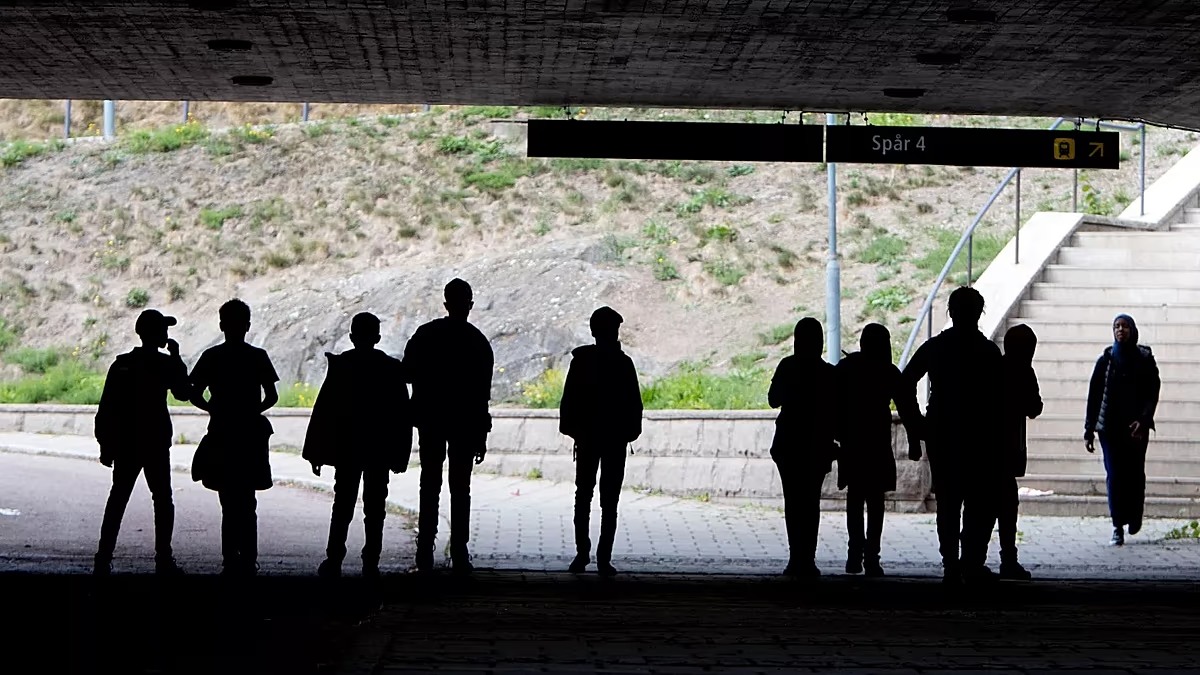
In a move emblematic of its broader policy shift, Sweden’s right-wing government is advancing a controversial new requirement that migrants must adhere to “honest living” to obtain or renew their residence permits. The proposal, part of a swift legislative push ahead of September elections, empowers the Migration Agency to assess applicants based on a broad set of behaviors. These include not only serious issues like extremist links or threats to public order but also more minor or ambiguous infractions such as incurring unmanaged debt, organized begging, welfare fraud, or working undeclared. Non-EU citizens found in breach could face deportation. Critics argue the measure is inherently discriminatory, creating a precarious legal limbo for migrants, while the government defends it as a necessary step for social cohesion.
Human rights organizations and legal experts warn that the “honest living” clause creates a perilous tiered system of rights, where non-citizens are afforded weaker protections, particularly concerning freedom of expression. John Stauffer of Civil Rights Defenders explains that while citizens enjoy robust constitutional protections, migrants could see their right to free speech weakened if their statements are deemed indicative of extremist sympathies. This uncertainty is compounded by the absence of a definitive list of violating actions, leading the Swedish Refugee Law Centre to describe the upcoming process as dangerously unpredictable. The vagueness means ordinary activities could be misinterpreted, casting a long shadow of fear over migrant communities.
This climate of unpredictability is already having a chilling effect on civil society. Activists report that individuals are withdrawing from lawful protest and advocacy work out of fear that participation could jeopardize their residency status. Frida Bengtsson of Greenpeace Sweden notes a rise in hesitancy among activists, including those trained in non-violent civil disobedience, who now question the potential immigration consequences of their actions. The law’s subjective criteria, critics contend, could effectively sanction the deportation of individuals for engaging in legitimate political dissent, thereby undermining democratic principles under the guise of maintaining public order.
Beyond the practical fears, the proposal has sparked accusations of hypocrisy. In a satirical critique, writer Gellert Tamas highlighted that if applied retroactively, the standard might ensnare members of the government themselves. He singled out Migration Minister Johan Forssell, referencing media reports that his teenage son was once a member of a known Nazi group. Tamas argued that under the law’s own logic, such a family association could be construed as having “links to an organisation promoting violence,” a point that underscores the potential for arbitrary and politicized application. This irony highlights a central critique: that the law’s vague standards are open to selective enforcement.
The “honest living” initiative is not an isolated policy but part of a sweeping decade-long overhaul of Sweden’s once generous asylum system, which began after the country received over 160,000 asylum seekers in 2015. The current government, supported by the anti-immigration Sweden Democrats, frames these measures as essential to regaining control over migration. This stance includes a stark financial strategy to incentivize voluntary returns, with a proposal to raise the repatriation grant from €900 to an astonishing €32,000 per adult—a 3,400% increase—following the program’s previous lack of uptake. Prime Minister Ulf Kristersson has repeatedly emphasized an “absolute need” for this stricter regime.
Ultimately, the debate over Sweden’s “honest living” requirement encapsulates a profound tension between national sovereignty and universal human rights. Proponents view it as a legitimate tool to demand integration and protect public security. However, for critics, it institutionalizes a two-tier society, where a migrant’s right to remain is contingent on a vaguely defined moral and behavioral test, risking arbitrary deportations and stifling free expression. As parliament considers the bill, its outcome will significantly define Sweden’s identity as a nation, determining whether its famous model of openness can coexist with a government determined to enforce a stringent new vision of civic life.