

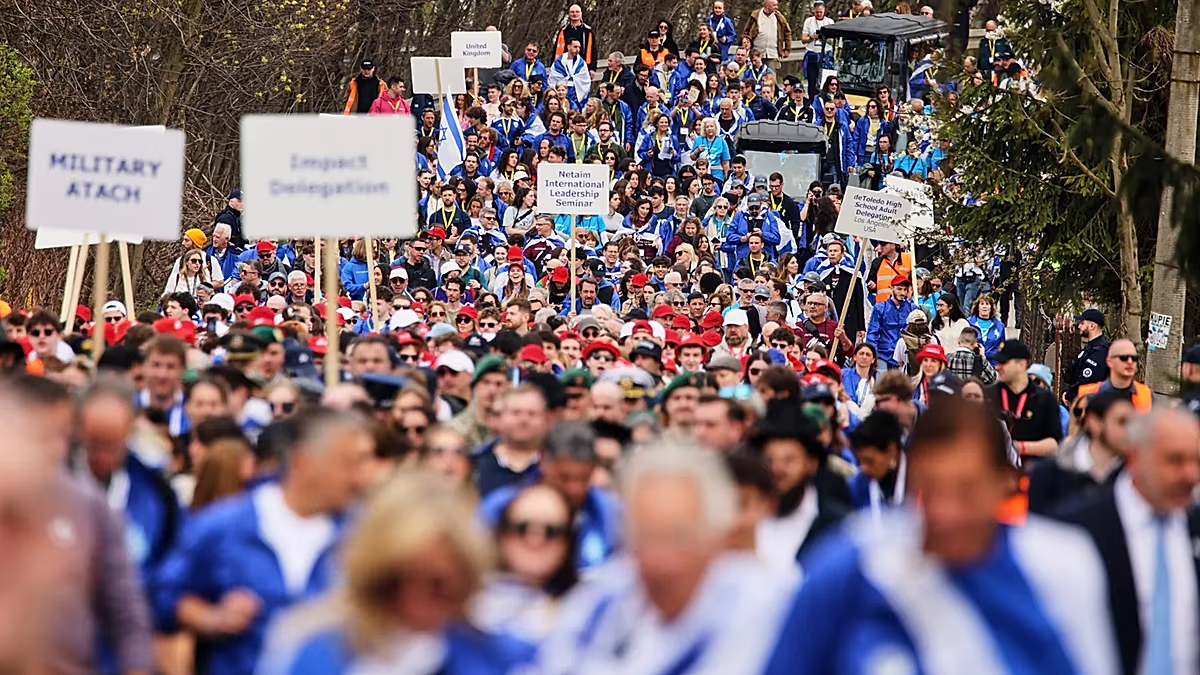
On a grey Tuesday in April, under the solemn skies of Poland, a profound act of remembrance unfolded. Holocaust survivors from around the globe, their numbers now heartbreakingly few, joined thousands of participants for the 38th annual March of the Living. The event, held at the site of the Auschwitz-Birkenau extermination camp, coincides with Yom HaShoah, Holocaust Remembrance Day in the Jewish calendar. The march itself is a symbolic journey from the iron gates of Auschwitz to the vast, haunting ruins of Birkenau three kilometers away—retracing, in reverse, the final steps of so many. This year, the gathering carried an even heavier weight, as the shadows of history seemed to lengthen and touch the present with a chilling familiarity.
The presence of the survivors, some of whom had traveled from Israel despite complex logistical hurdles due to recent regional conflict, was a living bridge between past and present. Each step they took was a testament to resilience. Yet, their very presence also underscored a painful and urgent warning voiced by organizers like Revital Yakin Krakovsky. She spoke directly to a alarming global surge in antisemitism, particularly since the October 7th attacks, stating that its scale and normalization echo the dark times that preceded the Holocaust. This was not merely a memorial for history; it was a vigil for the present, a stark declaration that the hatred that fueled the genocide has not been consigned to history books but is mutating and spreading anew.
The fusion of past and present trauma was made devastatingly concrete by the inclusion of survivors from recent antisemitic attacks. Among them was Hannah Abesidon, who attended the march after her 78-year-old father, Holocaust survivor Tibor Weitzen, was killed in the Bondi Beach massacre in Sydney. His life, shaped by one genocide, was ended in a violent act of modern hatred. Her words, “My father didn’t make it because he was a Jew. It starts with the Jews but it doesn’t end with the Jews,” hung in the Polish air, connecting the cattle cars of Birkenau to a beachside celebration in Australia. This tragic continuum gave the march a gut-wrenching immediacy, framing it not just as a tribute to the six million, but as a protest against the ongoing violence targeting their descendants.
Simultaneously, as the march proceeded in Poland, the entire nation of Israel came to a standstill in tribute. At 10:00 in the morning, a two-minute siren wailed across cities and highways. Cars stopped, drivers stood on roads, and the bustling rhythm of daily life halted in a powerful, unified act of collective memory. This moment of silence, observed annually on this Hebrew calendar date, is a visceral national ritual. It momentarily collapses time, forcing a society defined by its forward momentum to stop and inhabit a shared past of profound loss. The silence is a language in itself, speaking of a catastrophe so vast it is woven into the very fabric of modern Israeli identity.
This year’s remembrance unfolded against a backdrop of fragile regional tension, following a period of open conflict with Iran. The backdrop of war and a tentative ceasefire added another layer of anxiety and resonance to the commemorations. For many, the lessons of the Holocaust are deeply intertwined with the imperative of Jewish security and sovereignty. The sirens in Israel, therefore, mourned not only the victims who had no state to protect them in the 1940s, but also reverberated with contemporary fears and vulnerabilities. The commemorations thus existed in a tense space between mourning absolute powerlessness and affirming present-day strength, all while navigating an unstable geopolitical landscape.
In conclusion, the events of this Holocaust Remembrance Day formed a poignant diptych of grief and vigilance. In Poland, the physical march through the geography of genocide, led by survivors and those touched by new violence, was a powerful performance of memory against the tide of forgetting and hate. In Israel, the immersive, silent siren was an internalized, national meditation on that same memory. Together, they sent a unified message: that remembrance is not a passive, annual ritual, but an active, urgent duty. The survivors marching, the daughter mourning a father lost twice to hatred, and a nation pausing in silence all pleaded for the world to truly heed the central lesson of the Shoah—that unchecked bigotry is a threat to our common humanity. Their actions declared that to remember the past is to be compelled to shape a more just and vigilant present.