



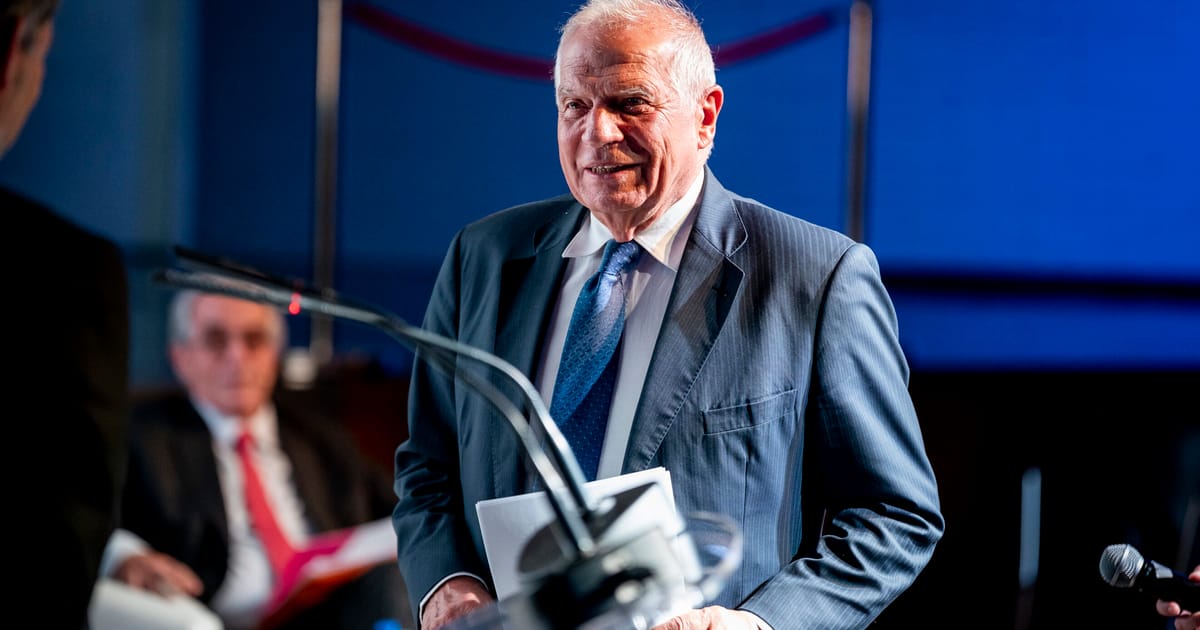
In a striking critique from a seasoned European statesman, Josep Borrell, the former European Union High Representative for Foreign Affairs, has leveled serious accusations against the current leadership of the European Commission. He contends that President Ursula von der Leyen exhibits a “systematic bias” in favor of the United States and Israel, a posture he believes comes at a direct cost to European citizens and the bloc’s strategic autonomy. Borrell points to the geopolitical fallout from conflicts involving these allies, noting how Europe has suffered from spiking energy prices while, as he recalls, former U.S. President Donald Trump openly gloated about the benefits to American oil exporters. This dynamic, for Borrell, illustrates a troubling imbalance where European policy appears subservient to U.S. interests, even when the consequences are borne by European households and industries, undermining the EU’s capacity to act as an independent global power.
Borrell extends his criticism to specific foreign policy crises, particularly the volatile situation with Iran during the Trump administration. He notes the shifting and often contradictory rationales provided by Trump for escalating tensions—from regime change to nuclear non-proliferation—which created profound instability. In this context, Borrell, a Spanish socialist who now leads the Barcelona Center for International Affairs, praises the stance of his country’s prime minister, Pedro Sánchez, who emerged as one of Europe’s most vocal critics of Trump’s strikes against Iran. Sánchez’s approach represented a willingness to diverge from the U.S. line in defense of multilateralism and de-escalation, a path Borrell clearly believes the EU as an institution should have embraced more firmly, rather than aligning so closely with Washington’s confrontational strategy.
The core of Borrell’s argument touches on the fundamental principle of consistency in international law. He directs pointed advice at his successor, EU foreign policy chief Kaja Kallas, urging her to “be clearer on condemning breaches of international law, whether done by Russia, Israel or the U.S.” His reasoning is rooted in the credibility of the European project itself: “we lose credibility [when] we use selectively international norms.” For Borrell, a rules-based global order cannot be upheld through a partisan lens; condemning the actions of adversaries while remaining silent on violations by allies fatally undermines the EU’s moral authority and its founding values. This selective application, he warns, is perceived globally as hypocrisy, weakening Europe’s diplomatic voice and its ability to serve as an honest broker in conflicts from Ukraine to the Middle East.
Borrell’s frustrations are not limited to high geopolitics but extend to concrete economic policy, where he sees the same pattern of concession. He explicitly argues that the EU should halt the ratification of a trade agreement negotiated between von der Leyen and the Trump administration. In his assessment, “The deal was unfair from the beginning,” structured to disproportionately benefit the United States. He highlights the asymmetry of the terms: “They imposed 15 percent tariffs on us and we reduce our tariffs on them.” This, in his view, is a tangible manifestation of the biased dynamic he describes—a negotiation where European interests were compromised, potentially sacrificing key economic sectors for the sake of political alignment with Washington, rather than driving a harder bargain for a truly balanced partnership.
This comprehensive critique from a former insider reveals a deep concern about the direction of the European Union under its current Commission leadership. Borrell, who has grown increasingly vocal about Israel’s campaign in Gaza and the EU’s response since leaving office, paints a picture of an institution at risk of losing its way. His comments suggest a European executive that, in seeking to maintain a transatlantic alliance at all costs, may be neglecting its duty to protect European citizens’ immediate welfare, uphold international law uniformly, and negotiate from a position of strength to secure equitable economic deals. The cumulative effect, he implies, is a diminishment of European sovereignty and a betrayal of the principled, independent role the EU is meant to play on the world stage.
Ultimately, Borrell’s analysis is a call for strategic recalibration. It is a plea for the European Union to rediscover its own voice and interests, distinct from those of its powerful allies. He advocates for a foreign policy guided by consistent principles rather than political convenience, and for trade policies that prioritize reciprocity and the economic security of member states. His remarks underscore a significant internal debate about Europe’s future: whether it will act as a cohesive, sovereign power with the courage to criticize friends and foes alike in defense of a rules-based order, or whether it will remain in a supporting role, its policies and credibility subtly eroded by perceived partiality and unequal partnerships. The path chosen will define the EU’s global standing for years to come.