



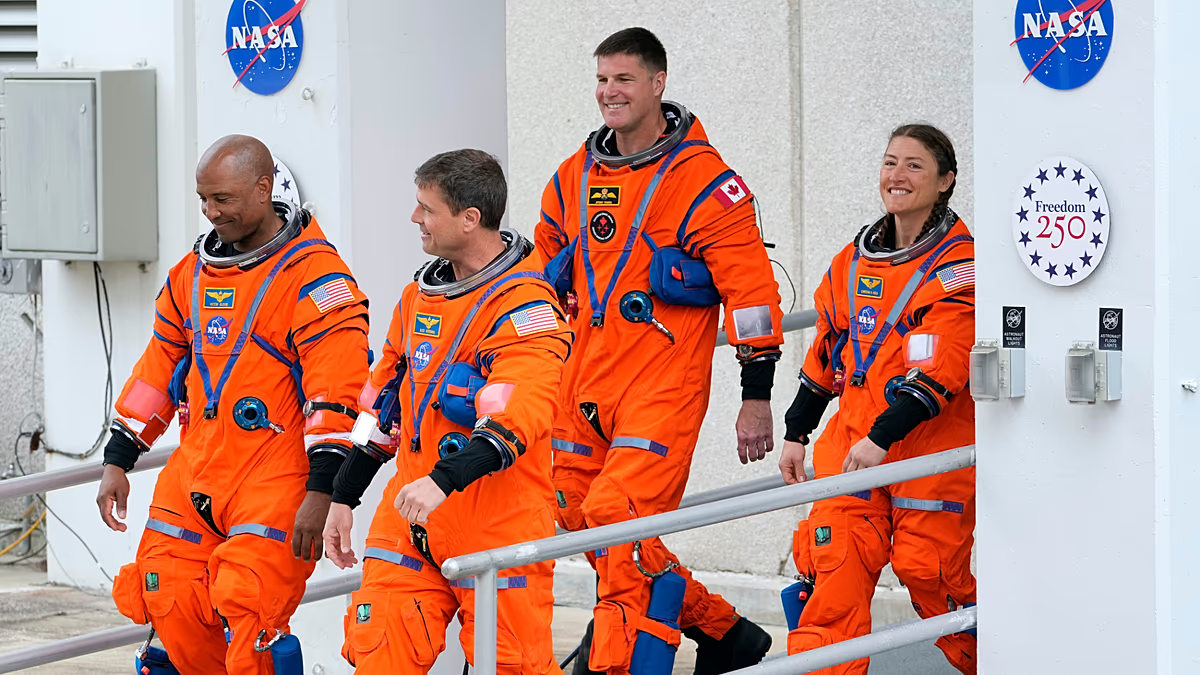
In the infinite stillness between worlds, a small, fragile vessel carrying four human hearts continues its silent ballet. On Saturday, the Artemis II crew—Commander Reid Wiseman, Pilot Victor Glover, and Mission Specialists Christina Koch (all NASA astronauts) and Jeremy Hansen (Canadian Space Agency)—awoke to another day of their historic voyage. As they stirred from sleep to the upbeat pop chords of Chappell Roan’s “Pink Pony Club,” they were approximately 272,000 kilometers from the receding Earth and closing in on the Moon at a distance of about 178,000 kilometers. Their day began with the quintessential comforts of home, scrambled eggs and coffee, consumed in a setting utterly alien. The mood, however, was one of profound focus and exhilaration. Speaking to Houston, Wiseman reported simply, “Morale is high on board.” This sense of camaraderie was deepened by a personal milestone for the commander, who had managed a call with his two young daughters. “We’re up here, we’re so far away, and for a moment, I was reunited with my little family,” he shared later, his voice thick with emotion. “It was just the greatest moment of my entire life.” In this blend of rigorous procedure and deeply human experience, the crew prepared for the celestial maneuver that awaits: their entry into the Moon’s gravitational embrace.
This journey is a monumental “Herculean” feat, as Wiseman dubbed it, representing the first human voyage to lunar vicinity in over fifty years. Their path is not one of landing, but of a crucial orbital waltz—a slingshot around the Moon that will test every system and human protocol for the planned Artemis III landing mission. The next critical threshold, expected overnight Sunday into Monday, is the moment Orion crosses into the “lunar sphere of influence,” where the Moon’s gravity becomes the dominant force pulling on their spacecraft. Beyond this point, history awaits. If all proceeds as planned, during their looping trajectory around the far side of the Moon, the crew will surpass the distance record set by Apollo 13, becoming the farthest-traveling humans in history. Yet, this mission is about more than a record; it is a deliberate and careful rehearsal. Later on Saturday, Pilot Victor Glover was scheduled to conduct a manual flying demonstration, a vital test of how humans can interact with and control the Orion spacecraft in the deep-space environment. Every action, from piloting to system checks, is a data point for the future.
A significant part of their preparation involves transforming from astronauts into observational geologists. Unlike the Apollo crews who skimmed low over specific landing sites, Artemis II offers a radically different vista. Their closest approach will be over 4,000 miles above the lunar surface, a distance that allows them to see the entire globe of the Moon—a complete, marbled sphere hanging in the black void. This unique perspective is key to their scientific objectives. The crew has undergone training to identify, photograph, and describe major lunar features like ancient lava plains and giant impact basins from this global vantage. Their photography, using both sophisticated cameras and newly approved smartphones, will capture details of the polar regions and the far side with human eyes for the first time, complementing and contextualizing the data gathered by robotic orbiters. As Christina Koch excitedly reported, they had already been gifted an early preview: “Last night, we did have our first view of the Moon’s far side, and it was just absolutely spectacular.” This was visually confirmed when NASA shared an image transmitted from Orion, pointing out specific terrain on the far left that, as program manager John Honeycutt noted, “have never been seen by human eyes until yesterday.”
Amid these epic panoramas, life inside the capsule remains a blend of awe and routine earthly challenges. The astronauts have beamed back breathtaking imagery, including a stunning full-disk portrait of Earth—a vibrant “blue marble” suspended in the expanse. These moments of sublime beauty coexist with the practical realities of living in a confined machine. One persistent issue has been the spacecraft’s toilet system, a common point of complexity in spaceflight. The crew has at times been directed to use backup urinal bags, and an attempt to jettison wastewater was thwarted, likely by a frozen blockage in the line—a troubleshooting process that is ongoing. These mundane hurdles underscore the reality that exploration is not just about grand trajectories, but about solving basic human problems in an inhuman environment. It is a testament to the crew’s professionalism that they handle these tasks with the same calm attention as they do their geological observations and system checks.
The Artemis II mission is not an end, but a pivotal opening chapter. It is the first crewed step in a sustained and ambitious program designed to return humanity to the lunar surface to stay. The data from this flight will pave the way for Artemis III, which aims to land the first woman and first person of color on the Moon. The long-term vision is profound: to establish a permanent lunar base, a proving ground and launchpad for the even more audacious dream of sending humans to Mars. Every photograph taken, every system tested, and every manual maneuver performed by Wiseman, Glover, Koch, and Hansen is part of laying this foundational stone. They are proving the spacecraft, the procedures, and human resilience for a new era of continuous deep space exploration.
Despite the immense pressure and historic weight of their journey, the human spirit aboard Orion finds moments of pure, unadulterated wonder. There is room here not just for astronauts, but for the individuals who dreamed of this since childhood. For Jeremy Hansen, the sensation of floating in microgravity fulfills a lifelong fantasy: “It just makes me feel like a little kid,” he confessed. This sentiment echoes through the capsule. They are highly trained experts executing a mission of exacting precision, yet they are also four people living out the deepest aspirations of countless generations, looking out the window at the receding cradle of humanity and the approaching, cratered sphere of a new world. In their hands, they hold cameras and checklists; in their hearts, they carry the simple, boundless joy of exploration. They are bridging a gap of half a century, not merely as technicians, but as human witnesses, bringing our eyes and our dreams back to the cosmic shore from which we once, briefly, stepped away.