



In the relentless global competition to construct ever more powerful and expansive data centers to fuel the artificial intelligence revolution, a quiet but profound alternative is emerging from the realm of biology. Instead of merely scaling up silicon, researchers are asking a radical question: could living human cells themselves become the foundation for a new kind of computing? At the forefront of this exploration is the Australian start-up Cortical Labs, which claims to have developed the world’s first device enabling users to literally “run code” on living human brain cells. This marks a significant step towards a future where computation might not be confined to chips of sand, but could integrate the very fabric of human biology.
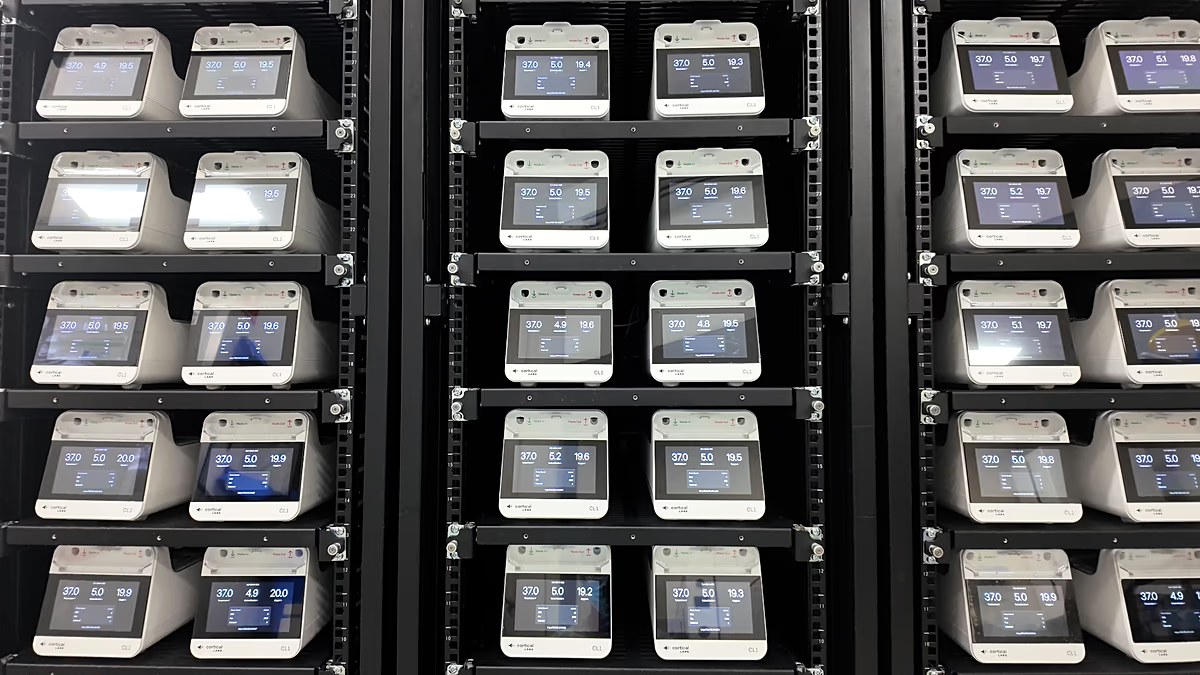
Cortical Labs’ system, dubbed CL1, represents a sophisticated fusion of wetware and hardware. It cultivates neurons from human stem cells—derived easily from a blood or skin sample—and places them on specialized silicon chips equipped with microelectrodes. These chips can both transmit electrical signals to the neurons as inputs and read their electrochemical responses as outputs, creating a closed-loop biological computing circuit. This standardized platform transforms what was once a complex, bespoke laboratory endeavor into a process achievable in hours or days. The company envisions these units being deployed in biological computing facilities, accessible remotely for applications ranging from neuroscience and disease modeling to robotics and novel AI paradigms. The goal, as expressed by Chief Scientific Officer Brett Kagan, is to engineer something entirely new, leveraging properties of biology hitherto untapped in computing.
The fundamental allure of biological computing lies in the innate efficiency and adaptability of living systems. Human neurons operate with remarkable energy frugality; our own brains learn complex concepts—like recognizing a dog—from mere handfuls of examples, whereas current AI models require tens or hundreds of thousands of data points. Biological systems also excel at processing noisy, uncertain information in dynamic ways. Integrating such cells into computing could therefore address the soaring energy demands and data hunger of conventional AI, which may be approaching practical limits. However, experts like Kagan acknowledge that traditional silicon computers remain vastly superior at fast, precise arithmetic. The true potential, therefore, is not in replacement but in integration: a hybrid future where silicon handles brute-force calculation and biological components manage adaptive, low-power learning and pattern recognition.
Yet, the path to this future is nuanced. Some researchers, such as Alysson Muotri of UC San Diego, caution that simple, two-dimensional networks of neurons, as currently used, may not yet offer decisive advantages over silicon. He suggests that more advanced, three-dimensional brain organoids—miniature, lab-grown brain-like structures—could unlock greater computational potential due to their complex architecture, though this remains deeply experimental. This technological progression naturally steers the conversation toward profound ethical considerations. The use of human cells in machines immediately prompts questions about consent, sourcing, and the nature of the biological material itself.
The ethical landscape is tiered, depending on the complexity of the biological system. For flat neuron cultures, the concerns are relatively muted, akin to those surrounding standard biomedical research. However, as Muotri warns, if researchers advance to creating sophisticated organoids with anatomical organization that mimics a brain, it raises the unsettling possibility that such a tissue “might generate some kind of experience in a dish.” This potential for emergent consciousness or sentience in a laboratory setting would necessitate new ethical frameworks, governance, and oversight. Cortical Labs positions its current work as ethically advantageous, arguing it could reduce dependency on animal testing and offer more controlled, reproducible biological models for research.
Ultimately, Cortical Labs’ CL1 device symbolizes a bold, early step into a frontier where the lines between computer and organism blur. It challenges the assumption that intelligence, whether natural or artificial, must reside solely in silicon. By harnessing the efficiency and learning prowess of human neurons, this approach seeks to complement our existing technological arsenal. While significant hurdles in scalability, capability, and ethics remain, the pursuit underscores a broader shift: the future of computing may not be found in simply building bigger data centers, but in learning to collaborate with the most powerful and efficient processing system we have ever known—the biological brain itself.