



Paragraph 1: A Global Energy Crisis Reignites the Search for Solutions
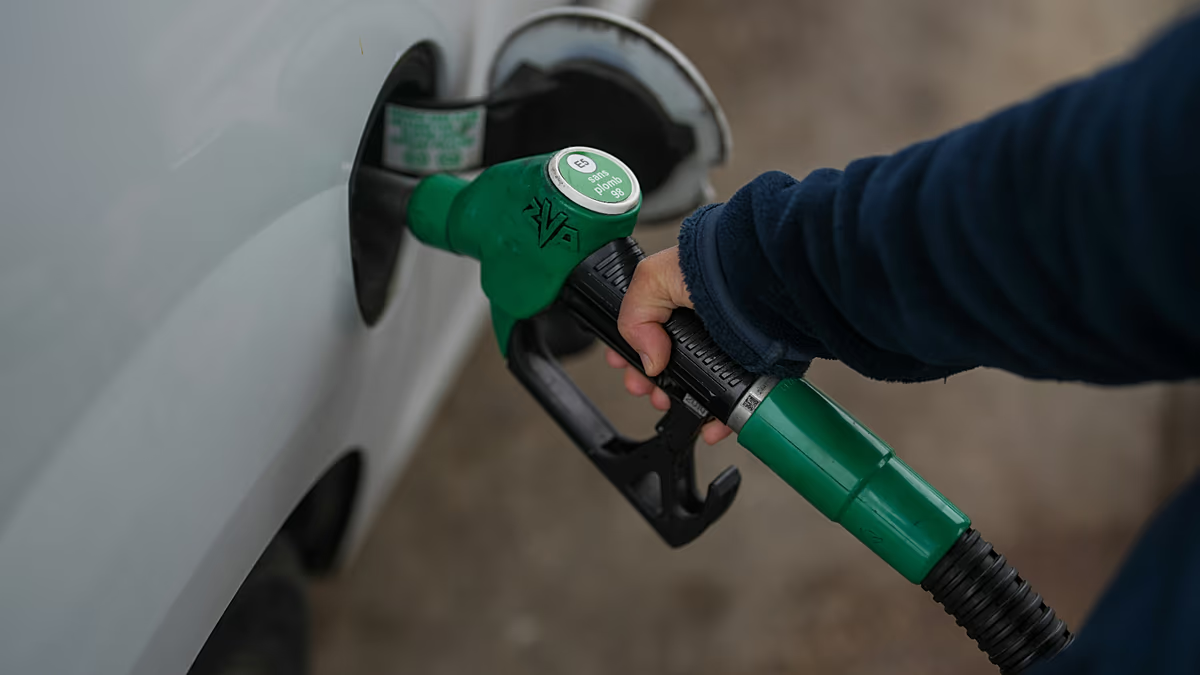
When conflict erupted in Iran in late February, the immediate shockwaves were felt far beyond the region’s borders, jolting the world’s attention back to the fragile underpinnings of global energy security. Iran’s decision to drastically curb oil shipments through the critical Strait of Hormuz—a maritime chokepoint for nearly a third of the world’s seaborne oil—created what experts have called the largest supply disruption in history. This crisis served as a stark wake-up call, particularly for Europe, forcing policymakers to confront a painful reality: an over-reliance on imported fossil fuels leaves economies and citizens vulnerable to distant conflicts and geopolitical maneuvering. The urgent question became not just how to manage the current shortage, but how to build a more resilient, self-sufficient energy future, turning the crisis into a catalyst for a fundamental re-evaluation of power sources.
Paragraph 2: The Alluring Promise of Nuclear Fusion
In this search for homegrown alternatives, alongside rapid expansions of wind, solar, and traditional nuclear fission, a more futuristic contender has gained renewed prominence: nuclear fusion. Often overshadowed by its divisive cousin, fission, fusion offers a radically different promise. While fission generates energy by splitting heavy atoms, fusion does the opposite, merging light atoms—the same process that powers the sun. According to agencies like the International Atomic Energy Agency (IAEA), fusion’s potential is staggering; it could yield up to four million times more energy per kilogram than burning coal and four times more than nuclear fission, all while producing no carbon emissions or long-lasting radioactive waste. It’s also considered inherently safer and could provide constant, predictable power, unlike weather-dependent renewables. The catch? This stellar promise remains just that—a promise. The immense challenge of achieving and sustaining a fusion reaction that gives out more energy than it consumes has, so far, kept it in the realm of ambitious experiments rather than power grids.
Paragraph 3: A German Startup Betting on an Unusual Design
Among the vanguard of scientists and engineers racing to turn fusion promise into reality is Proxima Fusion, a Munich-based startup born from prestigious German research. Their approach sets them apart from major international projects like ITER, which use a device called a tokamak. Instead, Proxima is betting on a less common design known as a stellarator. Both are complex, doughnut-shaped machines that use powerful magnetic fields to contain a super-hot, electrically charged gas called plasma—the environment where fusion occurs. The key difference lies in stability. As Proxima’s CEO, Francesco Sciortino, explains, stellarators are fiendishly difficult to design and build, but they offer a crucial advantage: they can theoretically operate in a steady, continuous state, unlike the pulsed operation of tokamaks. This intrinsic stability, proponents argue, makes stellarators a potentially superior blueprint for a future power plant that needs to run reliably around the clock.
Paragraph 4: The Roadmap from Experiment to Commercial Power
Proxima’s vision involves a clear, two-step path. The first milestone is “Alpha,” a demonstrator device currently in manufacturing, slated for operation in the early 2030s. Alpha’s core mission is to prove the stellarator can achieve the holy grail of “net energy gain.” Following that, the ambition leaps to “Stellaris,” envisioned as the world’s first commercial fusion power station, targeted for the latter half of the 2030s. The planned site is symbolically significant: Gundremmingen, the location of a former German nuclear fission plant. This shift from old nuclear to new embodies a national strategy. After phasing out fission in 2023, Germany has now committed over €2 billion to accelerate fusion development, seeing it as a keystone for future energy sovereignty. For Sciortino, this isn’t just about one company’s success; it’s about sparking an entire new industry. Success hinges on building a robust supply chain and collective momentum to advance the entire field faster than ever before.
Paragraph 5: Fusion as Europe’s Strategic Opportunity
This push for fusion is framed not just as a scientific endeavor, but as a strategic economic opportunity uniquely suited to Europe’s predicament. Europe lacks the abundant natural gas or oil reserves of other continents, and its renewable manufacturing, like for solar panels, has often been outsourced. “Fusion offers a spectacular economic opportunity for Europe more than for any other continent,” Sciortino argues, “because of our need for sovereignty.” He posits that fusion could provide the constant, massive baseload power that complements renewables, all generated domestically. This vision positions fusion as the ultimate solution for energy independence—a clean, safe, and virtually limitless source of power that could shield Europe from external market shocks and resource dependencies, turning a historical vulnerability into a defining strength.
Paragraph 6: Navigating a Sea of Optimism with a Dose of Caution
Despite the palpable excitement and significant investment, a chorus of caution urges tempering expectations. Critics point to the immense technical hurdles and, crucially, the uncertainties surrounding eventual cost. A recent study in Nature Energy challenged overly optimistic projections about how quickly fusion’s costs would fall as the technology develops. Researchers like Lingxi Tang from ETH Zurich note that prior estimates of rapid cost reductions may be inflated by “optimism bias,” a tendency in investment circles to favor rosy scenarios. His analysis suggests the pace of cost decline may be much slower than hoped. This skepticism serves as a vital counterbalance, reminding us that the journey from lab-scale breakthrough to affordable, grid-ready electricity is a marathon littered with challenges. The race for fusion is not just a race to ignite a star in a bottle, but a race to prove it can be done practically and economically, making the dream of limitless clean energy a tangible cornerstone of our future.