


Paragraph 1
We have, at last, returned to deep space. For over fifty years, human exploration has been confined to the orbital embrace of our home planet. Now, the Artemis II mission, having reached its midway point, has definitively broken that long silence. In mere days, the spacecraft Orion has accomplished profound milestones: slipping behind the Moon, enduring a planned and profound silence as communication with Earth was lost for forty minutes, and achieving a staggering distance of over 252,000 miles from home. This is not just a new record; it is a symbolic crossing of a threshold, placing our astronauts farther into the cosmic ocean than any humans have ever been before.
Paragraph 2
The silence of that loss of signal was a powerful reminder of the mission’s solitude and daring. When communications were restored, astronaut Christina Koch’s voice was a bridge across that vastness. Her words, “It is so great to hear from Earth again… We will always choose Earth, we will always choose each other,” distilled the essence of this journey. It is a testament to human curiosity and courage, but also a profound declaration of our connection to one another and to the fragile, beautiful world we have temporarily left behind. This mission is not about escape; it is about reflection and return, underscored by the very act of re-establishing that link home.
Paragraph 3
The lunar flyby is the technical heart of this journey, a critical rehearsal for NASA’s ambitious Artemis program. The ultimate goal is a sustained return to the Moon’s surface, targeting the mysterious and resource-rich south pole. But Artemis II is about the path, not the destination. Commander Reid Wiseman spoke of witnessing “sights that no human has ever seen,” while Pilot Victor Glover found himself beyond words, admitting there were “no adjectives” to capture the experience. This speaks to the fundamental novelty of the voyage—it is a re-acquaintance with deep space, a re-learning of what it means to travel and perceive at such a scale, preparing both the technology and the human spirit for what lies ahead.
Paragraph 4
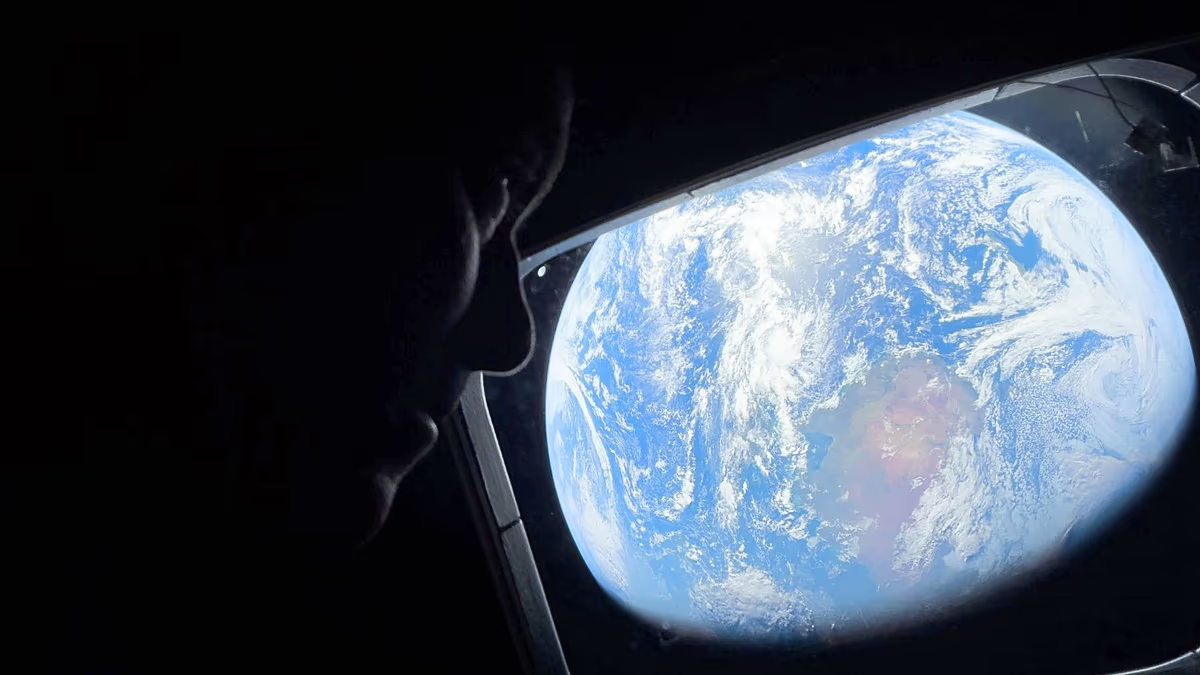
Yet, where language falters, imagery prevails. The photographs transmitted across that quarter-million-mile gulf are the mission’s true voice, and they have been spectacular. They offer awe-inducing vistas of Earth—not as a map, but as a living, suspended globe marbled with clouds and oceans, framed by the absolute black of space. They provide new perspectives on the Moon itself, casting its familiar face in unfamiliar shadows and light. And most humanly, they capture the intimate, everyday moments of four individuals in their compact habitat: working, observing, and living together in this extraordinary environment. These images are the universal translation of their unique experience.
Paragraph 5
The selection of images serves multiple, vital purposes. For science and engineering, they are data. For the public, they are inspiration, rekindling a sense of wonder and shared purpose in exploration. For history, they are documentation of a pivotal moment: the point at which humanity resumed its outward journey. They transform abstract mission milestones into tangible, emotional reality. Seeing the crescent Earth from such a distance underscores both our planet’s insignificance in the void and its supreme importance to us. Observing the crew in their routine normalizes the profoundly abnormal, making the leap into deep space feel more relatable, more human.
Paragraph 6
Artemis II, therefore, stands as a multifaceted triumph. It is a formidable engineering success, pushing hardware and systems to new limits. It is a vital stepping stone, building confidence for landing missions and future voyages to Mars. But perhaps most significantly, it is a cultural and philosophical reawakening. By sending astronauts back beyond Earth’s immediate vicinity, by sharing the sublime views from that vantage, and by hearing their reflections on home and companionship, NASA has reignited a deep-space narrative for humanity. The mission reminds us that exploration is not merely a technical checklist; it is a journey that expands our perspective, tests our bonds, and ultimately, as Koch affirmed, reinforces why we choose to come back to each other, and to Earth.