



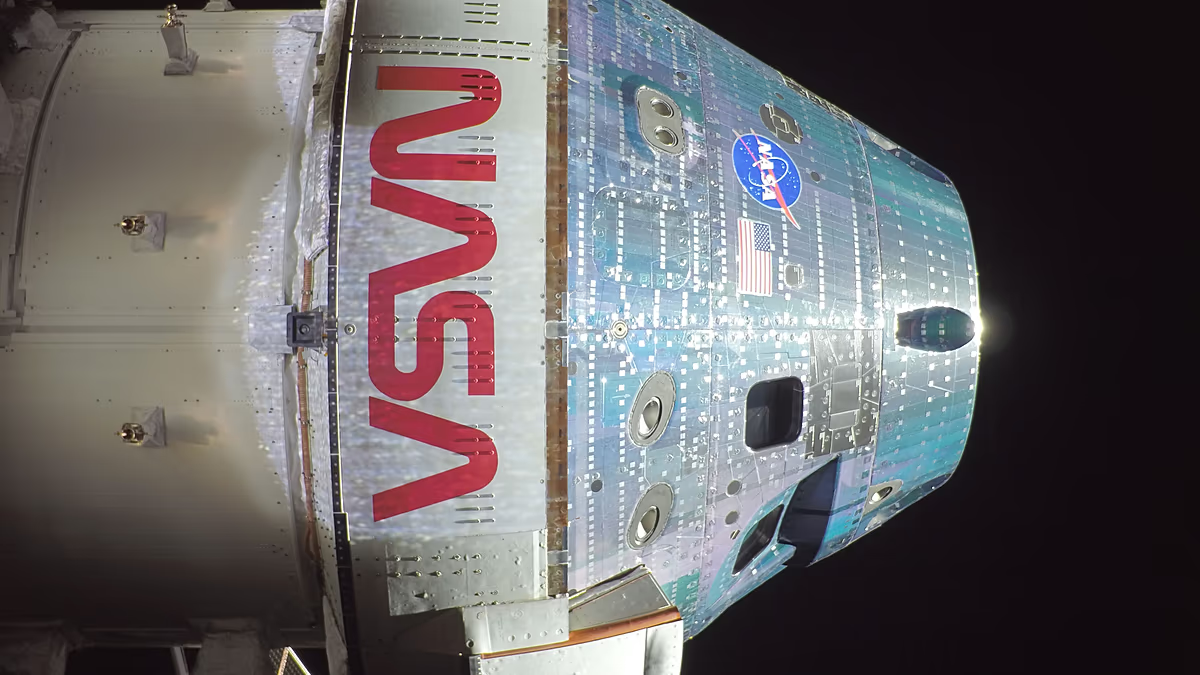
After a historic journey that saw them become the first humans in over half a century to voyage to the vicinity of the Moon, the four astronauts of NASA’s Artemis II mission now brace for the climax of their ten-day odyssey: the fiery, high-stakes return to Earth. This final act, a dramatic thirteen-minute plunge from the edge of space, will push their spacecraft and their courage to the limit. Having completed a record-breaking lunar flyby, their focus has sharply pivoted from the awe of deep space to the intricate, dangerous ballet of re-entry. As astronaut Victor Glover poignantly reflected, he has been contemplating this moment since his selection over three years ago, describing the anticipated descent as “riding a fireball through the atmosphere.” The coming hours will transform that metaphor into a stark, visceral reality.
Preparation for this ultimate test is a meticulous, step-by-step process. In the days leading to their return, the crew has already executed precise maneuvers, including a trajectory correction burn to fine-tune their path toward a specific splashdown zone off the coast of California. They have tested specialized suits designed to combat the physical shock of returning to Earth’s gravity, a condition known as orthostatic intolerance. On the mission’s ninth day, they will manually orient their Orion spacecraft, positioning it to maximize solar power and align for the final approach. Then, on the tenth day, the countdown truly begins. About twenty minutes before the atmosphere greets them, the service module—their life-support system during the mission—will separate and meet its own fate, burning up in the atmosphere. The crew will then perform a final “raise burn,” their last chance to adjust course before lowering their visors and sealing themselves within their protective suits, isolated as they begin the irreversible fall home.
The re-entry itself is a spectacle of extreme physics and human engineering. Orion will slice into the Earth’s atmosphere at an altitude of roughly 400,000 feet, southeast of Hawaii, and must travel nearly 2,000 miles to its target in the Pacific. As flight director Rick Henfling noted, “That’s where the fun really begins.” Mere seconds after contact, the spacecraft will be enveloped in a sheath of superheated plasma, triggering a communications “blackout” that will sever the crew’s link with NASA for approximately six anxious minutes. During this period, they will be utterly alone, protected only by the world’s largest heat shield as external temperatures soar to an incredible 2,760 degrees Celsius. This shield is their guardian against the fireball, allowing Orion to blaze a safe path through the inferno.
Following the blackout, at an altitude of 150,000 feet and still moving at tremendous speed, the focus shifts to a delicate, sequential deceleration. The choreography of slowing a capsule from orbital velocity to a gentle ocean landing is paramount. First, two small, seven-meter drogue parachutes will deploy at 25,000 feet, stabilizing Orion and slowing it to about 494 kilometers per hour. Then, three massive main parachutes will unfurl, further braking the spacecraft to a mere 38 kilometers per hour—a pace suitable for a soft splashdown. The entire descent, from atmospheric entry to touching the water, will last just thirteen minutes. “It’s going to start quickly, and it’s going to be over even faster,” Henfling remarked, underscoring the intense, compressed nature of this final ordeal.
Upon splashdown, a well-orchestrated recovery operation springs into action. Led by Landing and Recovery Director Liliana Villarreal, a team aboard the USS John P. Murtha will be stationed a safe distance away. After swift environmental assessments, small boats will approach the capsule, open the hatch, and assist the astronauts onto an inflatable raft nicknamed the “Front Porch.” Here, the crew will await helicopters that will airlift them to onboard medical facilities for immediate checkups. Villarreal expressed confidence, based on the success of the uncrewed Artemis I test, stating the goal is to recover the crew and deliver them to medical care within two hours of splashdown. Meanwhile, the Orion capsule itself will be hoisted onto the recovery ship and transported to a Navy base within 24 hours, before beginning its journey back to NASA in Florida for post-mission analysis.
This mission represents more than a technical triumph; it is a profound human milestone. The astronauts’ descent encapsulates the pinnacle of risk and reward in space exploration—a controlled plunge through an atmospheric furnace, followed by a serene parachute descent into the waiting arms of their support team. While NASA has contingency plans for alternative landing sites if problems arise, the primary goal remains that precise splashdown off San Diego. For the crew, the fiery re-entry is the concluding, breathless chapter of an journey that has forever expanded human horizons. Their safe return will not only mark the successful completion of Artemis II but will also ignite the momentum for future missions, paving the way for humanity’s sustained return to the lunar surface and beyond.