

The Final Bow: Viktor Orbán’s Absence Marks a Symbolic End
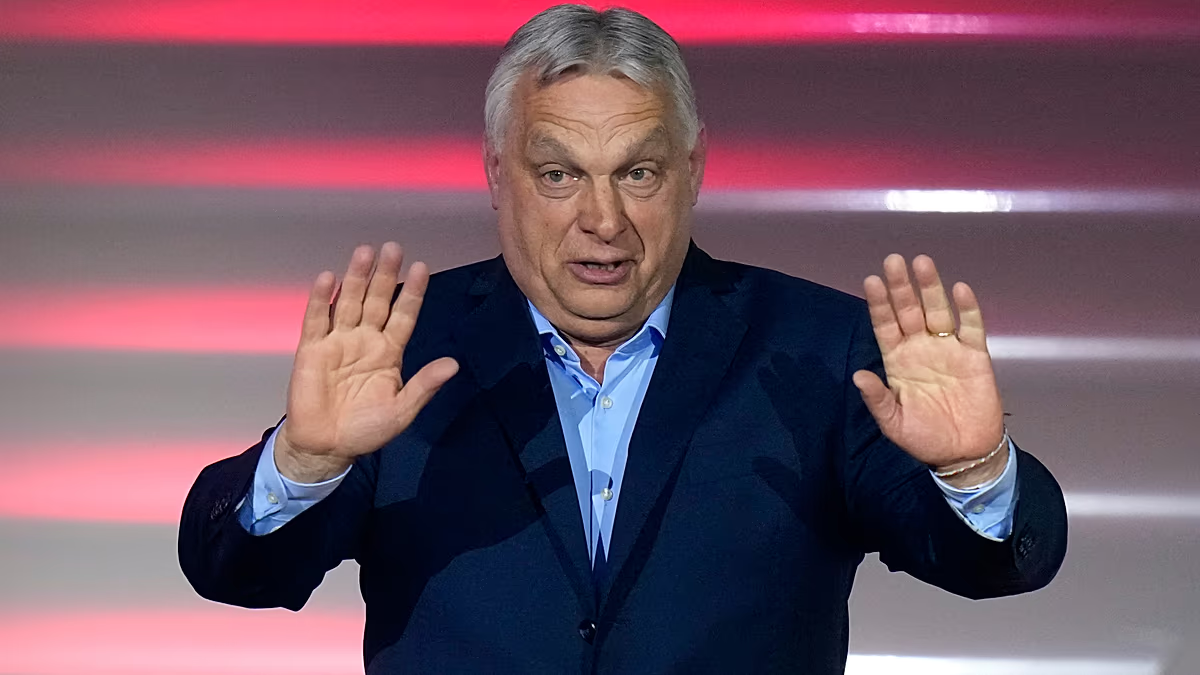
A quiet but significant shift is occurring within the corridors of European power. Outgoing Hungarian Prime Minister Viktor Orbán, a figure who has dominated the European political landscape for over a decade, will not attend next week’s informal summit of European Union leaders in Nicosia, Cyprus. This decision, confirmed by several EU officials, breaks with a long-standing tradition in Brussels where departing leaders are afforded a formal farewell by their peers—a gesture of appreciation complete with a symbolic token. For Orbán, who was decisively defeated in Sunday’s parliamentary elections, this would have been his final summit as prime minister, a customary curtain call after fourteen years of contentious but central presence. His absence speaks volumes, transforming a routine diplomatic ritual into a pointed symbol of his impending departure from the European stage.
A Transition of Power and a Broken Tradition
Orbán remains in office for now, a caretaker until the victor of the election, opposition leader Péter Magyar—who won by a landslide—assumes power sometime in May. Officials familiar with the summit preparations have stated they no longer expect Orbán to participate. The broken tradition is more than a mere scheduling note; it is a clear signal that the political winds have changed. Until his dramatic defeat, Orbán was the longest-serving member of the European Council, a veteran of countless meetings since his rise to power in 2010. His tenure was marked by a combative style that often placed him at odds with the EU’s mainstream. It is not yet clear if Hungary will be represented by another leader, such as Slovak Prime Minister Robert Fico, an ideological ally who has previously stood in for Orbán. This vacancy itself underscores the uncertainty surrounding Orbán’s final acts in office.
The Last Summit: A Legacy of Conflict
Orbán’s decision means his last physical summit appearance was the contentious meeting in March 2024. That gathering, rather than being a celebratory finale, was instead a scene of stark confrontation. Orbán faced harsh, unified criticism for his unilateral veto of a crucial €90 billion loan package for Ukraine. This move, seen by many as leveraging a crisis for domestic political gain, shattered a painstakingly negotiated agreement reached by all 27 leaders the previous December. At that December summit, Orbán had secured an opt-out for Hungary from the joint borrowing, but his subsequent veto—linked to demands regarding the interruption of Russian oil supplies through the Druzhba pipeline—was viewed as a profound breach of trust.
A Rare Rebuke: The EU’s Collective Frustration Erupts
The reaction in March was unusually forceful, even for the often-fractious European Council. António Costa, the typically mild-mannered President of the European Council, publicly slammed Orbán’s actions as “unacceptable.” Costa’s words, venting months of accumulated frustration, laid bare the collective exasperation: “The leaders took the floor to condemn the attitude from Viktor Orbán, to remember that a deal is a deal and all the leaders need to honour that word,” he stated. He concluded with a principle that resonated deeply in the room: “Nobody can blackmail the European Council. Nobody can blackmail the European Union institutions.” This public rebuke was a milestone, representing a moment where Orbán’s habitual political brinksmanship crossed a line, prompting a rare, unified stand from his fellow leaders.
The Incoming Voice: A Call for Resolution
The political transition within Hungary itself now adds pressure to resolve this stalemate. Péter Magyar, the incoming prime minister, has already called on Orbán to lift the veto on the Ukraine aid before vacating his office. This creates a poignant dynamic: the outgoing leader, wounded by electoral defeat, holds a key to a major European policy, while the incoming leader seeks a cleaner slate and a return to cooperative norms. Magyar’s request highlights the practical and symbolic burdens Orbán’s final actions carry, not just for Hungary’s international standing, but for European solidarity in support of Ukraine. The unresolved veto hangs as a shadow over Orbán’s legacy and a test for Magyar’s future diplomacy.
An Unceremonious Exit and a New Chapter
Therefore, Orbán’s absence from the Cyprus summit is far more than a simple no-show. It means his final, memorable act within the EU conclave was one of isolation and condemnation, rather than camaraderie and farewell. The skipped summit denies him the ceremonial send-off, rendering his exit unceremonious and defined by the conflict of his last appearance. This conclusion to his long era reflects the ultimate cost of his confrontational approach: a departure marked by estrangement rather than esteem. As the EU prepares to welcome a new Hungarian voice, the episode underscores a hope among European leaders for a less adversarial relationship, while closing the book on a chapter defined by one man’s relentless, and often disruptive, political defiance.