



Paragraph 1
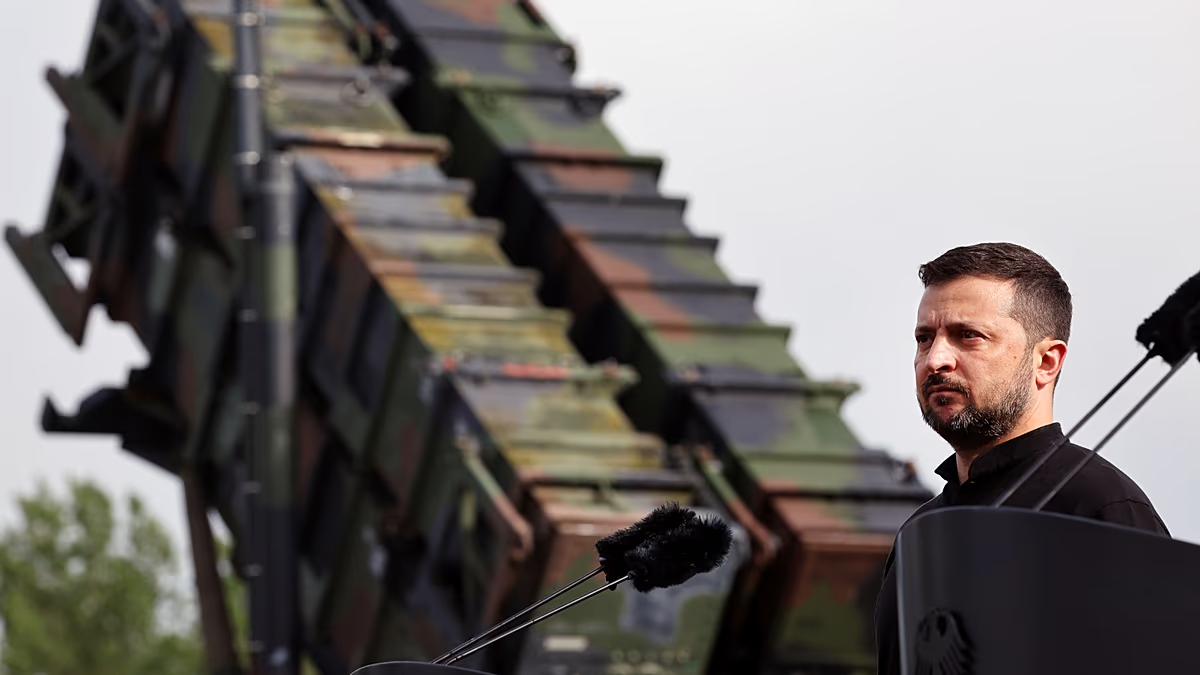
In a stark and sobering assessment, Ukrainian President Volodymyr Zelenskyy has declared that his nation’s shortage of Patriot air defence missiles has reached a critical breaking point. Speaking during a visit to Germany, Zelenskyy framed the situation in the most dire terms possible to the national broadcaster ZDF, stating plainly, “The situation is in such a deficit, it could not be any worse.” This admission underscores a terrifying vulnerability for Ukraine as it continues to defend its cities and infrastructure against relentless Russian bombardment. The Patriot system, produced exclusively in the United States, represents the most effective shield Ukraine possesses against the most devastating threats, particularly Russian ballistic missiles. Without a steady and robust supply of these interceptors, the Ukrainian sky becomes dangerously exposed, leaving millions of civilians and critical energy grids, military sites, and urban centres tragically undefended.
Paragraph 2
Compounding this immediate crisis is a broader geopolitical shift that is draining the well of international support. Zelenskyy openly acknowledged that the ongoing war in the Middle East has directly and negatively impacted Ukraine’s prospects for receiving vital military aid. Global attention and, more importantly, Western stockpiles of advanced weaponry are being stretched and diverted, creating a painful competition for resources at the worst possible time for Kyiv. This reality marks a significant and dangerous evolution in the conflict. The early, unified front of Western support has fractured, and Ukraine now finds itself not only battling Russian forces on the ground but also navigating a complex and increasingly distracted international political landscape where its existential struggle must fight to remain a priority.
Paragraph 3
Faced with this precarious dependence on external aid, Ukraine is urgently pursuing a path to self-reliance in its most critical defensive capability. Zelenskyy has explicitly labelled the development of a domestically manufactured anti-ballistic air defence system as a strategic priority of the highest order. “The unconditional task is our own air defence which will be able to fight against ballistics,” he stated, framing it as a non-negotiable goal for national survival. Ukrainian arms producer Fire Point has announced it is working on such a system, aiming for readiness by next year, and is actively seeking European partnerships for key technologies like radar and targeting. This ambitious endeavour represents a long-term vision to secure Ukrainian sovereignty, but it is a race against time, offering no solution for the acute shortage plaguing the country today.
Paragraph 4
The current gap in Ukraine’s defences is exacerbated by a fundamental shift in American policy. While European nations stepped up significantly in 2025, becoming the primary source of military assistance—including funding the purchase of Patriot interceptors from US stocks—the political will in Washington has evaporated. This was starkly illustrated by US Vice President JD Vance, who expressed pride in the Trump administration’s decision to cut off funding for weapons to Ukraine. At a political event, Vance asserted that telling Europe to handle the burden themselves was “one of the things I’m proudest that we’ve done.” As a leading critic of aid within the administration, his comments crystallize a new US stance of strategic disengagement, placing the entire onus of Ukraine’s defence on European capitals and leaving Kyiv in a precarious limbo between allies.
Paragraph 5
This confluence of factors—the desperate shortage of missiles, the global diversion of resources, and the withdrawal of US leadership—creates perhaps the most perilous moment for Ukraine since the early days of the full-scale invasion. The nation is caught in a dangerous transition: its vital, battle-proven Western shields are depleting faster than they can be replenished, while its own domestic solutions remain on the drawing board, months or years from deployment. Every day without adequate air defence is a day where Russian missiles and drones have a higher probability of reaching their targets, with catastrophic humanitarian and strategic consequences. The courage of Ukrainian soldiers and citizens is now being tested against a grim equation of physics and logistics, where the count of available interceptors may soon dictate the limits of national protection.
Paragraph 6
Ultimately, Zelenskyy’s stark warning from Germany is more than a plea for missiles; it is a chilling diagnosis of a new phase in the war. The conflict has matured from a sudden blast of violence into a protracted war of attrition, where sustained industrial production and unwavering political commitment are as decisive as battlefield manoeuvres. Ukraine’s urgent push for its own air defence industry is a testament to its resilience and understanding of this reality. However, the brutal interim period it now faces highlights a tragic paradox of modern warfare: a nation can possess the will to fight and the skill to defend itself, yet still find its fate hinging on political decisions made in distant capitals and the slow pace of developing its own complex military technology. The coming months will reveal whether European allies can bridge the gap left by the United States and whether Ukraine can survive the race against time to defend its own skies.