


Of course. Here is the summary and humanization of the provided content, structured into six paragraphs.
In a stark and deliberate escalation of rhetoric, the Russian Defence Ministry has publicly listed European manufacturers it alleges are producing drones for Ukraine. Published on April 16th, 2026, the statement frames these joint ventures as a direct “step towards escalation.” The ministry contends that this collaboration risks “increasingly dragging European countries into war,” transforming them into Ukraine’s strategic rear. This move represents a significant shift from military action to a form of public diplomatic pressure, intended to sow division and fear within European societies supporting Ukraine.
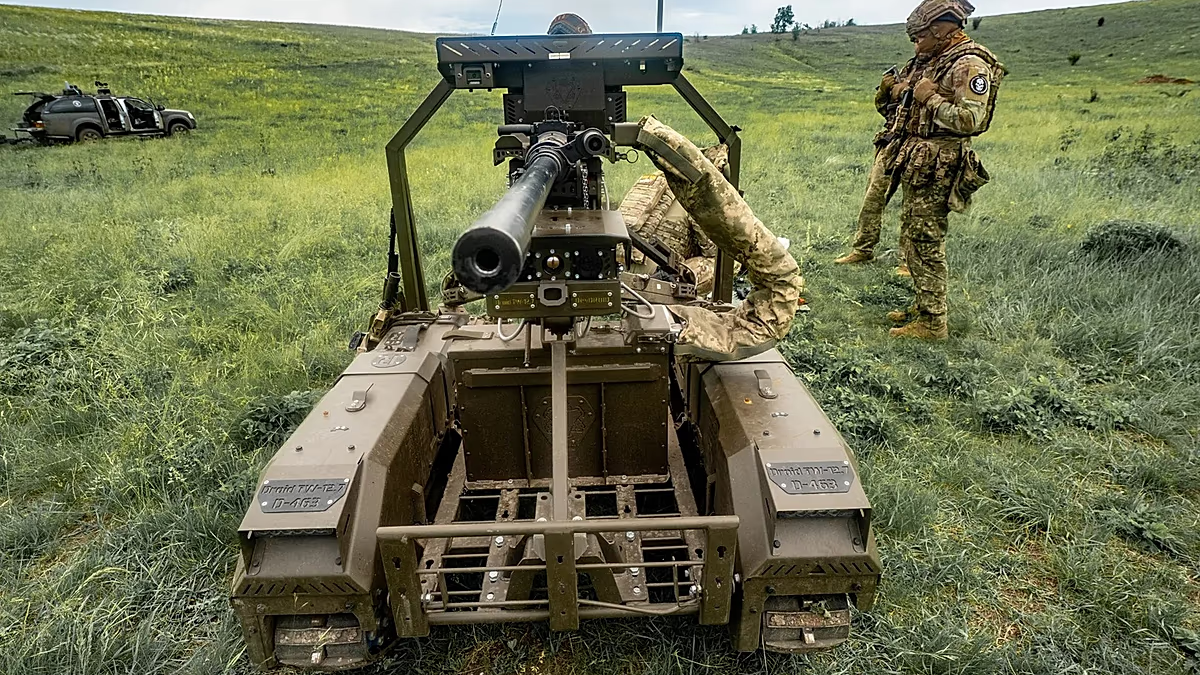
The ministry’s core accusation is that, in late March, leaders of several EU nations decided to ramp up the production and supply of drones destined for Ukrainian use in strikes on Russian territory. According to the Russian statement, this decision is a deliberate act leading to a “sharp escalation” across Europe. It warns that the use of these European-made drones against Russia could lead to “unpredictable consequences.” The language is deliberately ominous, designed to project a narrative of European aggression rather than Russian invasion, and to imply severe retaliation.
To make this threat tangible, the ministry did not merely issue a general warning. It explicitly published a list of what it claims are addresses and locations of “Ukrainian” and “joint” enterprises producing UAVs and components on European soil. The ministry stated that the European public must “clearly understand the true causes of threats to their security” and, crucially, “know the addresses.” This list reportedly includes 11 branches of alleged Ukrainian companies, with locations identified in the United Kingdom, Denmark, Germany, and Latvia, as well as 10 companies in Germany, Spain, and Italy.
The publication of this list was immediately underscored by a chilling statement from a high-ranking Russian official. Deputy Chairman of the Russian Security Council, former President Dmitry Medvedev, declared that the information “should be perceived as a list of potential targets for the Russian Armed Forces.” On social media, he reinforced this, stating the ministry’s announcement should be understood “extremely literally” as a “register of potential legitimate targets.” This transforms the ministry’s diplomatic warning into an explicit military threat, suggesting that these civilian manufacturing sites in Europe could be considered valid for Russian strikes.
This Russian warning comes at a time when European support for Ukraine is deepening, moving beyond simple aid transfers to integrated industrial cooperation. Ukrainian President Volodymyr Zelensky has recently signed agreements with Germany and Norway for the joint production of drones. Italian Prime Minister Giorgia Meloni, after meeting with Zelensky, affirmed that “Supporting Ukraine is not only a moral duty, but also a strategic necessity,” recognizing that “Europe’s security is at stake.” These developments highlight a Western commitment to sustaining Ukraine’s defence through long-term partnerships, directly countering the Russian narrative of mere intervention.
Ultimately, Russia’s publication of the manufacturer list and associated threats is a multifaceted strategy. It is an attempt to intimidate European governments and their publics by directly linking support for Ukraine to potential physical retaliation on their own territory. It seeks to frame European aid as the primary cause of escalation, obscuring the origin of the conflict in Russia’s own invasion. This psychological and informational tactic aims to create hesitation and division within the European alliance supporting Ukraine, testing its resolve by raising the specter of direct, costly consequences for their continued solidarity.