


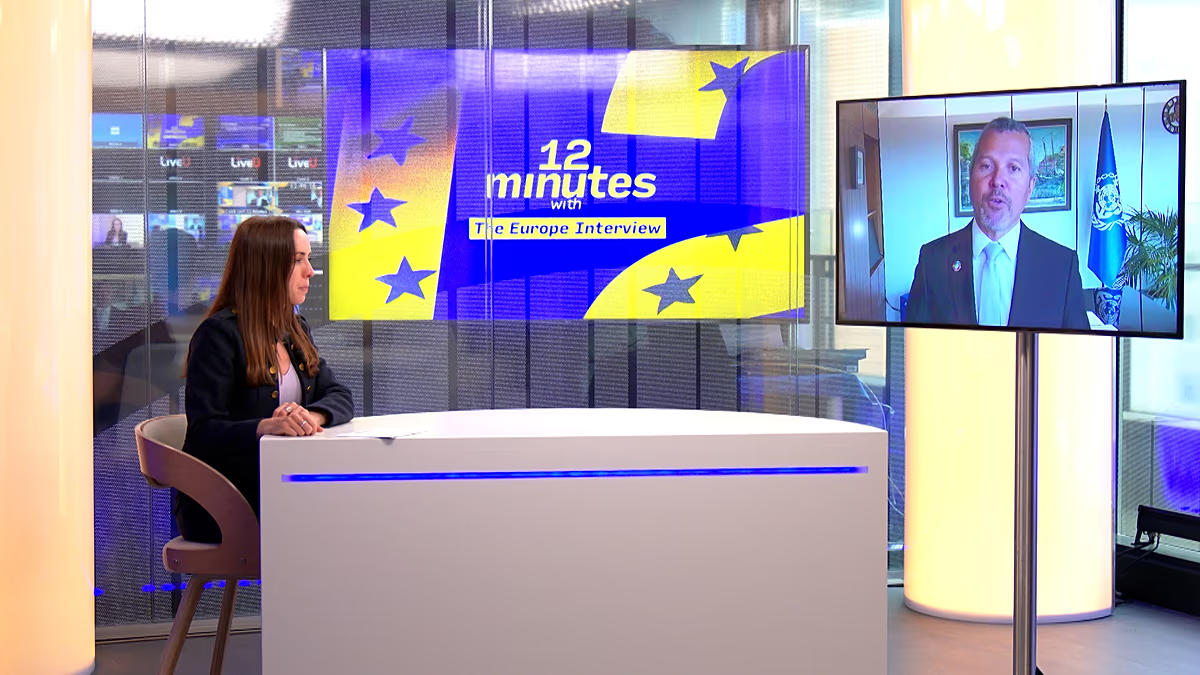
In a stark warning amid heightened tensions in the Middle East, the head of the United Nations’ maritime agency has forcefully defended the principle of free navigation on the world’s seas. Arsenio Dominguez, Secretary-General of the International Maritime Organisation (IMO), stated unequivocally to Euronews that no nation holds the right to block transit through internationally recognized waterways. His comments come as the United States, in an effort to exert economic pressure on Tehran, has deployed its navy to effectively blockade Iranian ports. This move is a direct response to Iran’s own actions in closing the vital Strait of Hormuz, a choke point for global energy supplies. Dominguez framed the issue in clear legal terms, noting there exists “no international law agreement that allows any country to prohibit the freedom of navigation on straits used for international navigation,” and called for urgent de-escalation to restore the flow of shipping.
The stakes of this geopolitical standoff are immense, rippling far beyond the Persian Gulf. Since the conflict erupted in late February, the Strait of Hormuz—a corridor through which approximately one-fifth of the world’s crude oil and liquefied natural gas passes—has been functionally closed to normal traffic. Where an average of 138 vessels once transited daily, shipping data now indicates fewer than 300 have made the passage in total over several weeks. This dramatic collapse in traffic has sent shockwaves through the global economy, disrupting energy markets and threatening the stability of worldwide supply chains. Dominguez shed light on a specific operational danger, revealing that Tehran has unilaterally established a new shipping corridor within the Strait, different from the IMO-approved lanes coordinated with Oman. He expressed grave concern, stating he has no information on the safety of either the new or the official routes, creating a perilous environment for any vessel attempting to navigate these waters.
Despite the current deadlock, the IMO is preparing for the day when peace allows for the restoration of normal operations. Dominguez detailed that a tried-and-tested traffic management scheme, agreed upon by Iran and Oman and in place since 1968, remains ready for immediate reactivation. “It’s ready to resume operations,” he assured. However, he stressed that technical preparations alone are insufficient; the physical security of ships and, most importantly, their crews must be guaranteed before navigation can safely recommence. These operational blueprints have been shared with both the United States and Iran, underscoring the IMO’s role as a neutral technical facilitator. This groundwork is gaining diplomatic support, with France and the United Kingdom set to co-host a multinational summit to strategize the Strait’s reopening, an initiative Dominguez praised as “multilateralism in the way that we need it.”
Central to Dominguez’s message was a powerful critique of the weaponization of global shipping. He rejected the use of maritime trade as “collateral” in political and military conflicts, arguing that the freedom of navigation is a principle that must be upheld by “every single country” to serve the needs of the entire global population. He connected the abstract concept of sea lanes directly to daily life, explaining that the moment shipping is disrupted, everyone on the planet feels the negative impact. His plea was for recognition of shipping as the indispensable circulatory system of the world economy, one that should remain insulated from geopolitical strife. The blockade and closure, therefore, are not merely regional issues but acts with universal consequences, punishing consumers and industries thousands of miles away from the immediate conflict.
The IMO chief underscored a hard economic reality that compounds the crisis: there is simply no alternative to maritime transport for the types of critical goods that flow from the Gulf region. While acknowledging the shipping industry’s historical resilience, Dominguez pointed out that the massive volumes of fuel, gas, fertilizers, and chemicals exported from this area cannot be rerouted by air or land in any meaningful quantity. “That is an impact that we will not be able to address because you need shipping to actually carry those cargoes in bulk,” he stated plainly. This inherent dependency magnifies the strategic urgency of resolving the standoff. The longer the Strait remains closed, the deeper and more prolonged the global economic pressure will become, affecting everything from transportation costs and factory production to home heating prices and food costs.
In conclusion, Dominguez’s interview presents a sobering assessment of a crisis at the intersection of international law, global security, and economic stability. His authority as the world’s top maritime official lends weight to the argument that the blockade and closure of the Strait of Hormuz are not just bilateral disputes but violations of a foundational global norm. The path forward, as he outlines it, requires a definitive end to hostilities to allow for the safe reactivation of pre-established shipping lanes under IMO oversight. The collaborative efforts of the international community, exemplified by the upcoming Franco-British summit, are vital. Ultimately, his testimony is a call to recognize that the security of merchant vessels on international waterways is a common interest, essential for maintaining the fragile web of trade that sustains modern life. The sooner peaceful transit is restored, the sooner the relentless pressure on the world economy can begin to ease.