



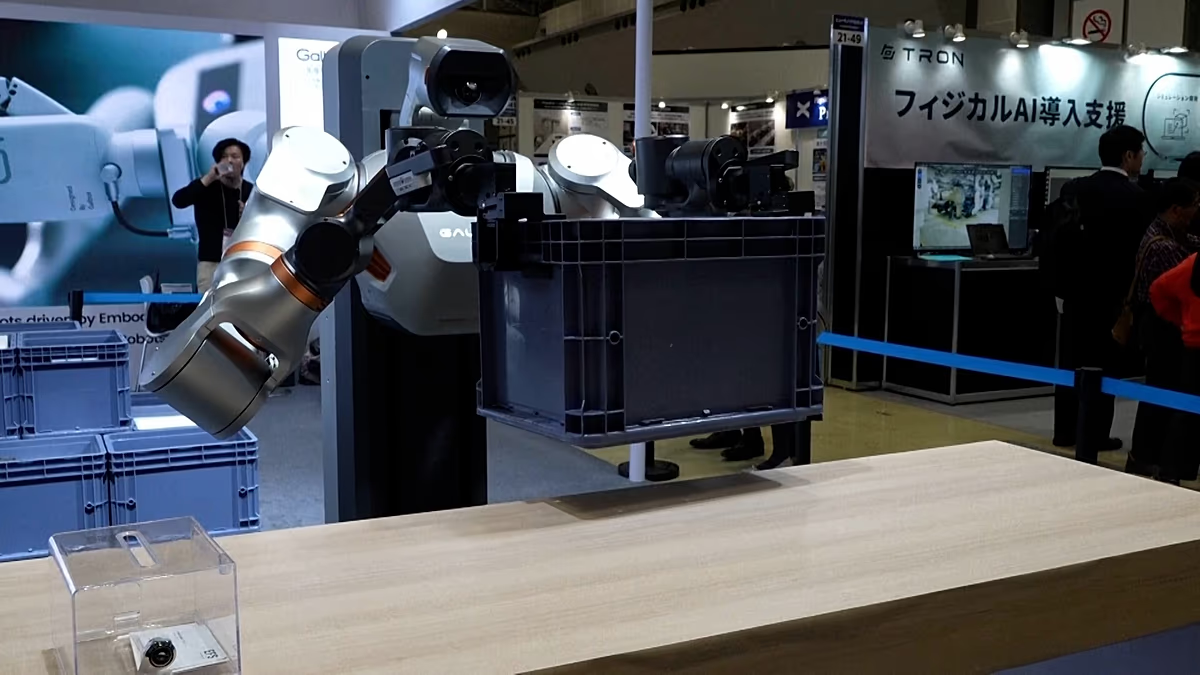
Japan is intensifying its efforts to compete in the rapidly evolving field of humanoid robotics, strategically shifting its focus toward the crucial software and data ecosystems that empower these machines. This shift was prominently displayed at Tokyo’s inaugural Humanoid Robot Expo, where the future of robotics felt both tangible and witty. Amidst the showcases, a human-sized robot named Galbot demonstrated practical agility by retrieving a bottle of tea, then turned to the audience with a humorously human concern: pondering future holidays and worrying about sunburn. This moment of levity, however, underscored a more serious trend: many of the robots present, including Galbot, were developed by Chinese firms, highlighting China’s growing manufacturing dominance in the sector. Robotics is no longer just an industrial pursuit; it has become a key arena in the broader technological—and even geopolitical—rivalry between China and the United States, with implications for national security and economic leadership. China’s commitment is formalized in its national five-year plan, which prioritizes the acceleration of humanoid robot development. Yet, within this competitive landscape, Japanese companies are carving out a distinct and essential niche, moving beyond hardware to master the “physical AI,” data infrastructure, and sophisticated software required for robots to operate effectively in our complex, real-world environments.
The Japanese approach centers on enabling robots to perceive and interact with the physical world, a discipline distinct from the conversational AI familiar to many. As Nao Yamada, manager at Tokyo-based AI data infrastructure company FastLabel, explains, while popular AI like ChatGPT processes language, “physical AI” interprets information from sensors—vision, touch, balance—to guide actual movement and decision-making. FastLabel exemplifies this specialization by collaborating with Chinese robotics firm RealMan, not to build robot models themselves, but to support the creation of the high-quality, scalable training data those models desperately need. This focus on the foundational “core part of robot AI” represents a strategic pivot. Japan is leveraging its deep expertise in precision, quality, and systems integration to address the industry’s most critical bottleneck: the data that teaches robots how to behave. It’s a recognition that the true intelligence of a humanoid robot isn’t just in its metal frame, but in the vast, meticulously curated datasets that allow it to learn and adapt.
Despite impressive demonstrations of robots walking or dancing, industry insiders acknowledge that significant hurdles remain before humanoids can achieve genuine utility. The challenge lies in transitioning from pre-programmed, repetitive motions to autonomous, judgment-based actions. Masato Ando of Aska Corporation, which partners with Chinese firm Dobot, illustrates this gap. A dance routine is a fixed sequence; it’s repeatable. However, a task like reliably gripping a diverse array of objects in a cluttered environment is not predefined. The robot must assess the object’s shape, weight, and texture, and choose from countless possible grip patterns—a level of adaptive intelligence that current technology is still striving to reach. Mastering these complex, unstructured tasks is the key threshold that will determine whether humanoid robots can transition from exhibition halls to practical, valuable roles in industries such as manufacturing, which are acutely facing labor shortages.
The drive for practical application is particularly urgent in Japan itself, a nation grappling with one of the world’s most advanced ageing populations and a persistent decline in its workforce. The vision extends beyond factory floors to the domestic sphere, where robots could potentially assist with care and daily tasks at home. This societal need creates a powerful incentive for development, but it also introduces a profound question of public acceptance. While the technological potential inspires high expectations, it can also stir unease. Atomu Shimoda, event director and organizer of NexTech Week, directly addresses this human concern. The goal, he emphasizes, is not replacement but partnership. The aspiration is to create machines that coexist and collaborate with people, ultimately being perceived as supportive partners rather than impersonal automatons. This philosophy of collaboration is central to Japan’s ethos, aiming to integrate robotics into society in a way that complements human dignity and agency.
Thus, Japan’s strategy in the humanoid race is multifaceted. It involves acknowledging and engaging with the hardware manufacturing strength of competitors like China, while simultaneously concentrating its efforts on the sophisticated “brain” and “nervous system” of robotics—the AI, data, and software that make autonomous, helpful action possible. The country is addressing its own demographic challenges by pushing the technology toward genuine usability, all while consciously navigating the societal dialogue about human-robot relationships. The work of companies like FastLabel and Aska represents the frontlines of this effort, tackling the granular problems of data quality and motor skill algorithms that stand between current prototypes and future helpers.
In conclusion, the Humanoid Robot Expo revealed not just the state of the technology, but the contours of a global competition where Japan is playing a pivotal, enabling role. By focusing on physical AI and data infrastructure, Japan is building the essential scaffolding upon which smarter, more capable robots will be constructed worldwide. Its parallel focus on societal integration and human partnership suggests a path for robotics that is not solely about automation, but about augmentation—enhancing human capacity and addressing shared challenges like labour shortages and elder care. The journey from a robot quipping about sunburn to one reliably assisting an ageing population is long and filled with technical obstacles, but Japan is dedicating its considerable expertise to solving the fundamental problems that will make that future a reality, aiming to ensure that when humanoid robots finally step into our daily lives, they do so as compatible and collaborative partners.