




A New Chapter in Lunar Exploration Begins
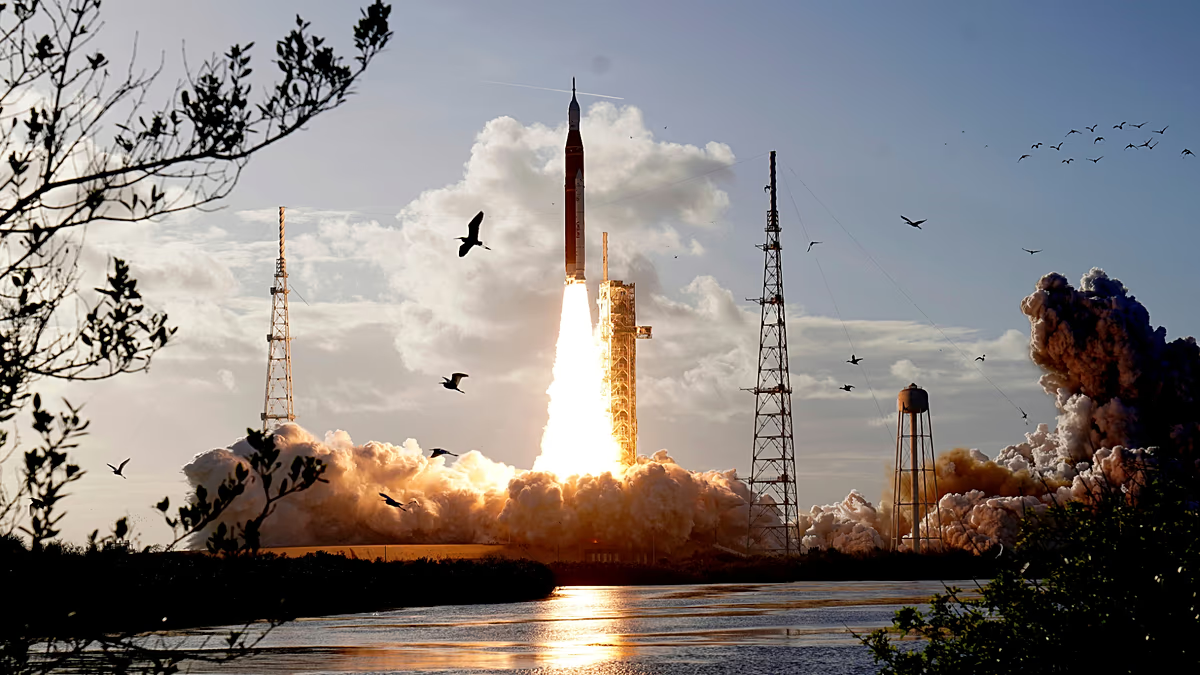
On a bright Wednesday morning, the roar of engines and billowing plumes of smoke signaled not just another launch, but the dawn of a new era in space exploration. For the first time in over half a century, a crew of astronauts embarked on a journey toward the Moon. The Artemis II mission, NASA’s most ambitious step yet in returning humans to lunar space, lifted off from the historic Kennedy Space Center in Florida, witnessed by tens of thousands of spectators who crowded beaches and roadways in a scene echoing the Apollo program’s glory days. This flight represents more than a technical milestone; it is a powerful symbol of renewed ambition, carrying the hopes of establishing a permanent human presence beyond Earth.
The Diverse Crew of Pioneers
The four astronauts strapped into the Orion capsule are a testament to how far space exploration has evolved. The crew is comprised of Americans Reid Wiseman, Victor Glover, and Christina Koch, alongside Canadian Jeremy Hansen. Clad in striking orange and blue launch suits, they represent historic firsts: Glover will be the first person of color on a lunar mission, Koch the first woman, and Hansen the first non-American to venture on such a journey. Just minutes after liftoff, Commander Wiseman captured the moment’s awe, radioing to mission control about a “beautiful moonrise” as their spacecraft aimed directly for its target. This diverse team is a conscious reflection of a modern, collaborative approach to exploring the cosmos.
Overcoming Tensions and Technical Hurdles
The path to a successful launch was not without its heart-stopping moments. Earlier in the day, tension filled the control room as engineers began pumping supercold liquid hydrogen fuel into the massive 32-story Space Launch System (SLS) rocket. This step carried the memory of dangerous hydrogen leaks that had caused a lengthy delay during a test just months prior. To NASA’s immense relief, this critical operation proceeded smoothly, with over 2.6 million liters of fuel loaded without issue. However, the final countdown was interrupted by a flurry of last-minute problems, including faulty battery sensors and communication glitches with the rocket’s safety system. In a testament to the team’s skill and preparation, engineers swiftly resolved each issue, allowing the countdown to resume and culminating in a spectacular, on-time launch.
A Groundbreaking Journey Through Deep Space
The Artemis II mission is designed as a rigorous 10-day test flight, pushing the boundaries of human travel. Unlike the Apollo missions that entered lunar orbit, this crew will take a longer, faster path. After spending about a day carefully checking all of Orion’s systems in Earth orbit, they will fire the main engine for a slingshot maneuver toward the Moon. They will not land or even enter orbit; instead, they will zoom past the lunar far side, venturing an astounding 6,400 kilometers beyond it—farther from Earth than any human in history has ever traveled. This “U-turn” trajectory will give them a unique perspective, with the Moon appearing as large as a basketball held at arm’s length and, with the right lighting, offering views of lunar landscapes never before seen by human eyes before they race back home for a Pacific Ocean splashdown.
The Broader Vision and Global Competition
This mission is the crucial first crewed step in the larger Artemis program, which aims to return astronauts to the lunar surface by 2028 and eventually build a sustainable base camp. This stands in stark contrast to the politically driven “flags and footprints” approach of the Apollo era. The current push is frequently framed within a new space race, this time with China, which has stated its goal to land humans on the Moon by 2030. NASA Administrator Jared Isaacman acknowledged this dynamic after launch, stating that competition can be a powerful motivator for national investment and innovation. The program also operates under significant political pressure, with the current U.S. administration pushing to accelerate the timeline for a landing, relying heavily on advancements from private sector partners to meet these ambitious goals.
A Symbolic Return and a Foundation for the Future
As the Artemis II crew began their voyage, NASA declared itself “back in the business of sending astronauts to the moon,” framing the 50-year gap as a mere intermission. While the journey is a monumental achievement in itself, it is fundamentally a proof of concept—a confidence-building shakedown cruise for the new SLS rocket and Orion capsule. The mission’s success is critical for paving the way for Artemis III, the planned landing mission. With experts noting the immense technical challenges ahead and NASA keeping its detailed risk assessment confidential, the path forward remains demanding. Yet, this launch has unmistakably rekindled the spirit of lunar exploration, demonstrating that human ambition to explore, discover, and establish a foothold on another world is once again driving us beyond the stars, with the whole world watching.