



For years, the storied nations of Central Asia—Kazakhstan, Kyrgyzstan, Tajikistan, Turkmenistan, and Uzbekistan—have held an almost mythical status, whispered about by seasoned travelers as the next great frontier. Yet now, a scroll through social media reveals they are frontiers no longer. These “stans,” particularly Uzbekistan, are firmly on the global tourism map. According to the latest UN Tourism data, Uzbekistan is one of the world’s fastest-growing destinations, with visitor numbers soaring by 14% in 2025. This surge is drawn to the country’s profound Silk Road heritage, where legendary cities like Samarkand and Bukarra have long captivated imaginations. Now, joining their ranks is the ancient city of Khiva, whose allure is about to become significantly more accessible thanks to a major infrastructural leap.
That leap is a new high-speed rail line, set to launch on May 2nd, which will seamlessly connect the modern capital of Tashkent with the timeless oasis of Khiva. This engineering marvel will effectively halve the grueling 14-hour journey to a comfortable seven-and-a-half-hour trip, making a visit far more feasible for travelers with limited time. With classes ranging from economy to VIP, the train offers a journey that mirrors the transition travelers will make: from Uzbekistan’s bustling, contemporary heart to a perfectly preserved medieval world. This pivotal link is poised to transform Khiva from a remote destination into a central highlight of any Uzbek itinerary, inviting more people to witness its unparalleled preservation.
Stepping into Khiva is an experience like few others on Earth. The city’s soul resides in Itchan Kala, the walled inner city that, in 1990, earned the distinction of becoming Central Asia’s very first UNESCO World Heritage Site. Enclosed by imposing sun-baked walls, this living museum is believed to be around 2,500 years old, once serving as the crucial final oasis for caravans before they ventured into the terrifying expanse of the Karakum Desert toward Iran. Within its gates, time feels suspended. Visitors can wander through a dense tapestry of over 50 historic monuments, where every lane and doorway tells a story of faith, scholarship, and power from centuries past.
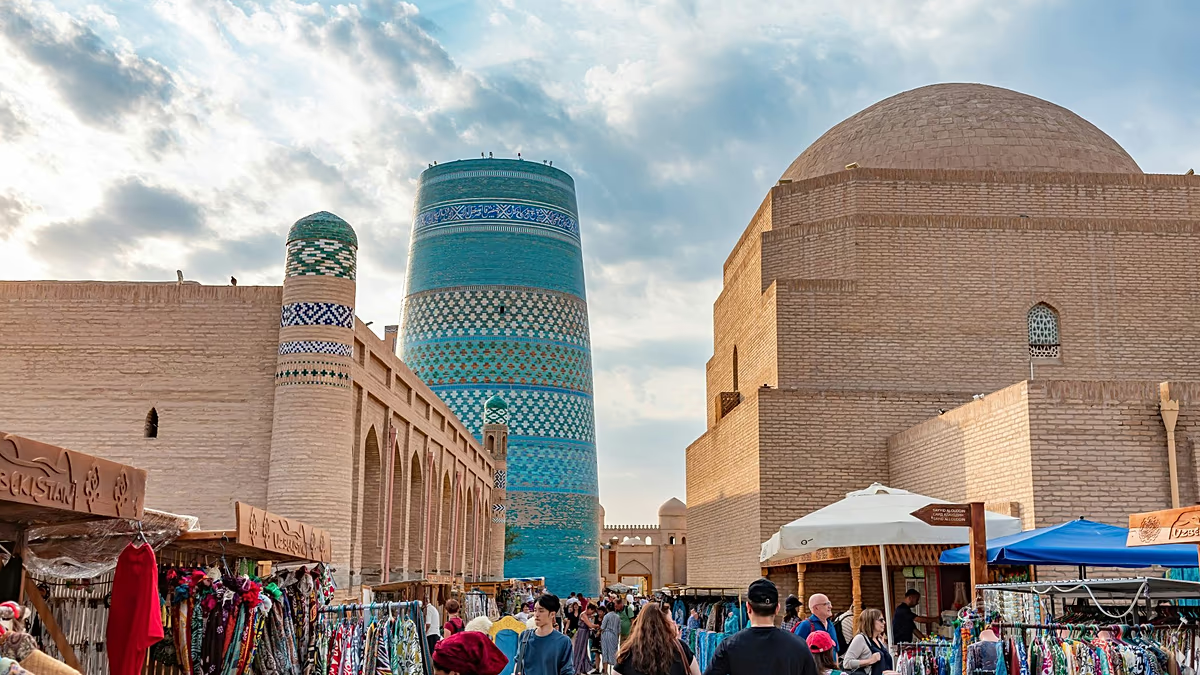
The architectural wonders within Itchan Kala are breathtaking in their detail and grandeur. The Juma Mosque is a unique masterpiece, its hall supported by a forest of over 200 intricately carved wooden columns and crowned with a covered courtyard designed to offer sanctuary from the fierce sun. The formidable Konya Ark citadel stands as a reminder of the Khans’ might, while the Pahlavon Mahmud Mausoleum dazzles with a dome and interior clad in sublime, luminous blue tiles—a signature of Islamic architecture here. For a breathtaking panorama of this sandy-hued city, punctuated by turquoise domes and slender minarets, one can climb the spiraling staircase of the Islamkhodja Madrasah minaret, the highest point in the old town.
The Silk Road was, above all, a conduit of commerce and culture, and that vibrant spirit endures just outside Itchan Kala’s eastern gate at the modern bazaar. Here, the historical caravan stop comes alive with the sounds, smells, and colors of today. You can sample rich traditional dishes like plov (a savory rice pilaf) or sweet, nutty desserts, and browse stalls selling everything from vibrant textiles and hand-painted ceramics to the inevitable tourist souvenirs. Beyond the market, a short excursion leads to the stunning Nurullaboy Palace. Completed in 1912, this palace is a fascinating architectural dialogue, beautifully marrying intricate Uzbek tilework and woodcarving with the neoclassical elegance of Imperial Russia, reflecting a pivotal moment in the region’s history.
Khiva is no longer just a distant legend or a stop for the most intrepid. With the new high-speed rail tethering it firmly to the present, it stands as an essential and accessible chapter in the story of Uzbekistan. It offers a profoundly immersive journey into a nearly complete medieval Islamic city, where the echoes of camel caravans seem to linger in the quiet courtyards and the legacy of scholars, craftsmen, and rulers is etched into every tile and tower. For the modern traveler, it presents a rare chance to walk through a vast, open-air museum that has lost none of its living, breathing soul—a captivating destination where history is not merely displayed but palpably felt.