



In a world often consumed by the relentless noise of geopolitical strife—where headlines scream of conflict and the ground beneath us feels increasingly fractured—the recent images from the Artemis II mission have arrived like a deep, quiet breath. Circling the Moon, the crew has broadcast a perspective that is both humbling and unifying: our vibrant, troubled planet is a single, fragile marble suspended in an immense cosmic ocean. This mission, slated to conclude with a predawn splashdown on April 10th, offers more than a technological marvel; it provides a psychological sanctuary. It reminds us that the human spirit possesses an innate drive to explore and understand, a drive that transcends earthly divisions. The profound fascination reignited by these views of Earth against the void is a testament to a shared yearning for wonder, pointing our collective gaze upward and outward.
For those inspired to delve deeper into this story of exploration, history is preserved and presented in remarkable places around the globe. In Houston, Texas, the pulse of American spaceflight is almost tangible at Space Center Houston. This is the home of Mission Control, where the iconic—if slightly misquoted—phrase “Houston, we have a problem” was first received. Visitors can stand in the very room where history was guided, touch a piece of the Moon, and walk beneath the towering Saturn V rocket. Exhibits bridge the legacy of Apollo with the ambitious future of the Artemis program, creating a direct narrative thread from humanity’s first steps on another world to our promised return and beyond. It is a place where the past is not merely displayed but felt, narrated by the voices of those who lived it, including an immersive show guided by the iconic Tom Hanks.
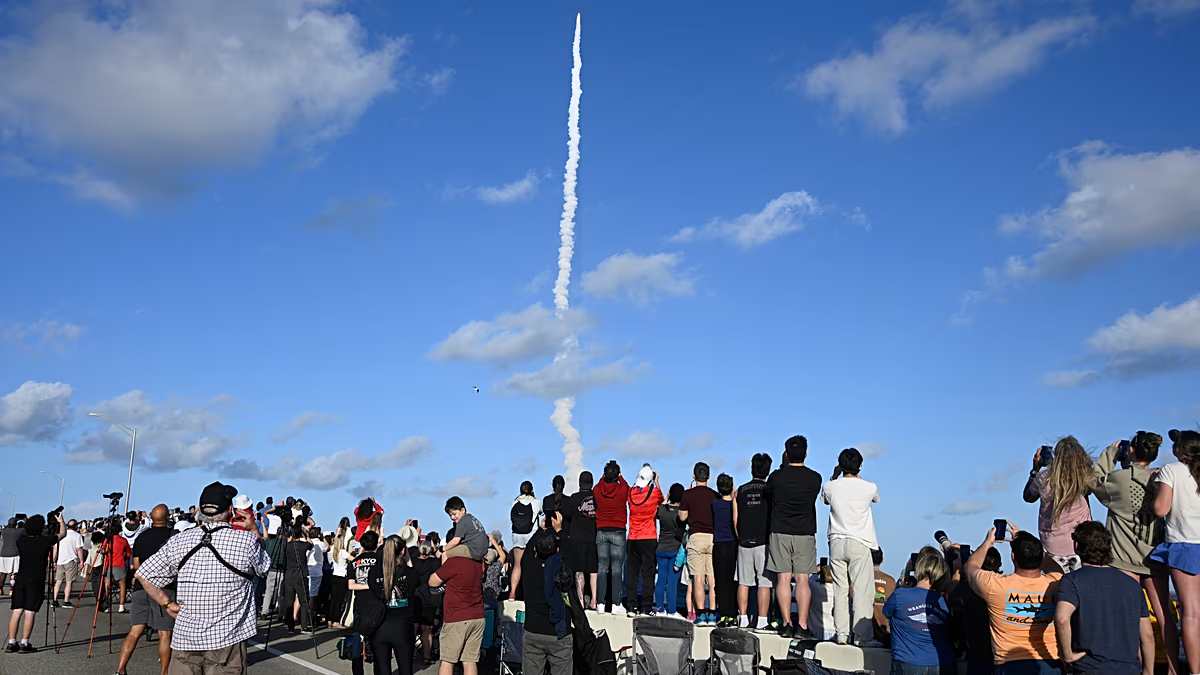
Meanwhile, on the coast of Florida, the roar of rockets still shakes the earth at the Kennedy Space Center Visitor Complex. This is not just a museum; it is an active portal to the cosmos. From public viewing areas, one can witness the fiery ascent of modern missions, feeling the thunderous vibrations of human ambition. A bus tour winds past monumental structures like the colossal Vehicle Assembly Building and the historic launch pads that sent Apollo to the Moon and now launch Artemis. The complex allows you to touch a piece of lunar rock, experience a simulated shuttle launch, and pay homage to pioneers in the Astronaut Hall of Fame. It is a living site where the past, present, and thrilling future of launch operations converge into a single, powerful experience.
The quest to understand our place in the universe is a truly global endeavor, as evidenced by facilities across Europe. In the Netherlands, the European Space Agency’s technology hub, ESTEC, opens its doors through the Space Expo in Noordwijk. Here, the focus is on the science and engineering that make exploration possible. Visitors can walk through a full-scale model of the International Space Station and learn about the meticulous research behind satellite imagery and deep-space probes. Further across the Atlantic, in the lush environment of French Guiana, lies the Guiana Space Centre. This unique spaceport, nestled near the equator, offers tours of its launch complexes for the Ariane and Vega rockets and even opportunities to witness a launch from a nearby beach, blending advanced technology with the raw beauty of the South American coastline.
Venturing into the storied sites of historic spacefaring nations reveals chapters written under different flags but driven by the same fundamental wonder. The Baikonur Cosmodrome in Kazakhstan is hallowed ground, the launch site of Yuri Gagarin’s pioneering voyage. While access is restricted and tours are costly, they offer a pilgrimage for space enthusiasts—a chance to stand where the human journey to orbit began and to feel the weight of that legacy. In China, the Wenchang Space Launch Site on the tropical island of Hainan represents the nation’s soaring ambitions in space. Though direct access is limited, the recent opening of public viewing platforms and the presence of hotels like the Hilton Wenchang—with beaches just kilometers from the pad—allow for communal viewing of launches, embedding the spectacle of spaceflight into the local culture and landscape.
Ultimately, the enduring magic of these places lies not solely in the rockets or artifacts, but in their power to reconnect us with a broader perspective. In a moment of global tension, the silent journey of Artemis II around the Moon and the accessible history preserved at space centers worldwide serve a profound purpose. They are communal touchstones that celebrate our capacity for curiosity, cooperation, and awe. They remind us that from a distance, there are no borders visible on our blue planet—only a shared home, and a shared destiny that extends into the stars. This perspective, offered by space exploration, is perhaps its greatest gift: a vision of unity and boundless possibility that we can carry back into our lives on Earth.