



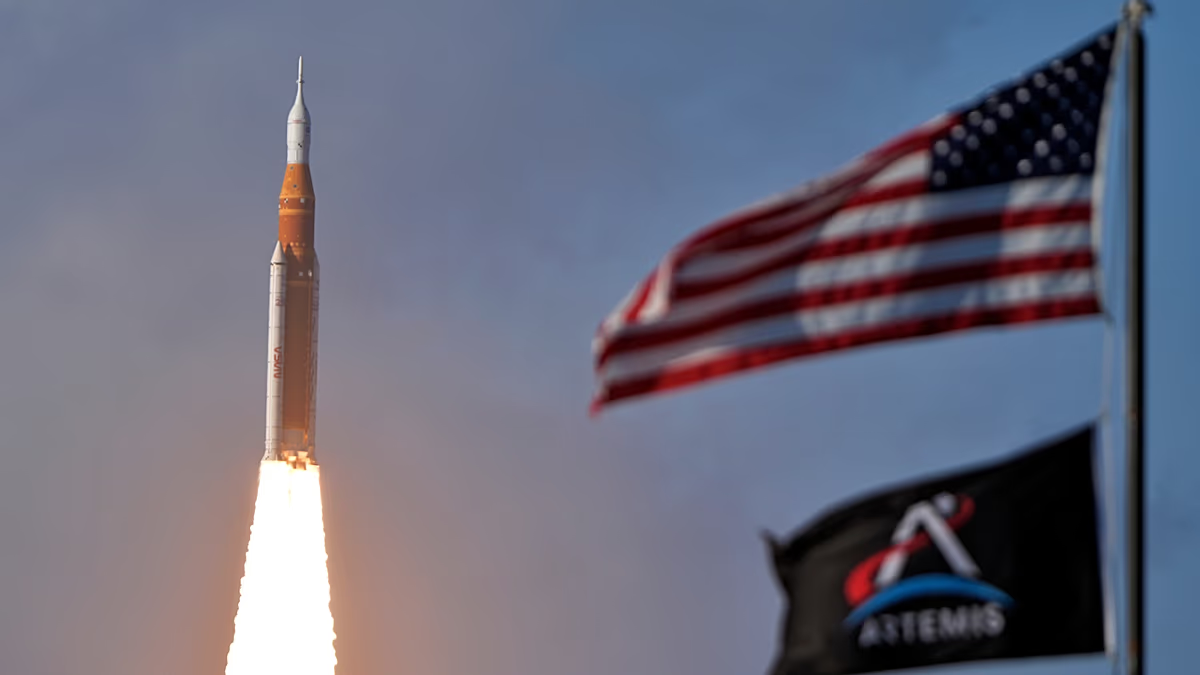
After enduring a series of delays, most notably persistent hydrogen fuel leaks that required months of troubleshooting, NASA has triumphantly returned human exploration to deep space. On a historic Wednesday, the thunderous roar of the 32-story Space Launch System rocket shattered a half-century of silence, carrying the Artemis II crew skyward from the Kennedy Space Center. The scene was a powerful echo of a bygone era, with roads and beaches once again jammed by tens of thousands of spectators, their eyes lifted toward the sky in a collective moment of awe. This launch was more than a technical achievement; it was a profound cultural moment, rekindling the lunar dreams that have lain dormant since the final Apollo mission. As launch director Charlie Blackwell-Thompson emotionally told the crew before liftoff, they carried with them the heart of a global team and the hopes of a new generation, signaling that humanity’s journey beyond our planet is firmly back on course.
The four astronauts embarking on this daring journey represent a monumental shift in who gets to explore the final frontier. Commander Reid Wiseman, pilot Victor Glover, and mission specialists Christina Koch and Jeremy Hansen from Canada comprise the most diverse crew ever sent on a lunar voyage. Their mission marks several historic firsts: Koch will be the first woman to travel to the Moon, Glover the first person of color, and Hansen the first non-U.S. astronaut to embark on a lunar flight. This deliberate inclusivity is a powerful statement, reflecting a modern vision of exploration built for and by all of humanity. Just five minutes into their flight, Commander Wiseman’s voice crackled over the comm, framing their mission with poetic clarity: “We have a beautiful moonrise, we’re headed right at it.” In that simple phrase, the abstract goal became a tangible destination, connecting the crew and the world watching below to the celestial target ahead.
Artemis II is not a replay of Apollo; it is a bold new path designed for a sustainable future in space. While the Apollo 8 crew famously orbited the Moon in 1968, the Artemis II astronauts will undertake a different, more ambitious trajectory. They will slingshot around the lunar far side without entering orbit, continuing another 6,400 kilometers into the void—setting a new record for the farthest any human has ever traveled from Earth. From that distant vantage point, they will make a U-turn and begin their high-speed return to a splashdown in the Pacific Ocean. This “free-return” trajectory is a critical test of the Orion capsule’s systems in deep space, ensuring its readiness for the more complex missions to follow. The entire voyage, a compact and intense ten-day journey, is a foundational step, moving beyond Apollo’s “flags and footprints” model toward a lasting human presence.
The ultimate ambition of the Artemis program stretches far beyond this single flight. Where Apollo was a brilliant, breakneck sprint born of Cold War rivalry, Artemis is conceived as a marathon, a methodical campaign to return to the Moon to stay. The program’s core goal is to establish a permanent base, a sustained outpost that will serve as a platform for scientific discovery, resource utilization, and learning how to live and work on another world. This lunar foothold is envisioned as a proving ground and a springboard, testing the technologies and operations necessary for the next giant leap: human missions to Mars. Artemis II is the crucial crewed shakedown cruise that validates this long-term architecture, proving that the spacecraft, life support, and communication systems can safely support humans in the deep-space environment where Earth is just a distant blue marble.
The successful launch of Artemis II is a testament to perseverance in the face of complex engineering challenges. The months of delays caused by hydrogen fuel leaks were not mere setbacks but essential iterations in the rigorous process of human spaceflight. Resolving these issues underscored the unwavering priority placed on crew safety and mission success. Each solved problem has strengthened the rocket and the team behind it, building confidence for the ambitious schedule ahead. This launch demonstrates that the monumental infrastructure required for sustained lunar exploration—the powerful SLS rocket, the advanced Orion spacecraft, and the global partnerships supporting them—is now operational, turning ambitious plans on paper into a reality streaking through the heavens.
As the Artemis II crew continues their journey, they carry a symbolic torch passed from the pioneers of Apollo, but they are lighting the way for a fundamentally different future. Their mission bridges a 50-year gap, reconnecting humanity with its exploratory destiny while charting a more inclusive and permanent path into the solar system. The spectacular images of their launch are more than just documentation; they are an invitation to a new generation to see themselves as part of this ongoing story. When these four astronauts peer back at our isolated, fragile planet from a record-breaking distance, they will embody a collective human achievement. Their safe return will not be an ending, but the exhilarating confirmation that the Moon is once again within our reach, and this time, we are going with the intention to build a future there.