




A New Dawn for Lunar Exploration
For the first time in over half a century, human beings have once again ventured beyond the familiar cradle of Earth’s immediate orbit, setting their course for the Moon. Following a historic and flawless launch, NASA’s Artemis II crew—Americans Reid Wiseman, Victor Glover, and Christina Koch, alongside Canadian Jeremy Hansen—spent a day circling our planet, a final checkout close to home. This pause was a deliberate and cautious step, allowing the crew to rigorously test the life-support systems of their new Orion capsule, a spacecraft never before entrusted with human lives. After confirming everything was in working order, a critical engine burn lasting just under six minutes propelled them onto a celestial path known as a “free-return trajectory.” As NASA’s Lori Glaze announced with palpable excitement, the laws of orbital mechanics have now taken over, committed to carrying this diverse crew around the far side of the Moon and back again, a silent promise written in the grammar of gravity itself.
A Crew of Firsts Gazes Upon a Singular Home
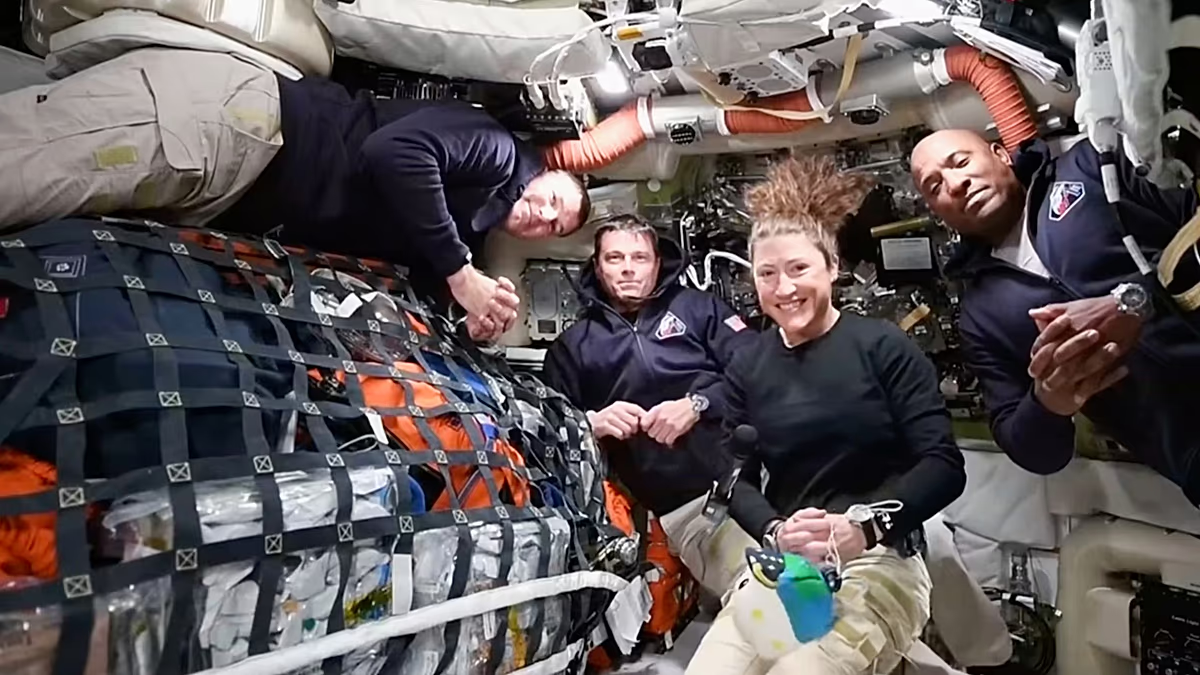
Inside the spacecraft, the profound reality of their journey quickly set in, marked not by grand gestures but by quiet awe. The astronauts found themselves irresistibly drawn to the windows, their faces pressed against the glass to take in the “phenomenal” view of Earth shrinking behind them. Christina Koch described the “breathtaking aspect” of seeing our planet bathed in daylight while a moonlit glow and the thin, brilliant beam of a sunset traced its curve. In this moment of shared wonder, the historic nature of their individual roles resonated deeply. Glover, Koch, and Hansen are, respectively, the first Black man, the first woman, and the first non-U.S. citizen to embark on a lunar voyage. Reflecting on the planet below, Glover offered a poignant observation to those watching from home: “Trust us, you look amazing… And from up here you also look like one thing: homo sapiens.” Their mission, while a product of national programs, became in that instant a powerful testament to unified human aspiration.
The Humble Work of Making a Home in the Void
The journey, however, is more than sightseeing. It is the meticulous, often mundane work of turning a sophisticated machine into a liveable home in the harsh environment of space. The initial hours were spent troubleshooting minor but essential issues, from a finicky communications system to a malfunctioning toilet—a piece of equipment Koch joked was “probably the most important on board,” earning her the lighthearted title of “space plumber.” The crew reported the cabin was a little chilly as they adapted, and they have begun the crucial daily routine of exercise, using a specialized flywheel device to combat the muscle and bone loss that weightlessness induces. Even their suits are engineered as miniature survival pods, capable of sustaining life for days in the unlikely event of a cabin leak. These details ground the mission in a relatable reality, reminding us that grand exploration is built on a foundation of problem-solving and daily discipline.
A Path Forged Toward a Permanent Future
Artemis II is a foundational step, a 10-day confidence-building voyage designed to rigorously test every system with a human crew before committing to a landing. As Commander Reid Wiseman acknowledged, “There is nothing normal about this… we are now just realizing the gravity of that.” If their path holds, they will also claim the record for traveling farther from Earth than any humans in history. But this mission is not an end in itself. It is the crucial gateway to Artemis III, which aims to return boots to the lunar surface by 2028, and to a far more ambitious vision: establishing a sustained, permanent human presence on the Moon. This future base is envisioned not as a final destination, but as a proving ground and launching pad for the next giant leap—human missions to Mars. In this context, the current era of lunar exploration is also framed by a new dynamic of strategic competition, with China aiming for its own crewed landing by 2030.
A Symphony of Humanity, From Mission Control to the Stars
Amidst the complex physics and rigorous protocols, the human spirit of the endeavor shines through in deliberate, touching ways. To set the mood for their critical departure burn, Mission Control chose to wake the crew not with a standard alarm, but with John Legend’s upbeat “Green Light,” followed by a cheering medley of voices from supporting teams across NASA. This small tradition connects this modern voyage to the legacy of Apollo, blending cutting-edge science with a deeply human need for connection and encouragement. It underscores that this journey is propelled by a vast, global team on the ground, their hopes and expertise riding alongside the four individuals gazing out the window. The mission thus becomes a symphony of effort, where a song, a solved plumbing issue, and a perfect engine burn are all essential notes.
Carrying a World’s Hopes Into the Deep
As the Artemis II astronauts continue their silent cruise, pulled by the Moon’s gravity on a long arc that will bring them face-to-face with the lunar far side before returning them home, they carry with them more than instruments and checklists. They carry the renewed curiosity of a species looking outward, the collective memory of those last lunar footsteps in 1972, and the aspirations of a new generation. They are demonstrating that the monumental “Herculean effort” of deep space travel is once again within our reach. Their journey is a statement—that exploration is a timeless human imperative, that our horizons are once again expanding, and that the lessons learned in the void between worlds are essential for our future, both on Earth and among the stars.