



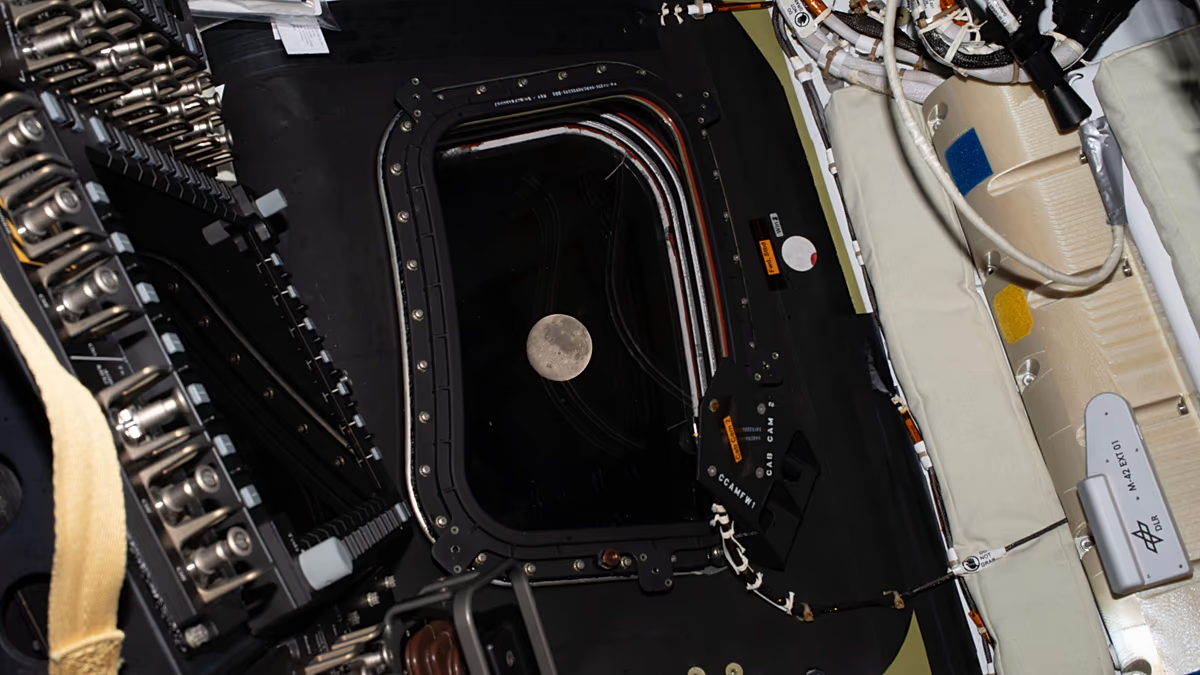
In a profound moment for human exploration, NASA’s Artemis II crew is now speeding home after successfully completing a lunar flyby that has carried them farther from our planet than any human has ever been. Astronauts Reid Wiseman, Victor Glover, Christina Koch, and Jeremy Hansen embarked on a celestial journey known as a free-return trajectory—a graceful, fuel-efficient figure-eight that used the gravity of both Earth and the Moon to slingshot them around the far side and back toward home. This critical maneuver, a rehearsal for future lunar landings, brought them to a stunning apogee of 406,778 kilometers from Earth, shattering the distance record held by the Apollo 13 mission for over half a century by more than 6,600 kilometers. It was a quiet, historic milestone, achieved as their spacecraft sailed through the deep silence of space.
The mission’s most tense, yet expected, moment came as the Orion capsule passed behind the Moon, severing all communication with Earth for roughly 40 minutes. In mission control, teams waited in the silent knowledge that the crew was utterly on their own, traversing the hidden lunar far side. When the spacecraft finally re-emerged and the signal was reacquired, astronaut Christina Koch’s voice broke the static with a relief and joy felt worldwide: “It is so great to hear from Earth again.” Her subsequent words, “We will always choose Earth, we will always choose each other,” transcended technical jargon, offering a poignant reminder of the human bond and shared home that underpins these vast endeavors. Shortly after, the universe gifted them a breathtaking spectacle: a total solar eclipse viewed from deep space, with the Moon perfectly blocking the Sun to reveal its ethereal corona, prompting pilot Victor Glover to radio, “We just went sci-fi. It just looks unreal.”
This was not merely a record-breaking joyride; it was a mission of purposeful observation. For over six hours, the astronauts served as human eyes, providing detailed, subjective descriptions of the lunar landscape that no robot could fully capture. Canadian astronaut Jeremy Hansen marveled, “It is blowing my mind what you can see with the naked eye from the Moon right now,” issuing a challenge to future generations to ensure this record would soon be broken. Victor Glover became an artist in words, vividly describing the “terminator”—the line dividing lunar day and night. “It is the most rugged that I’ve seen it from a lighting perspective,” he said, painting a picture of stark, dramatic shadows for the enthralled scientists on Earth. Christina Koch, meanwhile, depicted the sunlit craters as resembling a lampshade with “tiny pinprick holes,” their brilliance stark against the grey terrain.
The emotional core of the scientific mission came when the crew, united in grief and remembrance, requested permission to name two brilliantly visible, fresh craters. They proposed “Integrity,” after their faithful capsule, and “Carroll,” in honor of Commander Reid Wiseman’s late wife, who passed away from cancer in 2020. As Jeremy Hansen made the solemn request to mission control, Wiseman was overcome with emotion. The four astronauts, bound by extraordinary experience and shared humanity, embraced in a tearful huddle—a powerful, silent moment that spoke volumes about the personal journeys intertwined with the cosmic one. Lead mission scientist Kelsey Young responded with deep emotion, telling them, “Those types of observations are things that humans are uniquely able to contribute, and you just really brought us along with you.”
The world took note of their historic passage. U.S. President Donald Trump called the astronauts to offer congratulations, telling them they had “made all America really proud” and were “modern-day pioneers.” The praise underscored the global significance of Artemis II: NASA’s first crewed mission to the Moon’s vicinity since Apollo 17 in 1972. This journey is the essential proving ground for the hardware and human systems needed for the next steps. It sets the stage for Artemis III, which will see a crew practice docking with a lunar lander in orbit, and the subsequent Artemis IV mission, which aims to finally return bootprints to the lunar surface near the strategic south pole in 2028.
Now homeward bound, the Artemis II astronauts carry with them more than data and records. They carry renewed proof of human courage, curiosity, and our innate desire to explore. They have provided a new generation with its own “Earthrise” moment, re-igniting lunar ambition for the 21st century. Their mission, blending cutting-edge technology with raw human emotion and perspective, has successfully bridged the 50-year gap since Apollo. They have not only tested a spacecraft but have also rekindled a collective dream, proving that the path back to the Moon and onward is once again open, traveled by a diverse crew representing the future of exploration itself.