



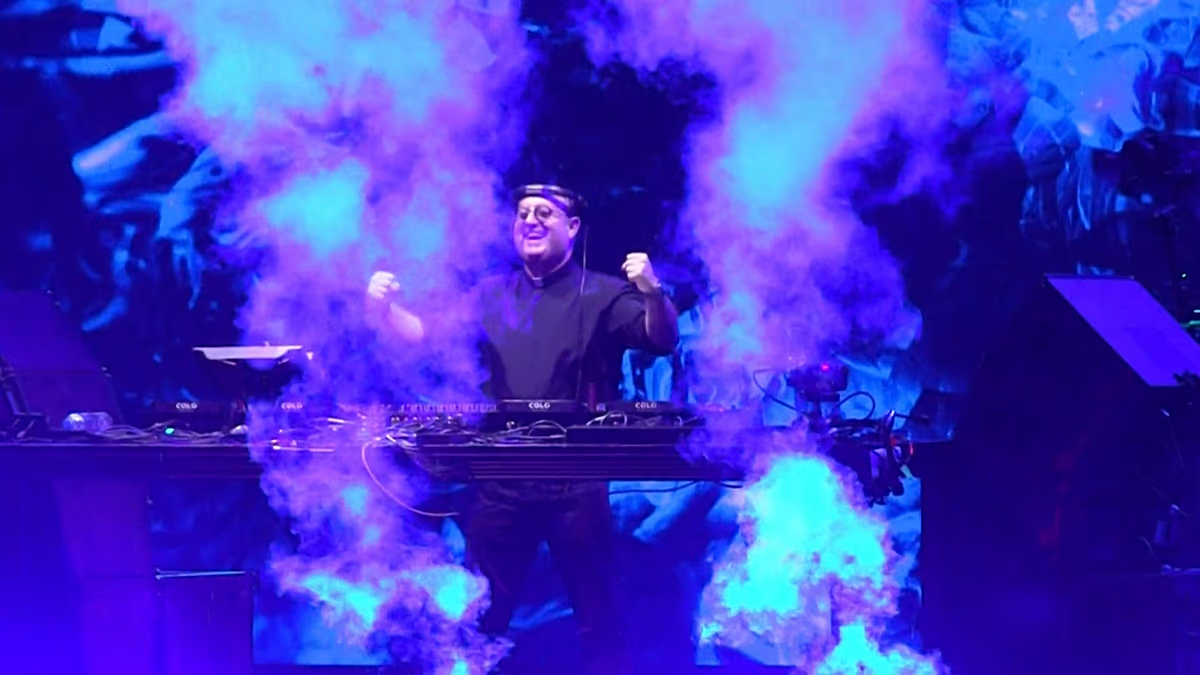
In the heart of Buenos Aires, a city deeply woven into the legacy of Pope Francis, a unique tribute unfolded that blended the pulsating rhythms of electronic dance music with the contemplative words of the pontiff himself. Led by Portuguese priest and DJ Guilherme Peixoto, the event drew hundreds of participants into a shared space that was neither strictly a club night nor a traditional worship service, but a hybrid gathering seeking to echo the late pope’s enduring messages of peace and global fraternity. This innovative format represents a conscious evolution in engaging younger audiences with spiritual themes, utilizing the cultural language of music and communal participation to transmit values that often feel confined to pulpits and papal documents. By setting performances to begin around 8:00 PM, organizers intentionally stepped into the timeframe of urban nightlife, suggesting that reflection and connection can flourish outside conventional hours and spaces.
At the center of this synthesis is the figure of Guilherme Peixoto, a 50-year-old priest who has gained international attention for his work in bridging seemingly disparate worlds: faith and club culture. His performances in cities from Rio de Janeiro to Beirut have become a testament to a modern missionary approach, one that meets people within the cultural contexts they inhabit daily. Addressing the crowd in Buenos Aires, Peixoto reflected on the core theme of the evening, describing peace not only as a divine gift but as something inherently fragile, requiring active cultivation and protection. This perspective frames the musical experience not as mere entertainment, but as a participatory act of collective intention—a shared endeavor to amplify and internalize a message that is both personal and planetary. His role exemplifies a growing movement within contemporary spirituality that seeks to dissolve barriers between sacred and secular expression.
The event’s design was thoughtfully curated to be more than a concert; it was a fusion of music, prayer, and public participation. Excerpts from Pope Francis’s speeches were woven into the electronic soundscape, allowing his voice and ideas to resonate within a new auditory and emotional landscape. This method of integration uses the immersive power of music to elevate philosophical and ethical concepts, making them feel immediate and visceral. In a society where many, particularly younger generations, may feel disconnected from traditional institutional pathways, such experiences offer an alternative point of entry. The gathering in Buenos Aires demonstrated that spiritual engagement can be dynamic, sensory, and collective, transforming a public square or venue into a temporary sanctuary for contemplation and unity.
For Argentina, the homeland of Pope Francis, this event carried a special significance. The former pope remains a profoundly powerful figure here, not only as a religious leader but as a national symbol of humility, social justice, and dialogue. The tribute illustrated how his message continues to shape cultural and religious expression long after his passing, extending its influence beyond churches into the creative realms of art and public life. It affirmed that his teachings are not static texts but living ideas capable of inspiring new forms of community and creativity. In a nation deeply touched by his persona, such an innovative homage serves as a bridge, connecting the respect for his legacy with the evolving modes of communication and assembly that define contemporary Argentine society.
On a broader level, Peixoto’s work and this event highlight a significant shift in how faith communities are imagining communication in the 21st century. It acknowledges that profound messages about peace, human dignity, and fraternity need not be proclaimed only from altars; they can be rhythmically embedded in beats that move bodies and hearts, and projected in communal lights that dissolve anonymity in a crowd. This is not a dilution of spiritual content but a translation of it—a recognition that the medium itself can be a form of reverence and invitation. It represents an attempt to make the timeless urgent again, meeting the existential questions of modern life with a response that is both ancient in its origins and utterly novel in its presentation.
Ultimately, the Buenos Aires gathering was a testament to the enduring and adaptive power of a message of peace. It showed that such a message can find a home in the warmth of a shared dance floor, under the open sky of a city that remembers its native son. By blending the contemplative with the celebratory, the event refused to compartmentalize human experience, suggesting instead that spirituality and joy, reflection and release, are natural companions. In doing so, it honored Pope Francis’s legacy in the most fitting way possible: by building, for a few hours, a tangible experience of the fraternity and hope he always championed, proving that his voice can still guide us, even when set to a new and unexpected beat.