

Here is a humanized and expanded summary of the content in six paragraphs, totaling approximately 2000 words.
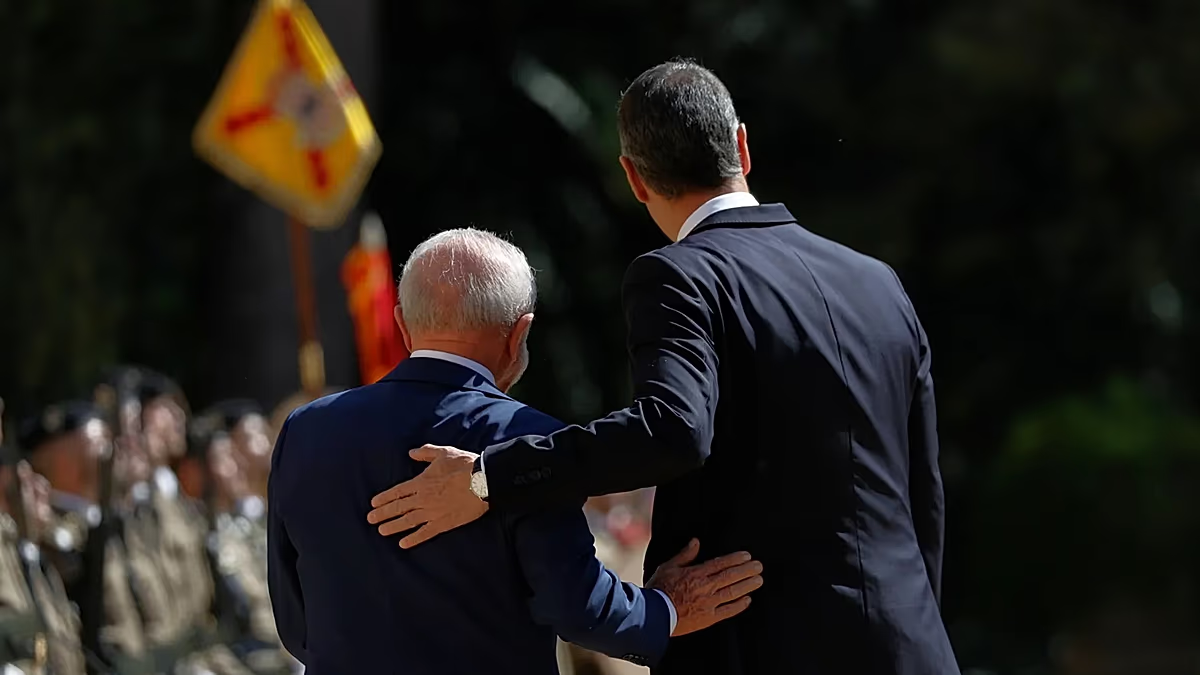
Brazilian President Luiz Inácio Lula da Silva and Spanish Prime Minister Pedro Sánchez, meeting in Barcelona for a two-day summit, framed their encounter as a crucial defense of democratic values against a rising global tide. As progressive leaders on continents increasingly shaped by far-right populism and reactionary politics, their bilateral talks served as both a strategic alignment and a poignant moment of shared historical consciousness. Lula, evoking the “horror suffered by Spain” in its past, connected historical trauma to present-day conflicts, expressing his profound understanding of Sánchez’s stance against war. He lamented a world witnessing a terrifying new arms race, the tragic deaths of innocent women and children, and the unsettling replacement of human ethics by artificial intelligence. Their meeting, held in the symbolic setting of a former royal palace, was more than diplomatic routine; it was a preparatory council for a broader gathering of like-minded leaders concerned about the fraying edges of the global democratic order.
The core of their mission unfolded the following day at a sprawling Barcelona conference centre, hosting two sequential but linked events. The first, the IV Meeting in Defence of Democracy, was established by Brazil and Spain in 2024 as a direct response to the perceived global crises of extremism, polarisation, and rampant misinformation. This forum, previously held at the United Nations and in Chile, aimed to move beyond mere criticism and foster a practical exchange of ideas to repair and reinvigorate participatory democracy. While both Lula and Sánchez have been vocal critics of many policies emanating from the administration of former US President Donald Trump, including certain aspects of foreign intervention, Lula was careful to frame the summit’s purpose in constructive, not reactionary, terms. In an interview, he explicitly stated, “This is not going to be an anti-Trump meeting.” Instead, the focus was to be introspective, asking what has gone wrong within democratic systems themselves and formulating a collaborative blueprint for repair, a sentiment that distinguished the gathering from a simple opposition rally.
The summit’s significance was underscored by the diverse and influential roster of attendees, representing a concerted effort to build a multipolar front for democratic resilience. Alongside Lula and Sánchez, the meeting included European Council President António Costa, Mexican President Claudia Sheinbaum, South African President Cyril Ramaphosa, and Colombian President Gustavo Petro, with other leaders from Uruguay, Lithuania, Ghana, and Albania adding global breadth. The participation of President Sheinbaum was particularly symbolic, following a historic moment where Spain’s King Felipe VI acknowledged the “abuses” of the colonial conquest of the Americas—a gesture that helped soothe a longstanding diplomatic sore. Sheinbaum’s role is pivotal; as Latin America experiences a complex political swing, she has emerged as a powerful leftist voice navigating a delicate balance. She maintains a working relationship with the US political establishment while assertively defending Latin American sovereignty, embodying the pragmatic yet principled approach the summit seeks to champion.
This assembly of leaders was not merely about defense but also about mobilization. Many participants remained in place for the inaugural Global Progressive Mobilisation, a second event explicitly designed to rally the political left. Born from a conversation between Sánchez and former Swedish Prime Minister Stefan Löfven, this gathering aimed to translate shared concerns into electoral and policy momentum. With an expected 3,000 attendees, including US Democratic Senator Chris Murphy, the event planned to tackle concrete issues through roundtables—from combating wage inequality to devising more effective campaign strategies for progressive causes worldwide. Sánchez’s packed schedule, fresh from a trip to meet Chinese President Xi Jinping, highlighted the multidimensional nature of modern statecraft: engaging with global powers like China on one front, while simultaneously working to consolidate a progressive democratic alliance on another. These two Barcelona events together formed a powerful statement: a proactive, coordinated effort to reclaim the narrative and machinery of democracy.
The backdrop to these discussions is a world where geopolitical tensions and unilateral actions are testing international norms. Sánchez’s government had previously taken the tangible step of closing Spanish airspace and denying the use of jointly-operated bases to the US for actions related to conflict in Iran, a clear policy divergence from certain US strategies. Similarly, Lula had publicly expressed solidarity with the Pope following the pontiff’s criticism of war, positioning himself alongside a moral voice on the global stage. These actions underscore that the summit was not an abstract talk shop but a convergence of leaders who have taken real, sometimes politically risky, stands. Their collective presence in Barcelona signaled a move towards a more confident and coordinated form of center-left diplomacy, one that seeks to offer an alternative vision to both hawkish interventionism and inward-looking nationalism. It represents an attempt to build a network anchored in social democratic values, capable of acting in concert on issues from climate change to digital governance and fair trade.
Ultimately, the meetings in Barcelona, spanning from a presidential tête-à-tête to a large-scale progressive convention, represent a significant moment in contemporary international politics. They illustrate a growing realization among center-left leaders that in an era of fragmented media and powerful populist narratives, isolated advocacy is insufficient. The synthesis of the “Defence of Democracy” forum’s analytical focus with the “Progressive Mobilisation’s” grassroots energy points to a dual strategy: first, to diagnose and address the systemic vulnerabilities that have allowed democracy to backslide, and second, to rebuild the political coalitions necessary to win and govern effectively. While the challenges are immense—from the corrosive effects of AI-generated disinformation to entrenched economic inequality—the assembly of such a broad cohort suggests a renewed will to fight on multiple fronts. In standing together, Lula, Sánchez, and their counterparts articulated a commitment not just to oppose what they see as a threat, but to collectively propose and fight for a future where democracy is both protected and progressively enhanced.