


Of course. Here is a summarized and humanized version of the provided content, expanded to the requested length and format.
The Berlin Conference: A Quest for Aid Amid Sudan’s Silent Catastrophe
In Berlin, a gathering of diplomats, aid organizations, and civil society representatives marks a somber anniversary: three years since war erupted in Sudan. This conference, hosted by Germany alongside international partners like the European Union, the United Nations, and several nations, is not a peace negotiation. Crucially, the warring parties—the Sudanese Armed Forces (SAF) and the paramilitary Rapid Support Forces (RSF)—are not even invited. The focus is deliberately narrow: to mobilize desperately needed humanitarian aid for the civilian population caught in the crossfire. As one expert noted, this exclusion is itself a point of criticism, underscoring a complex reality where dialogue for aid is separated from dialogue for peace. The German Foreign Office emphasizes the “urgently needed” nature of this mission, a recognition that while political solutions remain elusive, the immediate suffering cannot wait.
Germany stands as a central figure in this effort, being one of the world’s largest humanitarian donors. Its commitment is substantial, with pledges totaling €141 million for Sudan and affected neighboring countries. However, this conference against a backdrop reveals a stark global shortfall. Despite such pledges, only 40% of the UN’s humanitarian plan for Sudan was funded in 2025, leaving a devastating gap of €2.2 billion. Budget cuts across many traditional donor nations, including Germany itself, have contributed to this chilling deficit. The conference thus becomes a plea not just for coordination, but for renewed global commitment and shared responsibility, highlighting a troubling divergence between recognized needs and actual resources provided.
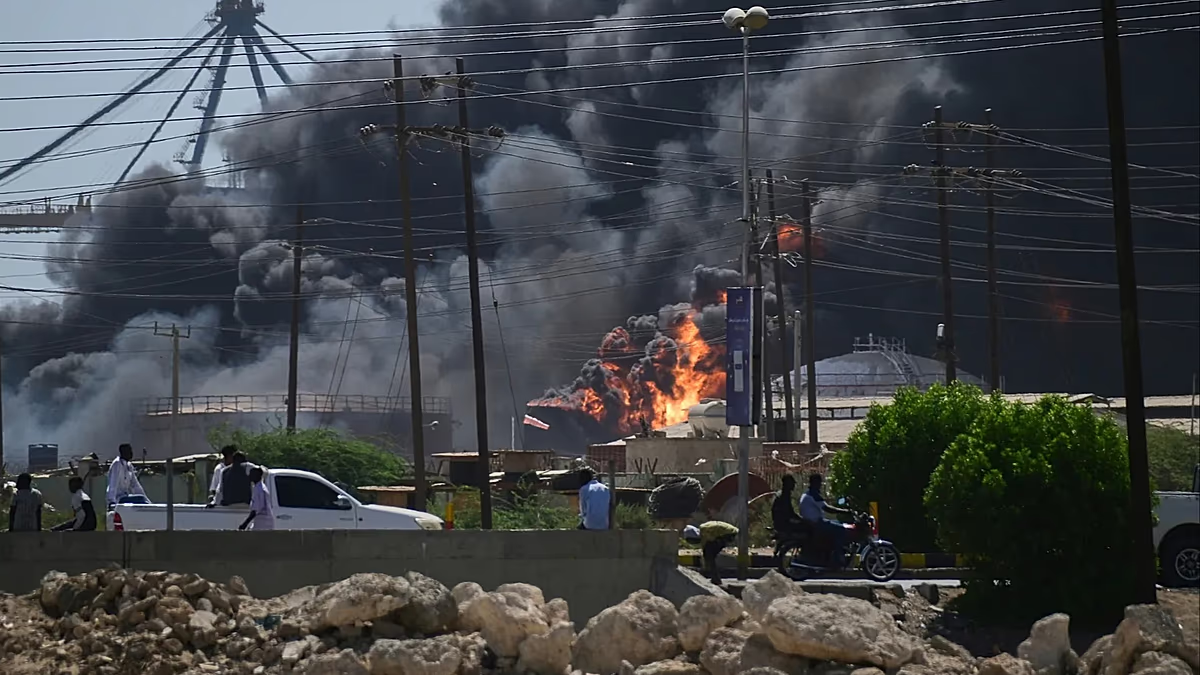
The statistics that frame this conference are not mere numbers; they are a map of human devastation. Since April 2023, the conflict between the SAF and RSF has created what is now the world’s worst displacement crisis, with over 11 million people forced from their homes. Death toll estimates vary horrifically, ranging from 150,000 to as many as 400,000 lives lost. On the ground, 28.9 million people—nearly 62% of Sudan’s population—face acute food shortages. More than 21 million endure acute food insecurity. The United Nations Development Programme paints an even grimmer picture of systemic collapse: poverty rates have skyrocketed from about 38% before the war to approximately 70% today. Average incomes have fallen to levels not seen since 1992, and extreme poverty is now worse than in the 1980s. As the UNDP representative emphasized, these figures represent “families torn apart, children out of school, livelihoods lost and a generation whose prospects are steadily diminishing.”
This conference, therefore, operates in a space of profound tension. It aims to address a civilian catastrophe while consciously sidestepping the political actors directly causing it. An expert pointed out the importance of also addressing the states that indirectly support the warring parties, calling for “real accountability.” Meanwhile, the absence of the combatants speaks to the fraught nature of international engagement in Sudan, where providing aid must navigate the complexities of legitimizing or engaging with belligerent forces. The challenge is immense: how to effectively channel life-saving assistance through and around a chaotic, active conflict zone without becoming entangled in its politics.
The path forward is fraught with obstacles beyond funding gaps. Some key Sudanese political groups, like the National Forces Alliance, have boycotted the conference, criticizing the exclusion of the Sudanese government and the involvement of groups linked to rival administrations. This underscores the deep fractures within Sudanese society itself, where even efforts focused purely on humanitarian relief can be seen through a lens of political allegiance and legitimacy. The conference’s success will depend not only on securing financial pledges but on ensuring aid can be delivered neutrally and effectively across frontlines and through fragmented territories, reaching those in need regardless of who controls the area.
Ultimately, the Berlin conference is a testament to both international concern and the limitations of that concern in the face of protracted war. It is a gathering centered on human survival—on food, medicine, and shelter—while the political machinery of war continues unchecked. The pledges made here are vital, but as the funding shortfalls show, they are insufficient. The civilian population of Sudan, millions of whom are surviving on less than $2 a day, faces a dual crisis: the immediate violence of conflict and the slow, grinding violence of starvation, displacement, and poverty. The world’s response, as coordinated in Berlin, remains a race against time to alleviate the latter, while the solution to the former—a lasting peace—remains a distant, unanswered question. The hope is that by sustaining lives today, the possibility for a peaceful tomorrow is preserved, but the road between is long and perilous.