



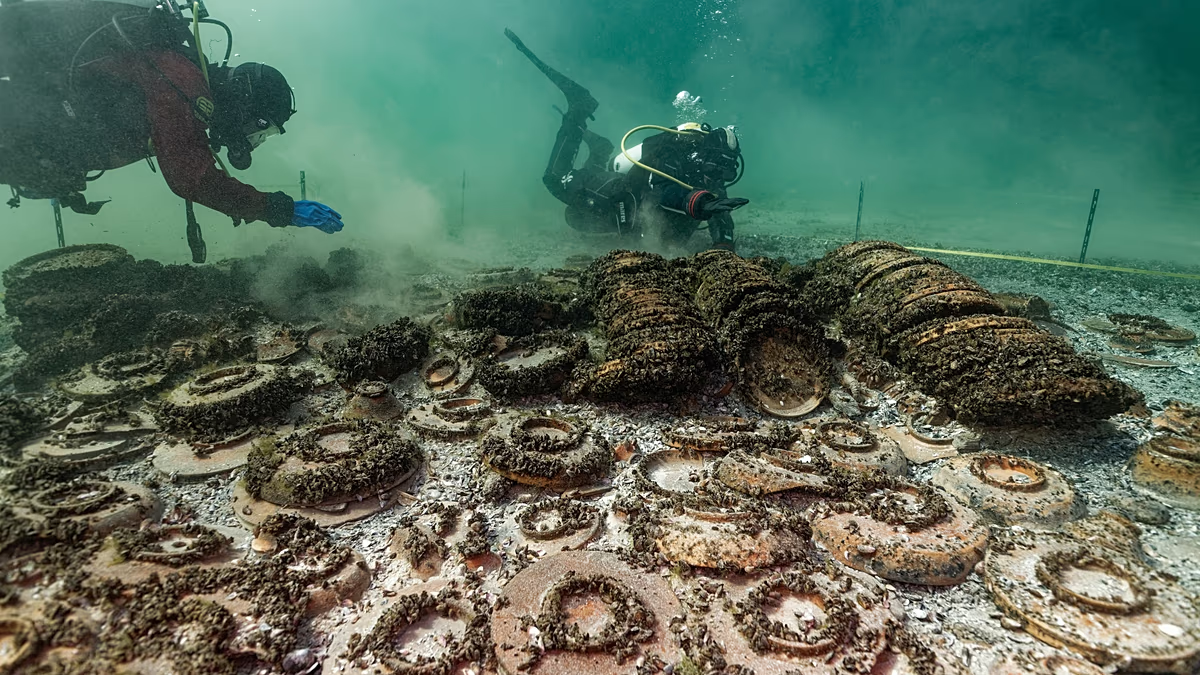
In the clear, cold waters of Lake Neuchâtel, a moment of profound discovery lay hidden beneath the mud. It was the end of November 2024 when divers Fabien Langenegger and Julien Pfyffer, representing the Swiss NGO Octopus Foundation, descended through the depths. Initially, their lights illuminated what appeared to be a menacing pile of circular shapes; a cache of wartime mines was a real and frightening possibility. But as Julien Pfyffer adjusted his camera light, the murky greys transformed into the warm, distinct hue of terracotta. Upon closer inspection, glimpses of ceramic plates emerged from the sediment. In that silent, weightless moment, hovering above the lake floor, both men realized they were not looking at debris but at a story frozen in time—a remarkably preserved cargo from the Roman Empire that had rested undisturbed for nearly two thousand years. The team maintained an extraordinary secrecy around the find for over a year, a necessary vigil to protect the site from modern-day looters while they prepared for the careful work ahead.
The catalyst for this dive had been an anomaly—a dark spot visible in drone footage in a lake that had been unusually clear in recent years, hinting at a potential shipwreck. What followed were meticulous excavation campaigns in 2025 and 2026, revealing not just a few artefacts but a treasure trove of history. The divers painstakingly recovered over one thousand individual objects, each piece a silent witness to a long-ago voyage. The cargo primarily consisted of mass-produced kitchen ceramics, with one wooden crate dated to 17 AD, suggesting the ship sank between 20 and 50 AD. The working theory is that this was a freight ship, a utilitarian vessel loaded with practical goods manufactured in what is now Switzerland, destined for a Roman military camp. While the wooden hull of the ship itself remains lost, perhaps still buried in the soft lake chalk, its inventory speaks volumes about organized trade and supply lines at the edges of the Roman Empire.
However, this was more than a shipment of pots and plates. Nestled amongst the civilian cargo were objects that whispered of a military escort. The archaeologists uncovered two gladiator swords, a dagger, a belt buckle, and a fibula—personal items that likely belonged to Roman legionaries. These finds suggest soldiers were aboard, presumably guarding the valuable shipment. The sheer scale of the cargo itself is telling; researchers estimate it could have supplied an entire legion of up to 6,000 men. This transforms the find from a simple merchant ship into a floating snapshot of military logistics, a crucial link in the chain that sustained Rome’s frontier presence. Each sword hilt and belt fitting pulls us closer to the individuals who once carried them, men far from home on the calm waters of a Helvetian lake.
One of the most touching discoveries was a humble wicker basket, miraculously preserved by the lake’s unique chemistry. Inside were six ceramic vessels, simpler in make and style than the standardized cargo. Archaearians believe this basket represents the personal effects of the crew—the everyday bowls and pots of the sailors themselves, perhaps still holding the remnants of their last meals. This poignant contrast between the impersonal, bulk cargo and the intimate kit of the seamen adds a deeply human layer to the discovery. It reminds us that history is not just about armies and economies, but about the individuals who lived it, from the legionary tightening his belt to the sailor packing his lunch. Even the food residues inside these vessels are now being analyzed, promising to reveal direct clues about the diet and lives of these ancient travelers.
The work now continues on land, where the true detective work begins. As Julien Pfyffer explains, the underwater archaeologists, often working in clouds of swirling sediment, must pass the torch to restorers in the lab. In the careful process of cleaning and conservation, hidden details are emerging: potters’ seals, traces of straw used as protective packaging between plates, and minute food residues. These subtle clues are the fingerprints of the past, invisible during the dive but crucial for a full understanding. The Octopus Foundation team is compiling their findings into a book and a documentary slated for 2027, while the spectacular artefacts are destined for public display at the Laténium museum in Neuchâtel. This process ensures the discovery moves from a secret of the deep to a shared chapter of human heritage.
This extraordinary find in Lake Neuchâtel is a powerful testament to the secrets still held by our waterways and a testament to the patience and passion of underwater archaeologists. As the Octopus Foundation team notes, there are likely more historical artefacts lying on the world’s seabeds and lake beds than in all of our museums combined. Each discovery, like this Roman cargo, is a fragile bridge across time, offering not just objects but narratives. From the gleaming sword of a soldier to the chipped bowl of a sailor, these relics collectively tell a story of commerce, military might, and daily life, patiently waiting centuries for their light to be switched on again.