



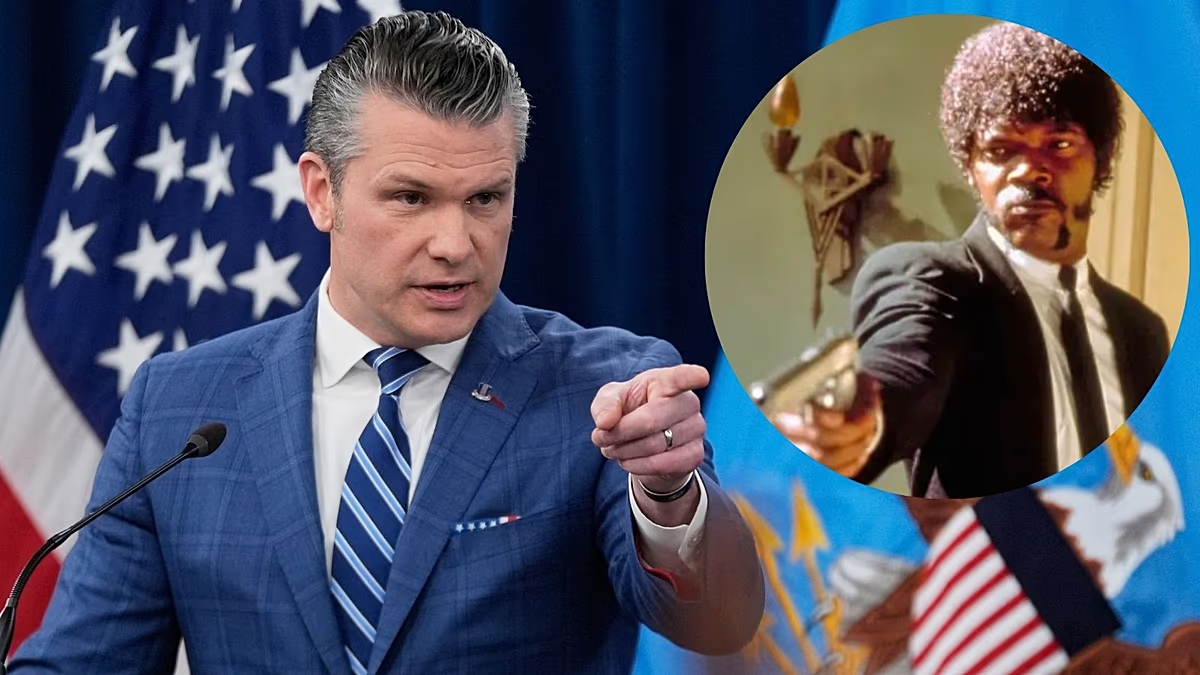
In a political landscape often defined by performative piety and cultural posturing, a recent incident involving U.S. Secretary of War Pete Hegseth has provided a starkly surreal example of both. The episode, which unfolded during a Pentagon prayer service, saw Hegseth—a figure known for his Christian nationalist rhetoric and frequent invocations of scripture—deliver what he presented as a powerful, genuine Bible verse. With dramatic flair, he attributed the words to the heroic “Sandy 1” search and rescue team, which had recently saved a downed airman in Iran. The prayer was a call for divine vengeance and camaraderie, ending with a resounding “Amen.” There was only one profound problem: the verse was not from the Bible at all. It was, almost verbatim, the fictional, cinematic scripture recited by Samuel L. Jackson’s hitman character, Jules Winnfield, in Quentin Tarantino’s 1994 cult classic, Pulp Fiction.
The parallels are impossible to ignore. Compare Hegseth’s “path of the downed aviator is beset on all sides by the inequities of the selfish and the tyranny of evil man” to Jackson’s iconic “path of the righteous man is beset on all sides by the inequities of the selfish and the tyranny of evil men.” Hegseth swapped “charity and good will” for “camaraderie and duty,” and “the weak” for “the lost,” before concluding with the militarized twist, “you will know my call sign is Sandy 1.” The core structure, rhythm, and menacing promise of “great vengeance and furious anger” were lifted directly from Tarantino’s script. This was not a casual allusion or a clever homage; it was a wholesale appropriation, delivered with solemn gravity as sacred text. The moment transcended mere gaffe, entering the realm of profound cultural and theological farce.
Unsurprisingly, the reaction was swift and merciless. The digital public sphere erupted with a mixture of disbelief, mockery, and accusation. Hegseth was labeled a “Fake Christian” and a “clown,” his serious demeanor juxtaposed against the pulp violence of Tarantino’s universe in a dissonance ripe for satire. Commentators and politicians, including California Governor Gavin Newsom, gleefully trolled the Secretary, with Newsom sharing a mock movie poster branding the administration “Pulp Fiction.” The scene felt ripped from a Saturday Night Live cold open, yet it was unfolding in the hallowed halls of the Pentagon. The defense mounted by his chief spokesman, Sean Parnell, only deepened the absurdity, claiming the prayer and the film were both merely “reflections” of the actual Ezekiel 25:17—a verse that bears almost no resemblance to Tarantino’s invented poetry.
This clumsy attempt at damage control highlights a deeper, more troubling tendency within certain political circles: a reflexive dismissal of factual critique as “fake news” and a branding of critics as “ignorant of reality.” Parnell’s statement insisted on a connection to Ezekiel that simply does not exist textually, forcing a square peg of pop culture into a round hole of scripture. The actual Biblical verse is a brief, generic proclamation of vengeance, devoid of the specific, elaborate poetry Tarantino—and now Hegseth—employed. This post-hoc justification suggests not just embarrassment, but a willingness to reconstruct reality to shield a figure from ridicule, further eroding public trust in official statements and blurring the lines between sincere belief and narrative convenience.
The incident is far more significant than a simple case of mistaken citation. It serves as a potent metaphor for a political culture steeped in cultural illiteracy yet obsessed with cultural signaling. Hegseth, seeking to project an image of warrior piety, reached for what he perceived as the rhetorical height of righteous anger. In doing so, he inadvertently revealed that the source code for his conception of divine justice was not the ancient prophets, but a postmodern film about gangsters and redemption. It underscores a hollowness where style is consistently mistaken for substance, and where the iconography of faith is leveraged for authority, even when its content is unrecognized. The “gospel of Tarantino” moment lays bare the performative nature of the spectacle, where the line between a Pentagon prayer and a movie scene can vanish, leaving only the unsettling echo of a trigger pull.
As of now, neither Quentin Tarantino nor Samuel L. Jackson has publicly responded to this unexpected adoption of their work into U.S. military-devotional practice. One can only imagine their bemused reactions. Perhaps they would appreciate the bizarre, circular nature of art influencing life, which then becomes a new kind of cultural artifact. For the rest of us, the episode stands as a sobering and darkly comic reminder of the power of narrative. It asks uncomfortable questions about what texts we truly hold sacred, what voices we accept as authoritative, and how easily potent fiction can be mistaken for foundational truth when delivered from a podium of power. In the end, the Secretary of War did not quote the Bible, nor did he merely quote a movie; he performed a perfect, unintentional allegory for our times.