


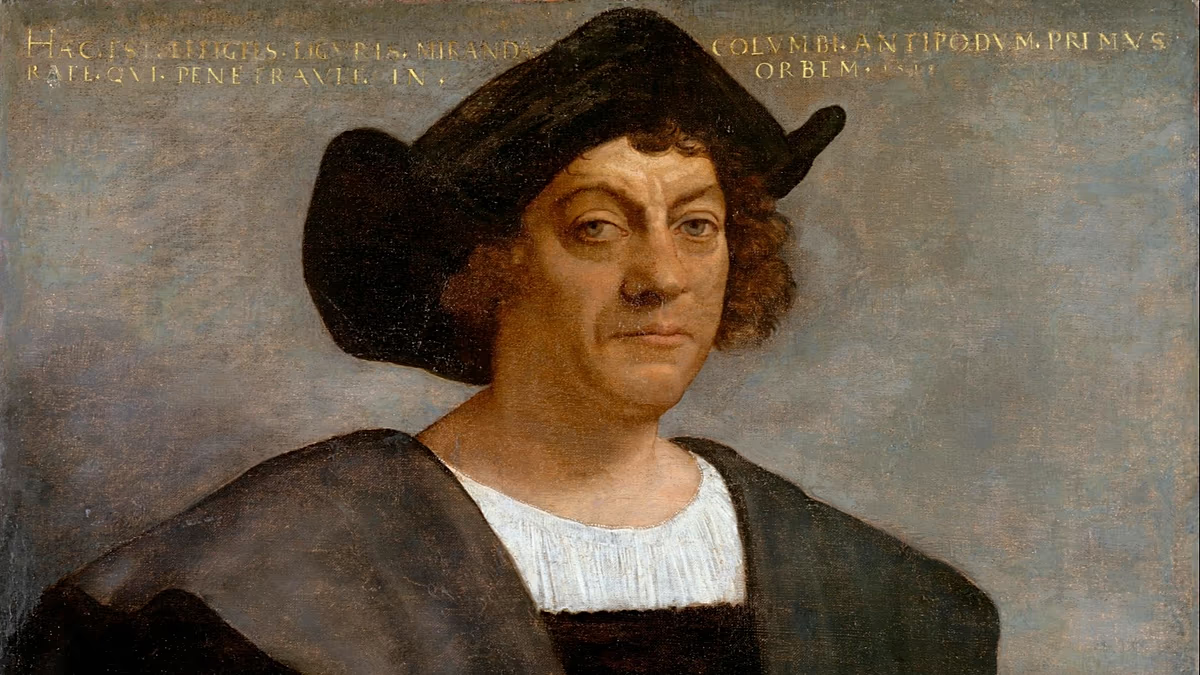
Five centuries after Christopher Columbus completed his first voyage across the Atlantic, the definitive story of who he really was remains stubbornly out of reach—a historical enigma wrapped in layers of myth, nationalism, and personal secrecy. For generations, the official account in textbooks has been that of a Genoese weaver’s son: a rough-hewn, self-taught mariner of modest origins who persuaded the Spanish monarchs to bet on a radical westward route to Asia. Yet that familiar origin story has long been shadowed by doubt, challenged by a mosaic of anomalies that don’t quite fit the picture. Historians, linguists, and now, increasingly, geneticists have pointed to curious gaps, odd turns of phrase in Columbus’s own writings, and puzzling silences in the archives. The man who reshaped the world’s maps seemingly took pains to obscure the map of his own past, leaving behind a question that endures as powerfully as his legacy: Where did Columbus come from, and why did he hide it?
The latest chapter in this centuries-long mystery comes not from an archive or a ship’s log, but from a peaceful crypt in Gelves, a town in southern Spain. Here, resting in the ancestral vault of the Counts of Gelves, lay what seemed an unlikely key: the remains of at least seven direct descendants of Christopher Columbus. In March 2022, the stillness of the crypt was broken by a team of researchers from Citogen laboratory and the Complutense University of Madrid. Their mission was to extract DNA, hoping genetics might cast light where paper records had failed. The results, recently detailed in a preliminary scientific report, point toward a figure straight out of Galician feudal lore: the formidable, battle-hardened nobleman Pedro Álvarez de Sotomayor, better known in history and ballad as Pedro Madruga. This is, in many ways, the finding nobody expected—a genetic whisper from the past that challenges the bedrock of a national legend.
What set the discovery in motion was a small, intriguing contradiction. The researchers analyzed the DNA of twelve individuals exhumed from the Gelves crypt and found that two of them shared a significant amount of genetic material, despite historical documents showing no direct genealogical link between them. One was Jorge Alberto de Portugal, the 3rd Count of Gelves, and a great-great-grandson of Columbus. The other was María de Castro Girón de Portugal, a 17th-century countess who married into the family; her lineage was purely Galician, tracing back to the Counts of Lemos. For two people connected only by marriage to share DNA, only one explanation was possible: somewhere, hidden in the unwritten branches of the family tree, was a common ancestor. Using computational models to test sixteen generations of genealogy, the team pinpointed that missing link. Every calculation pointed, as lead researcher Isabel Navarro-Vera explains, to Pedro Álvarez de Sotomayor. To confirm it, they virtually removed “Pedro Madruga” from the family tree—and just like that, the genetic link between the two individuals disappeared. No other ancestor, among hundreds analyzed, produced the same effect.
So who was Pedro Madruga, and why would he be linked to Columbus? He was no humble sailor, but a towering figure of 15th-century Galicia—a powerful, ruthless feudal lord who commanded lands and fortresses from his castle at Sotomayor. He was a player in the brutal civil wars of Castile, an ally of Portugal at times, and a thorn in the side of the very Catholic Monarchs who would later fund Columbus’s voyage. Then, around 1486, something remarkable happened: Pedro Madruga vanished from all historical records. That same year, a man calling himself Christopher Columbus appeared for the first time at the court of Queen Isabella and King Ferdinand. This eerie chronological echo—one life disappearing as another emerges—is the cornerstone of a theory first proposed by Galician historian Celso García de la Riega over a century ago. Supporting clues have accumulated ever since: Columbus’s writings contain turns of phrase characteristic of Galician-Portuguese speech; the coat of arms granted to him by the monarchs incorporated heraldic elements associated with the Sotomayor family; and the respectful, familiar treatment he received at court from the start puzzled many contemporaries, who noted he seemed less an unknown foreigner and more like a man already recognized in certain circles.
For all the intrigue, the research team is careful to emphasize that what they have is strong, but still indirect, evidence. Their findings come not from Columbus’s own body—his contested remains rest in Seville Cathedral—but from the DNA of his descendants. This requires independent verification, and the scientific debate is far from settled. At the University of Granada, a team led by Professor José Antonio Lorente has studied the bones in Seville for years, and in 2024 pointed toward a very different origin—a Sephardic Mediterranean background. Meanwhile, the Genoese theory still commands the broad support of mainstream historians, anchored by Columbus’s own will of 1498, in which he declared himself a native of Genoa. Supporters of the Galician hypothesis counter that a man who spent a lifetime obscuring his identity would hardly disclose the truth at the very end, especially when aligning with Genoa suited his heirs’ political and financial interests.
Ultimately, what has changed is not the historical question, but our toolkit for answering it. This new study offers the first genomic data compatible with a noble lineage from northern Spain. To move from a compelling hint to an accepted fact, the scientific community calls for full transparency: publishing the raw genetic data in open repositories, replicating the analyses in independent labs, and incorporating broader databases of historical population genetics. Until then, the man who dared sail over the edge of the known world remains, in a profound sense, a man sailing away from us—keeping his origins hidden in the mist, five hundred years on. The mystery of Columbus endures, a reminder that history is not just written in documents, but carried in blood and bone, waiting for the right moment to speak.