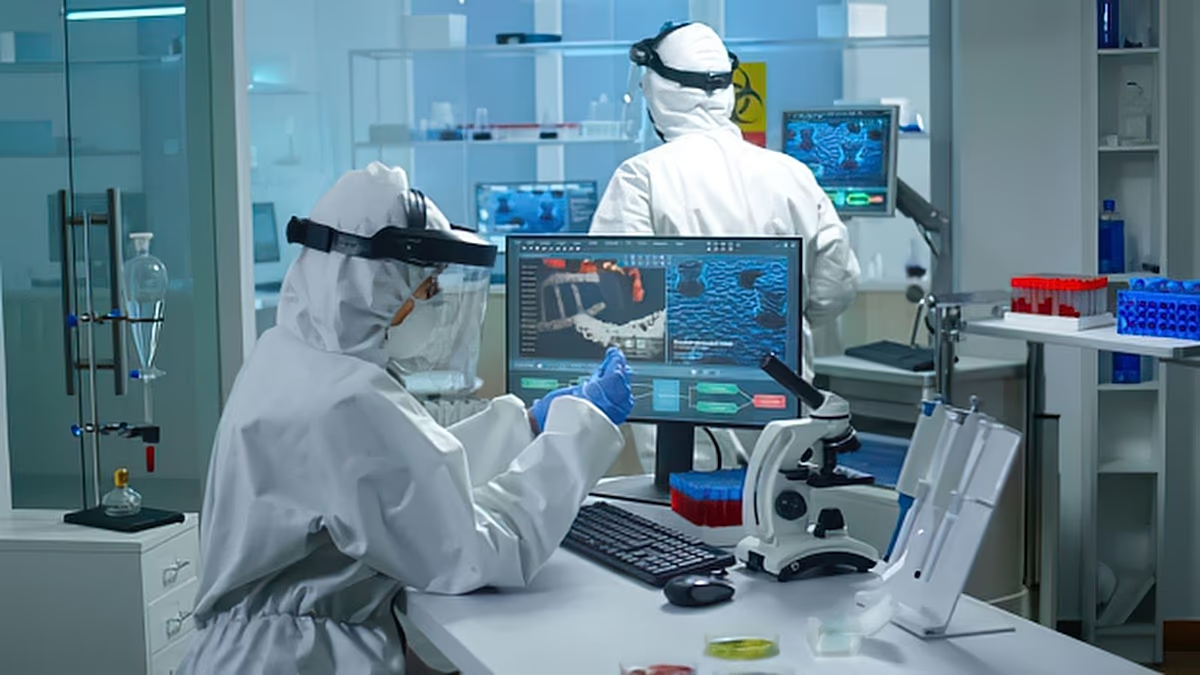




In the ever-evolving landscape of scientific discovery, where unlocking the mysteries of biology can lead to transformative medicines and therapies, a significant bottleneck has long persisted. Progress is not merely hampered by the intrinsic difficulty of the science itself, but by the immense complexity of modern research workflows. Scientists must navigate vast oceans of published literature, decipher intricate relationships between genes and proteins, plan meticulous experiments, and analyze colossal datasets—a process that can be slow and fraught with the potential for human oversight. Recognizing this challenge, OpenAI, a leader in artificial intelligence development, has now stepped decisively into this realm with the launch of a specialized new model named GPT-Rosalind.
This model’s name pays homage to Rosalind Franklin, the pioneering British scientist whose crucial X-ray diffraction work was instrumental in uncovering the double-helix structure of DNA. The naming is a poignant tribute, reflecting the ambition that GPT-Rosalind will serve as a similarly foundational tool for a new era of discovery. OpenAI describes the GPT-Rosalind series as a model built explicitly for modern scientific work, engineered to reason across the core elements of life sciences: molecules, proteins, genes, pathways, and the biology of disease. Unlike general-purpose AI, its strength lies in sophisticated multi-step reasoning, effectively utilizing specialized scientific tools and databases to assist in tasks from literature review to experimental planning and data analysis. The goal is not just to make existing workflows more efficient, but to augment human intellect—helping researchers explore more possibilities, surface hidden connections, and arrive at better hypotheses more swiftly.
The introduction of GPT-Rosalind marks a strategic and deepening commitment by OpenAI to the fields of health and medicine, areas that AI is already beginning to transform by accelerating drug discovery and shortening the pipeline from lab to clinic. OpenAI is not developing this tool in isolation; it is collaborating with a cadre of leading biotechnology firms and research centers, including Amgen, Moderna, the Allen Institute, and Thermo Fisher Scientific. These partners are applying the model across their workflows to accelerate research. Stéphane Bancel, CEO of Moderna, has noted that GPT-Rosalind is already demonstrating its value by synthesizing complex biological data and translating those insights into actionable experimental plans, potentially speeding up the pace of R&D significantly.
This launch is part of a broader, growing bet on AI-driven science by OpenAI. Just days prior to the GPT-Rosalind announcement, the company revealed a partnership with the Danish pharmaceutical giant Novo Nordisk. This collaboration aims to leverage AI across research & development, manufacturing, and commercial operations to help bring new and better treatments to patients faster, with a target for full integration by year’s end. OpenAI CEO Sam Altman encapsulated the driving vision, stating, “AI is reshaping industries, and in life sciences, it can help people live better, longer lives.” These moves signal a clear corporate direction: to position advanced AI as a central catalyst in one of society’s most critical domains.
OpenAI views GPT-Rosalind not as a finished product, but as the beginning of a long-term journey. Following this initial release, the company plans to continue expanding the model’s biochemical reasoning capabilities, focusing on long-horizon, tool-heavy scientific workflows. The aspiration is profound—to build AI that can meaningfully accelerate scientific discovery in areas that matter deeply to humanity. By providing a dedicated intelligence that can navigate the specialized language and logic of biology, GPT-Rosalind offers a powerful new partner for the research community.
In essence, GPT-Rosalind emerges as a specialized intellectual engine designed for the laboratory. It stands as a testament to the evolving role of AI, transitioning from a general-purpose tool to a domain-specific collaborator. By honoring Rosalind Franklin’s legacy in its name, OpenAI symbolizes a hope that this model will provide the kind of clarifying insight that leads to fundamental breakthroughs. As it integrates into the workflows of premier research institutions, GPT-Rosalind has the potential to become a cornerstone in the quest to understand life’s complexities and to translate that understanding into healing, echoing Franklin’s own contribution to one of science’s greatest revelations.