


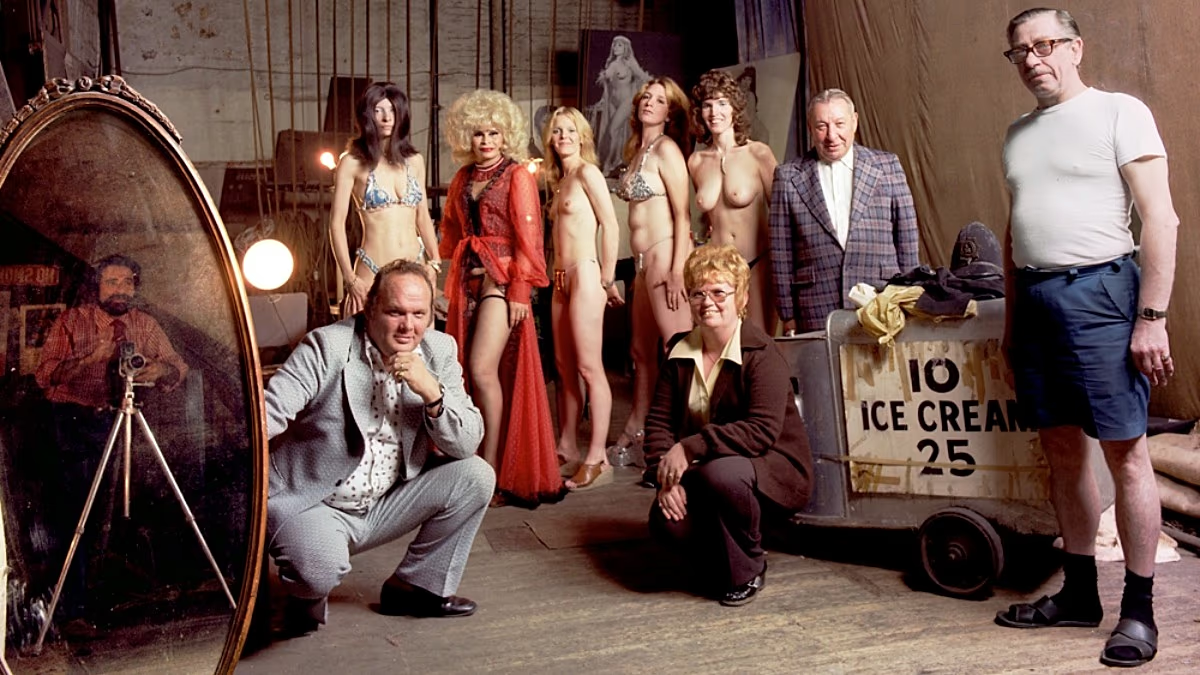
Neal Slavin stands as a foundational figure in the realm of group photography, an artist whose pioneering use of colour and unsentimental eye created a crucial visual record of American social structures in the late 20th century. His landmark 1976 book, When Two or More Are Gathered Together, is now celebrating its 50th anniversary with a revised edition, and a major exhibition, Photography and Belonging, at Düsseldorf’s Kunstpalast, highlights his enduring legacy. For Slavin, the group portrait was never about an anonymous crowd; it was always a gathering of distinct individuals. His epiphany came from an old panoramic photo of a Boy Scout troop, which sparked a profound reflection on memory and time. He realized that photography, more than any other medium, has the unique power to evoke and relive memory, freezing a constellation of individual lives in a single, resonant moment. This understanding—that a group is a temporary congregation of unique personal histories—became the core philosophy driving his work.
Slavin’s commitment to colour photography was both deliberate and defiant, positioning him at the vanguard of a movement that fought for artistic legitimacy. In the early 1970s, colour was largely relegated to commercial advertising, while black-and-white was considered the serious artistic medium. He and his contemporaries faced skepticism from the photographic “old guard,” but they persisted, seeing colour as essential truth-telling—a vital layer of information. A pivotal moment came when photographing volunteer ambulance drivers with their race trophies; in black and white, the gold and silver trophies were indistinguishable, but in colour, their meaning was clear. This proved to Slavin that colour was not merely decorative but informational, a crucial tool for capturing the reality of the world. He was not seeking to replace black-and-white, which he admired as a beautiful abstraction, but to extend photography’s descriptive language to match the vividness of lived experience.
The methodology behind Slavin’s iconic portraits is as significant as their visual impact. He deliberately allowed his subjects to arrange themselves within the frame, a radical departure from the rigid, director-controlled group shots of the past. By simply telling people to “take up any place you want… wherever you think you belong,” he unlocked a subtle theatre of hierarchy, identity, and power. This process revealed natural leaders, shy participants, and the complex web of social bonds. Slavin would then gently adjust the composition, but always with respect for individual agency, often forming what he called “fifty ten-minute friendships” within the group. This approach affirmed his core belief: a group is not a monolithic entity but a collection of individuals. The resulting photographs are thus unsentimental sociological documents, marked by a deep empathy that balances precision with humour, capturing the authentic, sometimes awkward, and always human dynamics of togetherness.
Fifty years on, Slavin felt the reissue of his seminal book was urgently timely. He observes a world where genuine, physical congregation is diminishing, supplanted by digital interaction through screens, smartphones, and social media. Where people once said “see you later,” they now say “see you online.” In this context, his work serves as a vital reminder of the irreplaceable human need for physical community. He argues that while the selfie has become the new dominant form of self-portraiture, it cannot replicate the rich, roadmap-like narrative of a group portrait, which charts the relationships and space between individuals. For Slavin, groups are an existential necessity; without them, we risk becoming “a planet of ghosts.” His work, therefore, is a poignant counterpoint to contemporary isolation, celebrating the enduring, if changing, instinct to gather.
When asked if decades of social and political division have changed how he views his own archive, Slavin’s perspective is strikingly consistent. He believes people at their core remain the same, driven by the same fundamental needs for rights, recognition, and belonging. The causes and contexts may evolve, but the human essence—the desire to form alliances, to confront, to belong—is a constant. This unwavering focus on shared humanity guides his selection of images, whether from the 1970s or 2023; a successful photograph is one that continues to “talk back” to him, vibrating with life and communication long after it is taken. For European audiences, he hopes the images transcend their specifically American setting to speak to universal behaviours—how people communicate, negotiate space, and form identity within a collective. The fascination, he notes, lies less in America itself and more in the “open discourse” and visible social experimentation of its people.
Reflecting on photography’s radical transformation from analogue to digital and AI, Slavin expresses ambivalence. The gains are clear: unprecedented access and the ability to instantly document life. However, he worries deeply about a concomitant “dumbing down,” where automated tools and screen-mediated communication erode our active engagement with the world and each other. Yet, he concludes, the fundamental human impulse behind the lens remains unchanged. Whether with a smartphone or a view camera, we are still seeking connection, memory, and self-reflection. Photography’s role, in an era saturated with images, endures as our primary mirror. Neal Slavin’s lifelong project, ultimately, is a manifesto for presence—a powerful argument that through the group portrait, we see not just a record of who we were, but a map for how, together, we truly are.