

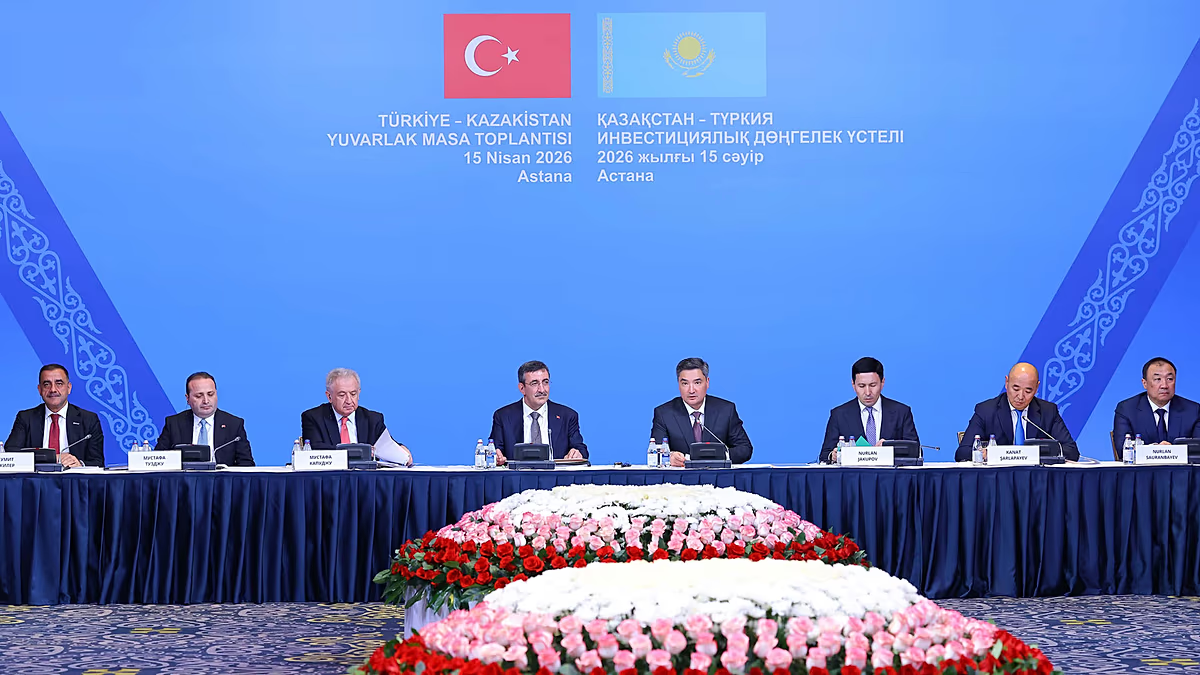
In a significant step towards deepening their longstanding ties, Kazakhstan and Türkiye have committed to a robust and pragmatic new phase of economic collaboration. During the 14th Intergovernmental Commission meeting in Astana, held between Kazakh Prime Minister Olzhas Bektenov and Turkish Vice President Cevdet Yılmaz, the dialogue moved decisively beyond symbolic diplomacy. Both leaders articulated a shared vision focused on tangible outcomes: diversifying a trade relationship historically anchored in raw materials and launching concrete joint industrial projects. This shift represents a strategic maturation of their partnership, aiming not just to increase the volume of exchange but to fundamentally transform its nature, building more resilient and integrated economies for both nations.
Central to this new roadmap is an ambitious quantifiable goal: lifting bilateral trade volume to $15 billion. This target, set by the countries’ presidents, builds on a relationship already experiencing strong momentum. As Vice President Yılmaz noted, trade has recently renewed a record, reaching the $10 billion mark. Achieving the new objective will require navigating specific practical challenges. Yılmaz explicitly identified accelerating customs and logistics processes as a top priority, acknowledging that bureaucratic and infrastructural hurdles must be overcome for trade to flow smoothly. Furthermore, both sides emphasized that mutual investment is the critical engine for sustainable growth, moving beyond a simple buyer-seller dynamic to a more intertwined economic fate.
The commitment to a “new investment cycle,” as directed by Kazakh President Kassym-Jomart Tokayev, is where this vision becomes concrete. Kazakhstan is actively seeking to pivot its exports from primary resources to higher value-added goods, and it sees Turkish expertise and capital as a key catalyst. The meeting yielded a promising portfolio of specific joint projects that illustrate this symbiosis. Plans include constructing an agricultural processing plant in Astana, developing a logistics hub in Aktobe, expanding pharmaceutical production in Almaty, and launching an aluminium plant in Shymkent. These initiatives, spread across Kazakhstan, promise technology transfer, job creation, and the development of new industrial clusters, with the Kazakh government pledging full support to bring them to fruition.
A powerful geopolitical and economic dimension underpins this bilateral cooperation: the strategic development of the Middle Corridor. This transit route, connecting Asia and Europe across Central Asia and the Caucasus, is gaining unprecedented importance. Vice President Yılmaz framed it not as a mere alternative but as a “mandatory choice” in global logistics. With the Northern Corridor facing geopolitical unpredictability and southern routes straining capacity, the Middle Corridor, with Kazakhstan and Türkiye as its pivotal anchors, offers a vital stable pathway. Yılmaz eloquently described it as a line that will bear “the load of all Eurasia,” arguing that strengthening this infrastructure is foundational for building lasting regional prosperity. This shared transit vision adds profound strategic weight to their economic partnership.
The existing foundation for this ambitious leap forward is already substantial. Türkiye stands among Kazakhstan’s top five trading partners, with over 5,000 Turkish-capital companies operating in the country—a testament to deep business-level engagement. Their joint project portfolio encompasses more than 170 initiatives valued at approximately €8 billion. Recent trade figures show healthy growth, with bilateral exchange reaching €4.6 billion in a recent period, a 9% increase, driven by a notable 17% surge in Kazakh exports. This data confirms the relationship’s positive trajectory and provides a solid base from which to launch the more complex, project-driven cooperation now envisioned.
The momentum from this commission meeting is set to accelerate with high-level political engagement. Turkish President Recep Tayyip Erdoğan’s upcoming visit to Kazakhstan will see the partnership elevated to the summit level through the High-Level Strategic Cooperation Council, where a new set of agreements is expected to be signed. Furthermore, both leaders will engage in broader Turkic collaboration at the informal summit of the Organization of Turkic States. These parallel diplomatic tracks underscore that the burgeoning economic cooperation between Astana and Ankara is not occurring in isolation. It is nested within a wider framework of cultural, historical, and political alignment, suggesting that the $15 billion trade target and the shared industrial future are not just aspirational goals but achievable milestones on a well-charted path.