



For roughly one in ten Europeans over the age of 60, the steady, reliable rhythm of the heart is disrupted by a condition known as arrhythmia. This isn’t a singular experience but a spectrum of unsettling sensations that can dramatically alter a person’s quality of life. As explained by Dr. Petr Neužil, a leading cardiologist at Prague’s Na Homolce Hospital, the condition is a study in contrasts. One patient may feel nothing at all, completely unaware of the electrical misfires within their chest. Another might be plagued by persistent palpitations—a fluttering or pounding sensation that serves as a constant, anxious reminder. For others, the effects are far more debilitating, manifesting as crushing breathlessness, profound weakness, and an overwhelming inability to perform simple daily tasks. This variability makes it a deeply personal and often frightening ailment, demanding solutions that are both effective and accessible.
The gold-standard treatment for many serious arrhythmias is a procedure called catheter ablation. It is a marvel of modern medicine, a minimally invasive technique where doctors thread incredibly flexible tubes through a patient’s blood vessels all the way to the heart. Once in position, the tip of the catheter applies either extreme heat or cold to create tiny, precise scars on the heart’s surface. These scars act as insulation, blocking the erratic electrical pathways that cause the chaotic heartbeats. While highly successful, the system faces a critical strain: demand vastly outstrips capacity. In Czechia alone, hospitals can only perform about 10,000 such procedures annually, leaving roughly three-quarters of patients in need on a waiting list. The delay for this life-changing intervention can be agonizing, stretching up to ten months, a period during which a patient’s health and peace of mind continue to deteriorate.
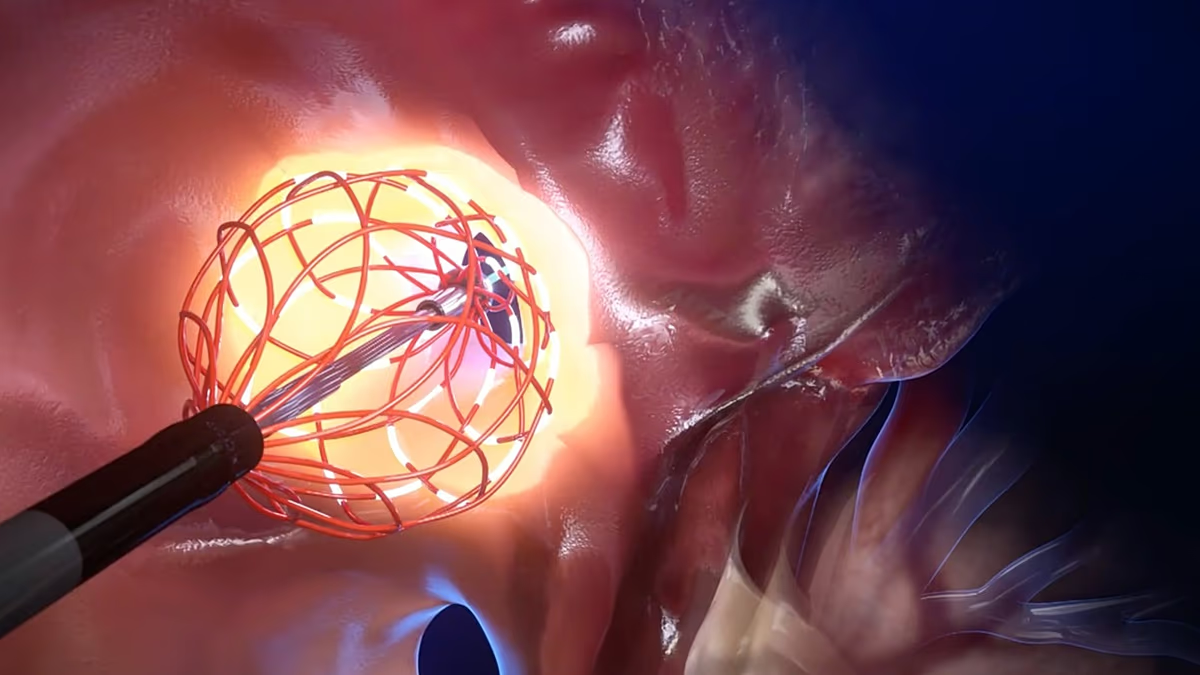
It is this pressing gap between need and resource that has spurred a significant innovation, currently undergoing clinical study at hospitals like Na Homolce. The catalyst is a new type of catheter, developed by the global medical technology company BTL Industries, designed to revolutionize the ablation process itself. The core challenge with traditional catheters is their piecemeal approach; they treat arrhythmic tissue spot-by-spot, which can be time-consuming and requires meticulous, prolonged manipulation inside the heart. The new device turns this paradigm on its head. It is engineered to cover a much larger area of unhealthy tissue with a single, ultra-short energy pulse. As Dr. Neužil highlights, this “single shot” methodology means less time with catheters inside the patient, fewer individual applications of energy, and less complex manipulation—streamlining the entire operation from start to finish.
The technological leap behind this efficiency is profound. Martin Hanuliak of BTL explains that the catheter delivers its energy in microsecond pulses—that’s one-millionth of a second. This incredible speed is key to its safety and efficacy. These microsecond pulses are uniquely tuned to selectively destroy the problematic heart muscle tissue (myocardium) while strategically sparing surrounding structures like nerves and the esophagus. This precision not only makes the procedure safer but also promotes faster and more complete healing of the heart itself. Furthermore, as product manager Jiří Dašek details, this is no ordinary catheter. It represents a feat of micro-engineering, packed with moving parts smaller than a millimeter, a stark departure from the static, straight catheters of the past. This allows for dynamic positioning and more adaptable treatment.
BTL’s commitment to this project reflects a broader corporate philosophy where sustained growth is inextricably linked to continuous innovation. With 650 engineers among its 4,500 global employees and a production line that assembles over a million electronic boards into 40,000 different medical devices each year, the company is a hub of healthcare technology. The new catheter is a flagship project in this ongoing drive. Once it receives the necessary regulatory approvals from health authorities, BTL plans for the entire production—from the sophisticated catheter to its control unit—to be located within the European Union, ensuring supply chain resilience and supporting regional high-tech manufacturing.
The potential benefits of this advancement extend far beyond the technical specifications. By significantly shortening procedure times—from potentially several hours down to a matter of minutes for the ablation itself—the new technology promises a cascade of positive outcomes. Hospitals can treat more patients, dramatically reducing those daunting waiting lists. Operational costs are lowered through shorter operating room occupancy and fewer disposable tools. Most importantly, patients experience a safer procedure with a reduced burden on their bodies, leading to quicker recoveries and a faster return to normal life. With clinical studies now underway, doctors and developers are looking ahead with optimism, hoping to see this innovative tool available on the European market by the beginning of 2028, offering new hope and a quicker path to healing for hundreds of thousands living with an unsteady heartbeat.