



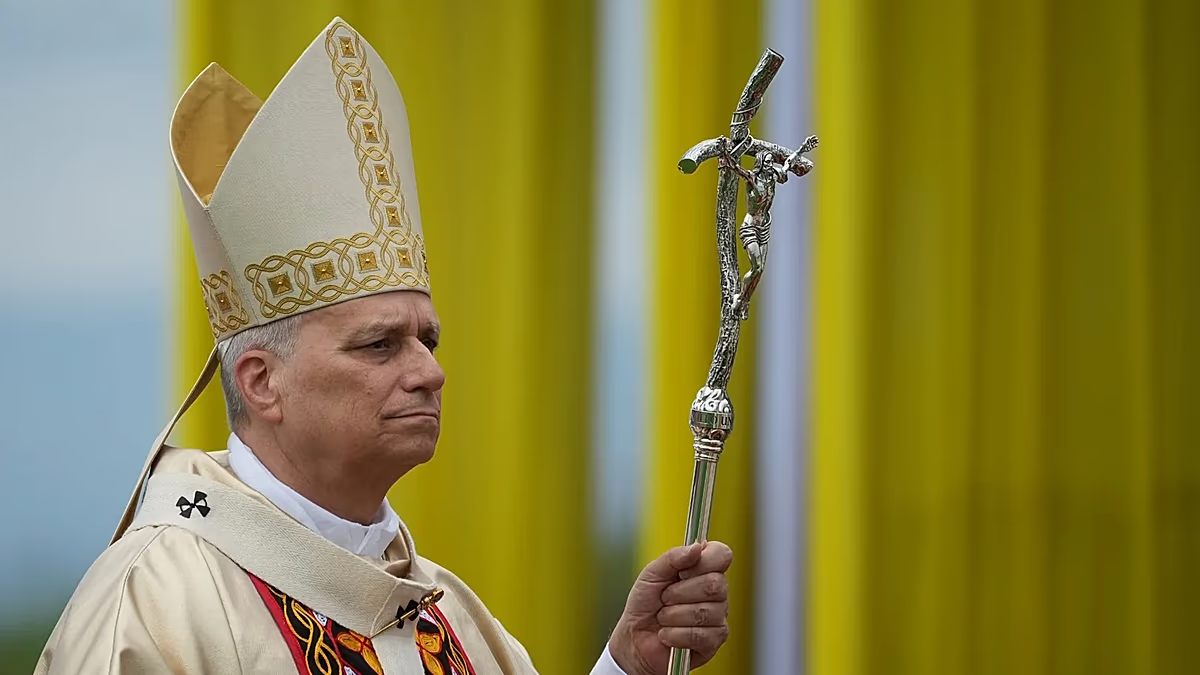
In a solemn and resolute address delivered on Thursday, Pope Leo XIV stood before the faithful in the city of Bamenda, Cameroon—a region scarred by nearly a decade of separatist conflict—and issued a powerful condemnation of global injustice. Departing from his previously restrained diplomatic tone, particularly after recent tensions with US President Donald Trump, the pontiff spoke with moral clarity against those exploiting faith and power for gain. “Woe to those who manipulate religion and the very name of God for their own military, economic and political gain,” he declared, framing a world ravaged by a “handful of tyrants” yet sustained by the compassion of ordinary people. His words, coming after US Vice President JD Vance advised the Vatican to focus solely on morality, marked a deepening of the rhetorical rift with the Trump administration and underscored the Pope’s commitment to speaking on peace as a matter of urgent, global ethics.
The setting for this speech was profoundly symbolic. Bamenda, the epicentre of Cameroon’s Anglophone insurgency, is a place where thousands have died in a conflict rooted in feelings of marginalisation. Arriving under heavy military escort in a bulletproof popemobile, Pope Leo was met by a joyous, singing crowd offering a stark contrast to the region’s pain. Within the St. Joseph’s Cathedral, he acknowledged this duality, calling the area a “bloodstained yet fertile land.” As he departed, he released white doves—a gesture of hope for peace in a territory he described as “mistreated.” His message here was specific and piercing: he linked the local cycle of violence directly to global economic systems, accusing those who plunder resources of reinvesting profits into weapons, thereby perpetuating “an endless cycle of destabilisation and death.” He lamented the grotesque imbalance where billions are spent on devastation while funds for healing and education remain scarce.
Later, at a mass at Bamenda’s recently renovated airport—shut for years due to the war—the Pope expanded his critique to a broader indictment of Africa’s exploitation. With a strong social justice theme, he denounced “those who, in the name of profit, continue to lay their hands on the African continent to exploit and plunder it.” This directly addressed Cameroon’s context, a nation rich in oil, timber, cocoa, and minerals that has long attracted foreign extraction and fueled local elite enrichment. His visit, occurring just six months after a violent state crackdown on protests following President Paul Biya’s disputed re-election, carried immense political weight. Indeed, upon his arrival in Cameroon, Pope Leo had already urged the country’s leaders to examine their conscience regarding corruption and rights abuses—a pointed challenge delivered in the presence of the 93-year-old Biya, who has ruled since 1982.
The human reality of the conflict the Pope addressed was palpable in the streets of Bamenda. Teacher Vivian Ndey, 60, attended the cathedral events carrying a “plant of peace” and spoke of the crisis’s toll on education: teachers fearful, students vanished. Her presence highlighted the civilian suffering in a war that erupted after the government’s violent repression of peaceful Anglophone protests in 2016. Since then, according to the UN, at least 6,000 people have been killed, with civilians enduring killings and kidnappings. Separatist fighters, who declared a Republic of Ambazonia in the two English-speaking regions, had even announced a three-day truce to allow for the Pope’s safe visit—a testament to the symbolic power of his presence. The heightened security on Bamenda’s routes underscored the lingering danger, but also the profound hope that his message might offer a path toward reconciliation.
This African tour, Pope Leo XIV’s first since his election, represents a significant evolution in his papacy. Beginning earlier this week, it has seen him abandon cautious diplomacy to advocate forcefully for peace, a shift notably catalyzed by Trump’s criticism of his stance on Iran. In Cameroon, he connected the specific tragedy of a local insurgency to universal patterns of greed and oppression, framing the plunder of resources as a direct driver of conflict. His words were not merely a spiritual comfort but a call for systemic accountability, aimed at both local power structures and global economic actors.
Following his historic visit to Bamenda, Pope Leo XIV will continue his journey with a mass in Douala before departing for Angola and Equatorial Guinea. His tour underscores a commitment to engaging with Africa’s complex realities—its wounds, its resilience, and its exploitation. By humanizing the statistics of war through encounters like that with Vivian Ndey, and by condemning the “tyrants” ransacking the world from both within and beyond its borders, the Pope has positioned the Vatican not as a retreat from political matters, but as a moral witness to them. In doing so, he asserts that speaking for peace, in bloodstained lands and global halls of power alike, is the very core of moral leadership.