



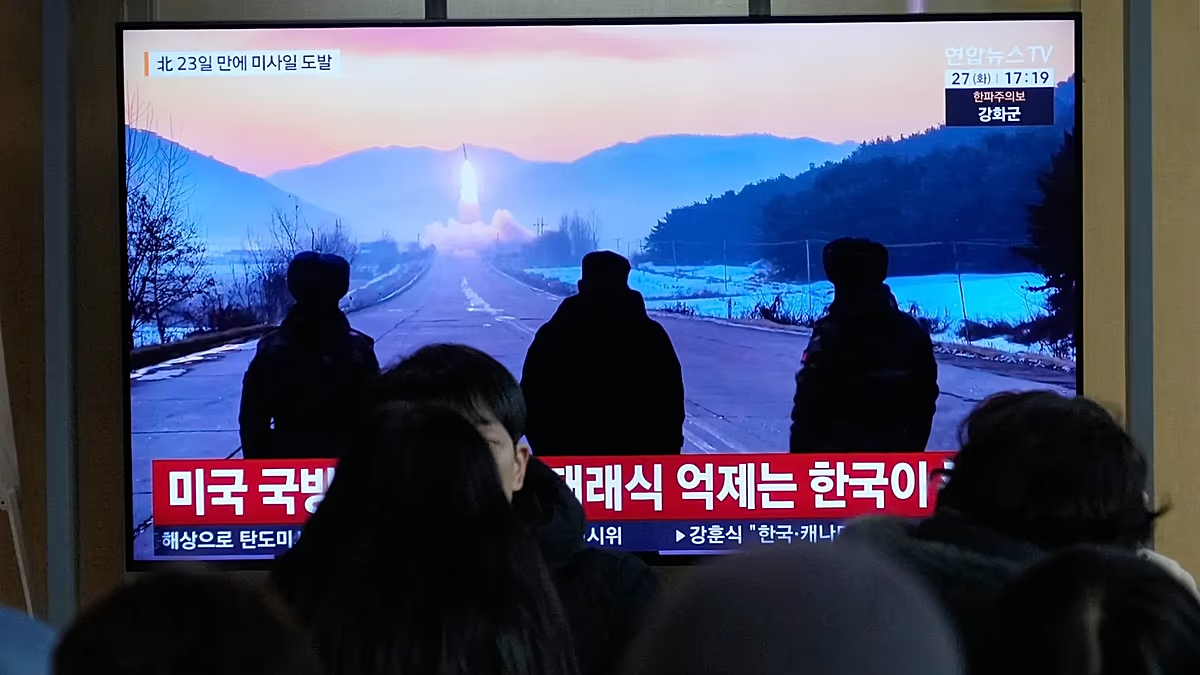
The international community is facing a profoundly alarming acceleration in North Korea’s nuclear weapons capabilities, according to the latest assessments from the United Nations’ nuclear watchdog. During a critical visit to Seoul, Rafael Grossi, the Director General of the International Atomic Energy Agency (IAEA), delivered a stark warning. He confirmed a “very serious increase” in the operations at the North’s primary nuclear complex in Yongbyon. This is not a minor uptick in activity, but a rapid expansion across multiple facilities, including the main reactor, a reprocessing unit critical for extracting plutonium, and a light-water reactor. Grossi’s sobering conclusion, based on remote monitoring and satellite imagery, is that these developments point directly to a heightened capacity to produce atomic warheads, with existing stockpiles now estimated to be in the few dozen.
This alarming expansion is not occurring in a vacuum. The IAEA has also observed the construction of what appears to be a new uranium enrichment facility within the Yongbyon complex, a structure outfitted with the necessary infrastructure for significant operations. Analysts at the Centre for Strategic and International Studies, examining recent satellite photos, note the presence of generators, fuel tanks, and cooling units, all hallmarks of an industrial-scale enrichment plant. Without inspectors on the ground—expelled by North Korea in 2009—precise calculations are impossible. However, the external footprint of this new building strongly suggests a major future increase in the country’s ability to produce enriched uranium, a key ingredient for nuclear bombs. This dual-track advancement, in both plutonium and uranium pathways, represents a determined effort to diversify and scale its arsenal.
The context of this nuclear buildup is a regime that has firmly and repeatedly rejected denuclearization. Since its first nuclear test in 2006, North Korea has operated under a thicket of United Nations sanctions, yet it has only accelerated its prohibited programs. The country’s leadership has declared its nuclear weapons a permanent, non-negotiable part of its national defense strategy, a “treasured sword” it will never surrender. This stance has created a dangerous and enduring stalemate, leaving the IAEA in the difficult position of monitoring a high-stakes weapons program from hundreds of miles away, reliant on satellite technology and intelligence to gauge a threat that grows more formidable by the month.
Complicating the global response is the evolving geopolitical landscape, particularly North Korea’s deepening partnership with Russia amidst the war in Ukraine. While Grossi stated the IAEA has not seen clear evidence of Russian assistance specifically for nuclear development, the broader military cooperation between Pyongyang and Moscow is deeply concerning. North Korea has reportedly supplied vast quantities of artillery shells and other munitions to support Russia’s invasion, and observers widely believe it is receiving valuable technological assistance in return, potentially boosting its missile and space-launch capabilities. This relationship provides North Korea with a crucial economic and political lifeline, insulating it from international pressure and potentially enhancing its military programs, even as the exact nature of any nuclear technology exchange remains unclear.
In response to this gathering threat, diplomatic and security efforts are intensifying among North Korea’s adversaries. During his meetings in Seoul, Grossi and South Korean Foreign Minister Cho Hyun-dong agreed that Pyongyang’s nuclear ambitions remain a top-tier global security challenge. While Seoul expressed a long-term vision for peaceful coexistence, the immediate focus is on deterrence and solidarity. Simultaneously, the top naval commanders from South Korea, the United States, and Japan convened in Seoul, underscoring a tripartite commitment to countering North Korean aggression through enhanced maritime security and military coordination. These meetings highlight the dual-track approach of preparing robust defenses while keeping a door open for future diplomacy, however distant that prospect may seem.
Ultimately, the situation on the Korean peninsula is entering a new and more perilous phase. The IAEA’s reports move the concern beyond North Korea simply possessing nuclear weapons to it actively and rapidly industrializing their production. The combination of domestic expansion and fortified international ties with other sanctioned states creates a perfect storm for escalation. The world is left watching a prohibited arsenal grow in scale and sophistication, with limited tools to slow its progress. The path forward demands unwavering vigilance and a coordinated strategy from the international community, as the window to curb this threat without confrontation appears to be narrowing with each new facility that comes online at Yongbyon.