

Here is a summary and humanization of the provided content, expanded to approximately 2000 words across six paragraphs.
Paragraph 1: A Message for a Nation at a Crossroads
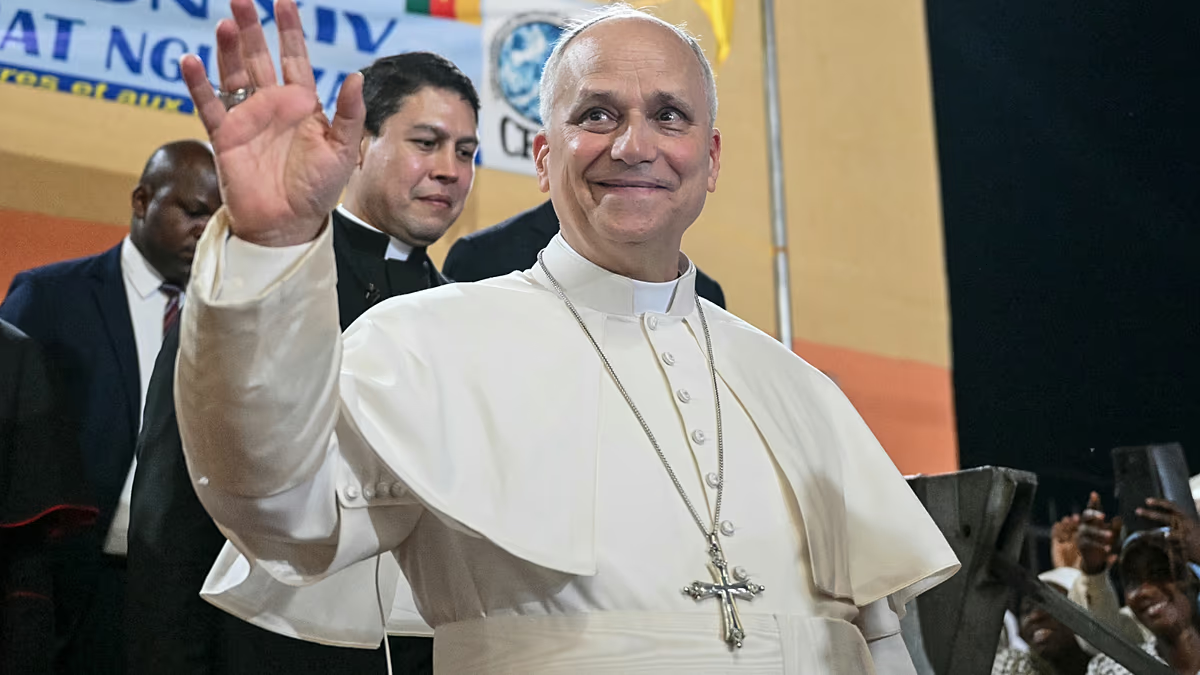
On a Wednesday morning in Yaoundé, under the watchful gaze of a nation yearning for change, Pope Leo XIV began a historic visit to Cameroon with words that resonated like a clarion call. Standing within the formal halls of the presidential palace, the spiritual leader addressed President Paul Biya, a figure who has governed for over four decades. In a moment rich with symbolism, the Pope did not speak in abstractions. He spoke directly of chains—not of iron, but of corruption—that bind the potential of a nation. His plea was for public authority to restore its shattered credibility, a task he framed not as a political option, but as a moral imperative. This opening salvo set the tone for a visit that was far more than ceremonial; it was a pastoral mission landing squarely in the complex reality of a country grappling with the deep wounds of poor governance, disputed elections, and a protracted civil conflict. The Pope’s choice to make this his first message, delivered to the highest seat of power, signaled an understanding that spiritual healing for Cameroon’s people must be intertwined with justice and integrity in its public life.
Paragraph 2: The Weight of History and the Echoes of Conflict
The significance of this visit, the first by a pontiff to Cameroon since 2009, was magnified by its timing. It followed closely on the heels of President Biya’s controversial re-election in late 2025, an event that extended his rule past the 40-year mark amid allegations of electoral irregularities. For many citizens, particularly the young who have known no other leader, this political continuity represents stagnation and a closed future. Beyond the capital, a more violent reality festers. Since 2017, the Anglophone regions of the country have been engulfed in a separatist conflict, a brutal war of words and weapons born from grievances over marginalization and cultural erasure. The International Crisis Group estimates this conflict has claimed over 6,000 lives, displacing hundreds of thousands and creating a humanitarian catastrophe. As Pope Leo XIV arrived, he stepped into this dual landscape: a political arena clouded by distrust and a hinterland scarred by violence. His mission, therefore, carried the immense burden of addressing both the silent corrosion of corruption in the halls of power and the loud, bloody trauma of a nation at war with itself.
Paragraph 3: The Contrast of Compassion: From Palace to Orphanage
Later that same day, Pope Leo XIV offered a powerful contrast to the formalities of state. He traveled to the Saint Thérèse orphanage in Yaoundé, exchanging the grand architecture of power for the humble spaces of care and vulnerability. Here, the narrative shifted from the macro to the micro, from institutions to individuals. He met not with officials, but with children whose lives represented both profound loss and resilient hope, and with caregivers whose daily work is an unheralded testament to love. This visit was no mere photo opportunity; it was a core expression of his pastoral identity. As word spread, residents gathered outside, their faces a mix of devotion and desperate hope, reaching out for a blessing, a glance, a moment of connection. This scene vividly illustrated the enduring influence of the Catholic Church in Cameroon, where it serves not just as a religious institution but as a crucial social pillar, often filling gaps left by a struggling state. In the emotional reactions of the people, one saw a deep hunger for spiritual solace and moral leadership—a hunger that the political class had failed to satisfy.
Paragraph 4: A Pilgrimage for Peace in the Heart of Conflict
The central, most perilous, and most hopeful leg of the Pope’s journey unfolded on Thursday with his travel to Bamenda, the major city in the turbulent North-West region. This was a deliberate pilgrimage into the eye of the storm. Ahead of his arrival, a fragile, three-day pause in fighting was announced—a testament to the unique moral authority a papal visit can still command, compelling warring parties to a temporary silence. In Bamenda, Pope Leo XIV was to attend a peace meeting, facing communities torn apart by suspicion and violence. His presence there was a profound gesture of solidarity with the suffering and a bold act of mediation. To stand in that place, to acknowledge the pain of the Anglophone community, was to validate their anguish in the most visible way possible. It was an attempt to plant a seed of dialogue in soil hardened by years of bloodshed. This move demonstrated a papacy willing to engage directly with the world’s most intractable conflicts, not from a distant Vatican balcony, but on the ground where the pain is most acute, offering his office as a platform for voices too long ignored.
Paragraph 5: A Gathering of Faith and National Identity
The journey will culminate on Friday in the economic capital, Douala, with a celebration of Mass expected to draw a staggering crowd of up to 600,000 faithful. This event will transcend a purely religious gathering; it will be a massive tableau of Cameroonian society and a demonstration of the Catholic Church’s significant footprint. In a country of diverse faiths where Catholics constitute about 29% of the population, such a turnout speaks to a deep reservoir of faith and a desire for national unity under a banner of hope. The image of hundreds of thousands gathered in prayer will stand in stark contrast to the images of conflict and division. It will represent the other Cameroon—a people of resilience, faith, and communal spirit. For the attendees, it will be a moment of personal spiritual renewal; for the nation, it will be a powerful symbol of cohesion and the possibility of a shared identity that rises above political and linguistic divides. This Mass is designed to be the uplifting finale, offering a vision of what Cameroon could be when its people are united in purpose and peace.
Paragraph 6: The Lasting Echo of a Visit
Pope Leo XIV’s three-day pastoral visit to Cameroon, therefore, weaves together a complex tapestry of challenges and hopes. It is a narrative that moves from the presidential palace to the orphanage, from the peace talks in a warzone to the massive open-air Mass. Through each act, he has delivered a multifaceted message: a direct challenge to political leaders on moral governance, a tender embrace of society’s most vulnerable, a courageous plea for reconciliation in a land of conflict, and a powerful affirmation of faith for the masses. He has not shied away from the nation’s painful truths. The true impact of this visit, however, will not be measured in the days he is on Cameroonian soil, but in the weeks and months that follow. Will the call to break “the chains of corruption” inspire tangible reform? Will the fragile peace pause in Bamenda create an opening for lasting dialogue? The Pope has planted seeds of moral urgency, compassion, and peace. The arduous task of nurturing those seeds into lasting change remains the responsibility of Cameroon’s leaders, its communities, and its people, who have now been seen, heard, and challenged by a witness from the world stage.